
In the heart of the Nouvelle-Aquitaine region, where the Creuse River winds between granite hills and dense woodlands, an ancient craft persists, turning raw thread into monumental visual architecture. The art of Aubusson tapestry weaving, recognized by UNESCO as Intangible Cultural Heritage of Humanity, is far from a mere decorative vestige of Europe’s noble past; it is a living discipline experiencing a vibrant 21st-century renaissance. Over centuries, this central French enclave has refined a visual language in which wool, silk, and linen assemble with near-mathematical precision.
Entering the workshops of Aubusson and Felletin today means witnessing a creation process where time is measured in centimeters per week, and the quiet of the studio is broken only by the steady tap of the wooden comb against the warp. Facing the digital immediacy and mass production of industrial design, the textile manufacture of the Creuse asserts the value of deliberate slowness, intergenerational technical mastery, and a profound synergy between artist and weaver, locally known as the lissier.
The Hidden Geography of Thread: The Creuse Valley and Its Mineral Light
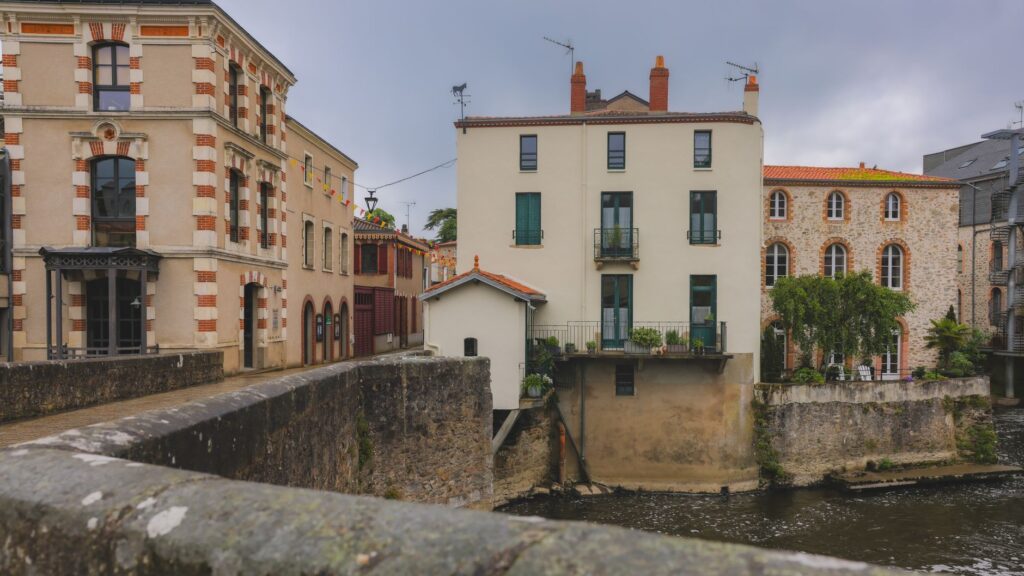
Aubusson’s emergence as the international capital of tapestry relies on unique geographical and geological conditions. Since the 15th century, the purity and slight acidity of the Creuse River and its tributary, the Beauze, proved essential for scouring raw sheep’s wool and fixing mordants inside dyeing cauldrons. The granite basin naturally demineralizes the water, granting threads an extraordinary color fastness and durability that endure through centuries without losing vibrancy.
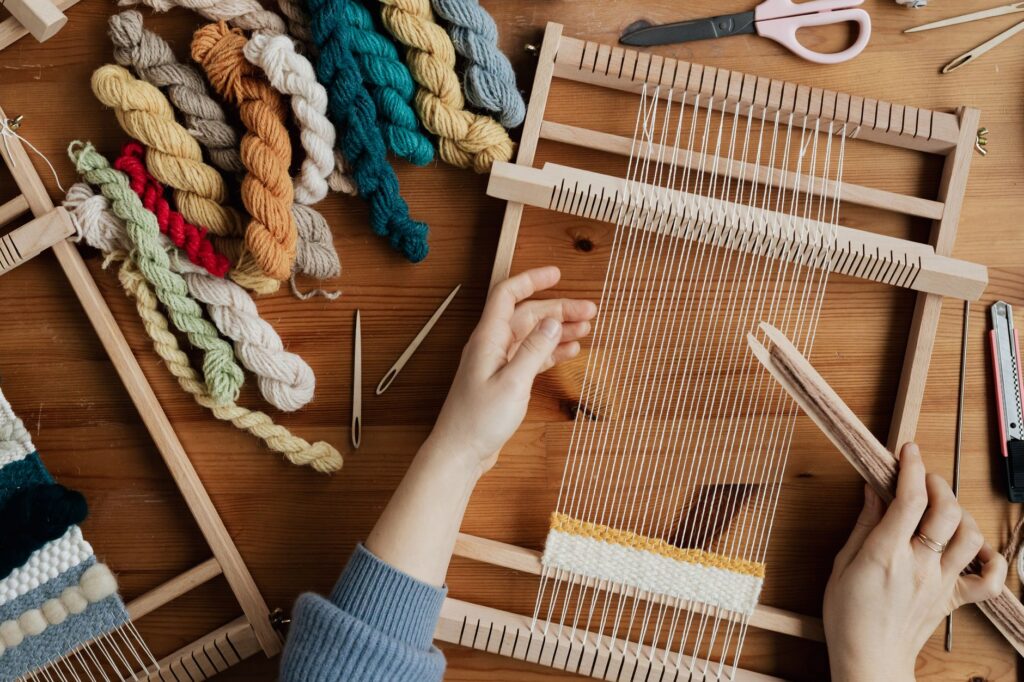
The surrounding landscape deeply informs the atmosphere inside the studio. Central France’s light, filtered through the valley’s shaded canopy, enters through high, north-facing windows in historic weavers’ stone houses. This stable, glare-free illumination allows the lissier to evaluate chromatic nuances without optical distortion, ensuring absolute fidelity to the original design conceived by the painter or designer.
Between the Cartoon and the Loom: The Silent Dialogue of Artist and Lissier
Creating an Aubusson tapestry demands a continuous aesthetic translation between two minds: the visual artist who paints the original work and the master weaver who interprets it in fiber. The foundational guide is the cartoon, a full-scale template executed in gouache or oil, often rendered in reverse, as the traditional basse-lisse (horizontal loom) requires weaving from the back of the textile.
The artisan does not simply execute a mechanical copy. The work requires sharp critical intuition to interpret brushstrokes, color transitions, and pictorial textures by meticulously selecting warp and weft yarns. Through techniques like the chapelet—blending threads of different shades on a single shuttle—the weaver achieves delicate tonal gradations that evoke the fluidity of oil painting or the luminosity of watercolor.
blockquote>
A tapestry is not the replica of a painting, but its physical reincarnation in a medium possessed of body, weight, and light.

The Architecture of the Warp: Basse-Lisse Technique and Thread Tension
Unlike Paris’s Gobelins manufactory, renowned for vertical high-warp looms (haute-lisse), Aubusson historically specialized in the horizontal basse-lisse loom. In this horizontal configuration, warp threads—typically made of sturdy cotton or reinforced wool—are stretched parallel to the floor between two heavy wooden rollers known as ensubles.
The master weaver works seated at a bench, leaning over the wooden frame. Using foot pedals called marches, the weaver separates alternating warp threads via heddles, creating the shed through which the wooden shuttle carrying weft yarn passes manually. To monitor progress, the artisan slides a small hand mirror beneath the warp, observing the right side of the tapestry taking shape in the shadowed space below.
The Wool Alchemy: Natural Dyes and the Spectrum of Chromatic Nuance
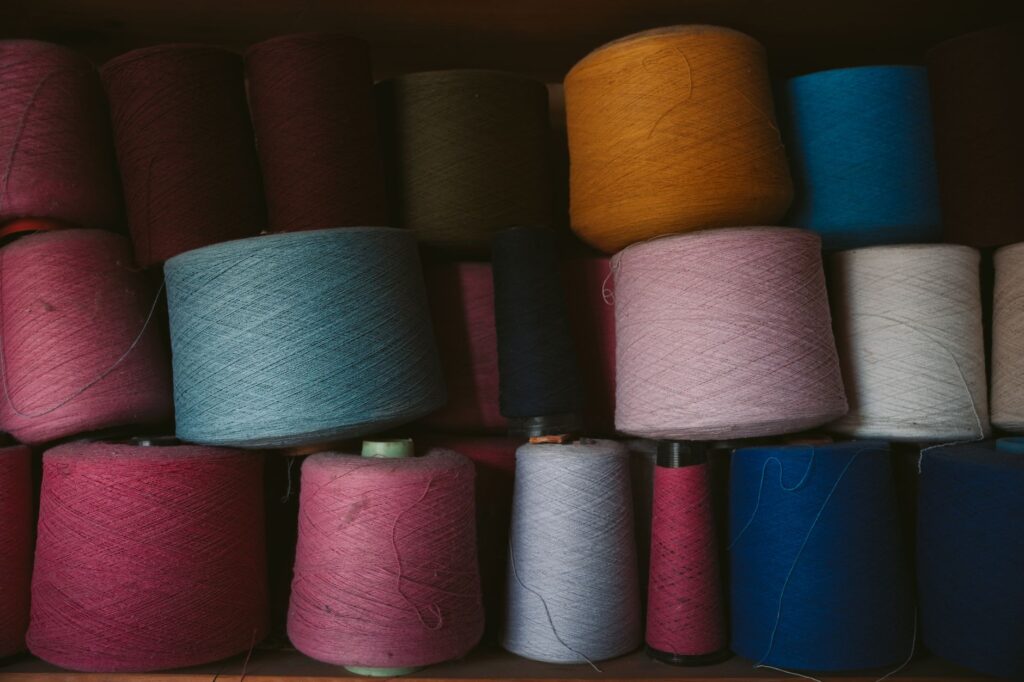
Color is the soul of the tapestry. At the Cité Internationale de la Tapisserie and private heritage workshops, the dyeing process retains technical standards handed down from 18th-century treatises. While synthetic dyes with exceptional lightfastness are utilized for modern art requirements, deep knowledge of botanical dyes—such as madder root for reds, weld for yellows, and woad for deep blues—remains foundational.
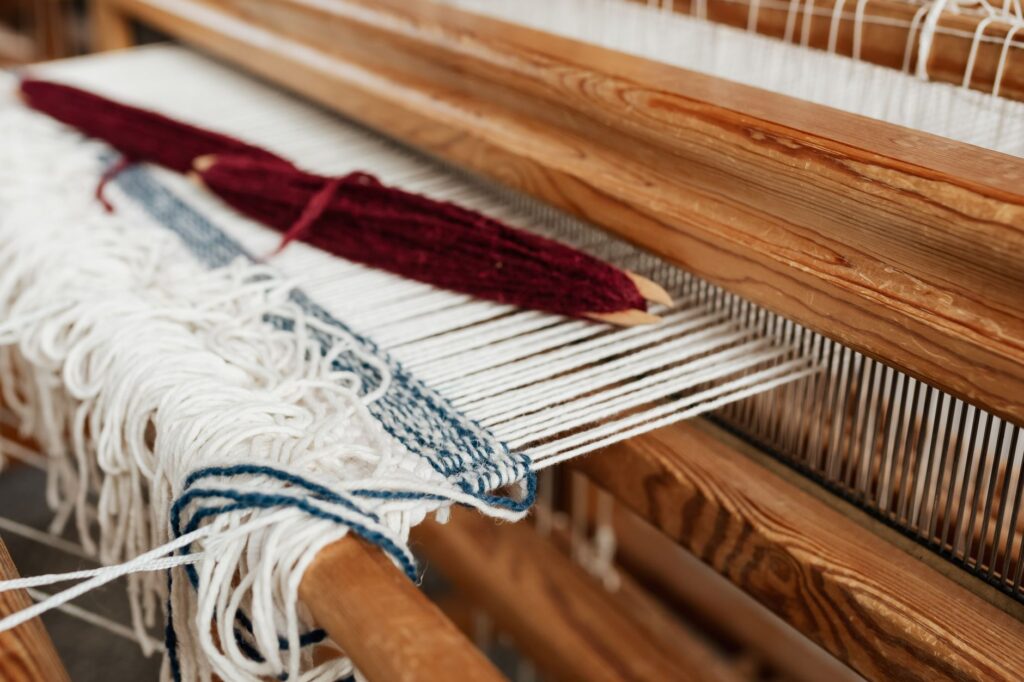
Preparing the yarn palette demands meticulous accuracy. In Aubusson’s traditional color charts, a single hue can be subdivided into over fifty progressive shades. Wool selection is equally vital: weavers choose long-staple, resilient sheep’s wool capable of absorbing dye uniformly and enduring mechanical tension and comb strikes without fraying its fiber structure.
Suspended Time: The Geometric Patience of High Craftsmanship
Time calculations in monumental tapestry weaving challenge contemporary productivity metrics. On average, a skilled weaver produces between one to one and a half square meters per month of dedicated work. Grand tapestries commissioned for public institutions or private collections often require three or four lissiers working side by side for over a year on a single loom frame.
This deliberate pace creates an environment of intense focus within the atelier. The rhythm is dictated by the artisans’ synchronized breathing and the firm strike of dense hardwood tools—carved from boxwood or applewood—compacting the weft lines into the warp. Every knot, every invisible separation line between color fields (termed relais), and every stitch demands manual precision where a millimeter’s misalignment can warp the overall perspective.
blockquote>
In the quiet of the workshop, time ceases to be a clock metric, turning into a physical volume built thread by thread.
From Jean Lurçat to Contemporary Design: The Avant-Garde That Saved the Loom
In the early 20th century, the Creuse tapestry industry faced severe decline due to mechanical copying of antique masterpieces and a loss of creative direction. French painter and designer Jean Lurçat revolutionized the field in the 1930s by simplifying the color palette to essential shades and introducing numbered cartoons, where each color area corresponded to a pre-assigned yarn code.
Lurçat’s technical simplification reduced production costs while restoring the tapestry’s mural and architectural power. Today, that forward-looking spirit flourishes through partnerships between the Cité Internationale de la Tapisserie and contemporary international artists, architects, and designers. High-profile graphic reinterpretations—such as large-scale textile adaptations of J.R.R. Tolkien’s illustrations or Hayao Miyazaki’s cinematic imagery—demonstrate that the basse-lisse loom remains a remarkably versatile medium for modern visual storytelling.
Practical guide
Getting there and around
Aubusson is located in the Creuse department within the Nouvelle-Aquitaine region. By car, it is reached from Limoges via the N141 highway (approximately one hour and fifteen minutes) or from Clermont-Ferrand via the D941. For public transit travelers, regular regional buses (Ligne 13) connect from Limoges-Bénédictins railway station, alongside regional TER train links connecting through Guéret.
Essential sites and historic workshops
- Cité Internationale de la Tapisserie: Located on Rue des Arts inside the former National School of Decorative Arts. Features expansive museum galleries, a research library, weaver training facilities, and live restoration labs.
- Atelier-Musée de la Cartonnerie: Situated in Felletin (10 km from Aubusson), offering unique insights into the trade of cartoon painters and housing historic collections of original templates.
- Manufacture Pinton: One of the oldest active private manufactures, located in Felletin, accessible through advance-booked guided tours.
- Maison du Tapissier: Housed in a 16th-century stone residence in historic Aubusson, illustrating the daily lives and social history of master weavers across the centuries.
Visiting advice and best season
Spring and early autumn offer optimal conditions for exploring the Creuse region, avoiding peak summer crowds while benefiting from gentle natural light ideal for architectural and craft photography. Booking workshop tours at least two weeks in advance is highly recommended, especially to witness the traditional tombée de métier ceremony, when a completed tapestry is unfastened and cut from the loom.
The Final Knot: The Silent Resonance of Raw Matter
When months of continuous labor conclude, the atelier gathers for the tombée de métier. Before the artist, the weavers, and a small circle of witnesses, shears cut through the tension threads of the warp. It is a moment of profound tactile gravity: the textile, held rigid for nearly a year in the loom’s horizontal frame, falls softly into its creators’ arms, revealing for the first time its natural drape, weight, and light-absorbing depth.
In this final act, the tapestry takes on an independent life separate from the painting that birthed it. Minor variations in hand-spun yarn, subtle ridges where thread paths cross, and the warmth of natural dyes transform a cold granite wall into an inviting, resonant surface. In the peaceful spaces of Aubusson, the woven cloth preserves not only the living heritage of the Creuse valley, but reminds contemporary eyes of the enduring dignity of human handiwork mastered over a lifetime.