The Abrupt Genesis of an Impossible Line in Western Norway
In the heart of the Norwegian fjord region, where basalt rock faces plunge vertically into the dark waters of the Sognefjord, 20th-century civil engineering had to defy the physical limits of gravity. The Flåm Railway (Flåmsbana) was not conceived as a tourist fantasy designed to entertain the contemporary traveler, but as an uncompromising logistical response to isolated connectivity needs. At the dawn of the last century, residents of the interior valleys of Aurland municipality relied on bridle paths and complicated navigation routes to link their agricultural settlements with North Sea commercial lanes. The technical premise was monumental: overcoming an elevation drop of 863 meters over barely twenty kilometers of linear distance, a proportion making this route one of the steepest standard-gauge railway lines on earth.
The layout demanded unprecedented geological planning. The Norwegian engineers who conceived the project in 1923, with main construction stretching nearly four decades through extreme technical hardships caused by wars and harsh terrain, had to carve a path where the earth offered scarcely a single horizontal support. The result was a bold railway system snaking through some twenty hand-excavated rock tunnels, many performing spiral turns deep within the mountain’s core to gain or lose height in a controlled manner. This subterranean architecture is not merely functional; it represents a testament to human perseverance against a natural environment that imposed absolute isolation during long, dark winter months.
The region’s rugged orography dictated that every kilometer constructed was a battle against shifting geology. Snow avalanches, rockfalls, and the constant infiltration of glacial meltwater required specially designed protective structures, such as massive cyclopean retaining walls and snowsheds ensuring convoy stability. Today, understanding the magnitude of the Flåmsbana requires looking beyond commercial postcards to analyze it as critical infrastructure that radically transformed accessibility to one of Europe’s most rugged zones, directly connecting the highlands of the Hardangervidda plateau with the fjord maritime system.

High-Gradient Engineering and the Technical Challenge of Adhesion
Unlike other famous mountain routes worldwide that rely on rack-and-rail systems to overcome steep slopes, the Flåm Railway entrusts its traction entirely to conventional adhesion on steel rails. With a maximum gradient reaching the impressive ratio of 1 to 18 (a 55 per mil incline across eighty percent of its total length), locomotives and carriages must confront colossal mechanical effort both in ascent and retention during descent. This technical demand spurred the evolution of railway technology in Norway, compelling operators to design highly specialized redundant braking systems guaranteeing absolute safety under any weather condition, whether amidst heavy snowstorms or rails moistened by persistent coastal rain.
The braking system on the line’s trains includes up to five independent brakes operating simultaneously, allowing each wheel to control its own inertia on the most dizzying stretches. Older electric locomotives operated for decades have been replaced by modern units equipped with asynchronous traction motors, capable of regenerating energy during descent and feeding it back into the regional electrical grid. This energy optimization underscores the Scandinavian commitment to operational sustainability, demonstrating that historic infrastructure can adapt to the 21st century’s most demanding environmental standards without losing its technical authenticity.
Stations along the route operate as high-precision logistical nodes. At Myrdal station, the convergence point with the main Bergen Line (Bergensbanen), daily transfers of thousands of travelers arriving from Oslo or Bergen are managed. Timetable synchronization must be millimeter-precise: any delay on the main line disrupts the flow of convoys descending toward the fjord, where electric ferries await punctually to continue the multimodal transport chain. This machinery demonstrates how railway engineering and modern nautical transport articulate in a territory where conventional roads prove insufficient or environmentally unviable.
The Geography of Water: Waterfalls, Gorges, and Snowmelt Impact
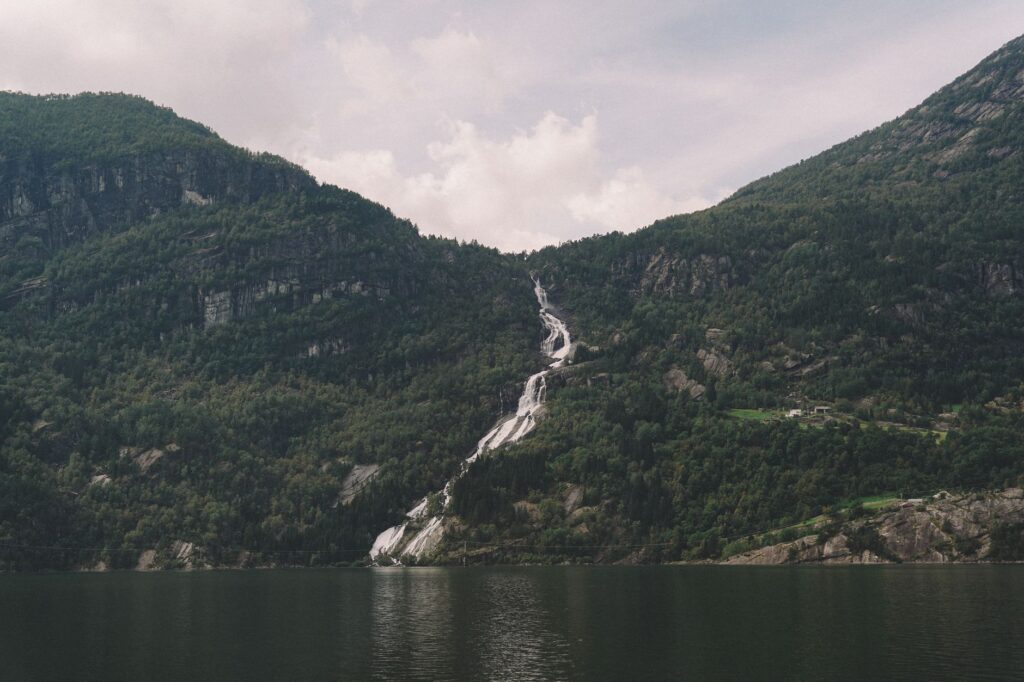
The landscape accompanying the rail journey is dominated by the omnipresence of water in all its forms. From the snow-capped peaks feeding the Flåmsdalen valley to the depths of the fjord, water sculpts the relief and dictates the line’s operational rhythm. One of the most notable visual and technical milestones along the route is the stop beside the Kjosfossen waterfall, where the train pauses for a few minutes allowing travelers to contemplate the fury of a cascade discharging thousands of liters per second very close to the tracks. The hydraulic force of this environment is not merely a scenic attraction, but a constant reminder of natural dynamics that engineers had to master through bold bridge construction and subterranean channels.

The local hydrological regime experiences drastic seasonal variations conditioning railway maintenance planning. During spring, rapid snowmelt causes sudden surges in the Flåmsoelvi river, the watercourse running parallel to the tracks. Technical inspection teams constantly review bridge abutments and rock slopes to prevent erosion caused by the current. These preventive conservation tasks are essential to keep operational a line running three hundred sixty-five days a year, withstanding extreme winter temperatures dropping well below freezing.
Integrating the railway into such a fragile ecosystem has required low-impact visual and ecological solutions. Tunnels do not alter superficial hydrological balance, and drainage systems are designed to channel rainwater without eroding slopes covered in fir trees and moss. This respectful coexistence between large industrial infrastructure and the protected natural environment of the valley turns the railway into a model of sustainable territorial intervention in high-mountain zones.
The Flåm railway proves that the true feat of modern engineering does not lie in subduing nature through brute force, but in tracing a respectful path allowing travelers to comprehend the monumental scale of Norwegian abysses.
Vernacular Architecture and Human Settlements in the Flåmsdalen Valley
Throughout the nineteen kilometers separating Myrdal from Flåm, the landscape changes radically, shifting from barren alpine tundra to a lush, inhabited river valley. Traditional wooden farmhouses, characterized by steep roofs covered in turf and moss, dot the valley’s more accessible slopes. These settlements, many isolated for centuries, found in the railway their primary link to outside civilization. Small intermediate stations, such as Berekvam, Dalsbotn, and Vatnahalsen, traditionally functioned as community centers receiving basic supplies, mail, and commercial correspondence, weaving an indispensable social network for rural community survival in western Norway.
Station architecture responds to functional early-20th-century Norwegian design, where wood treated with tar and traditional ochre and red colors blend with the forested surroundings. Vatnahalsen, situated at an altitude of 820 meters, houses one of the region’s most emblematic historic hotels, an establishment growing under the shelter of the arriving train and operating today as a nerve center for adventure tourism and mountain hiking. Preserving these historic buildings reflects an industrial heritage policy valuing both the railway track and the human spaces making it viable.
The socio-economic impact of the line has evolved from a purely subsistence function and local freight transport to become a regional economic motor. Nonetheless, local communities have managed this transition toward the service economy by preserving traditional architecture and limiting uncontrolled urban expansion at the valley floor. The result is a delicate balance between cultural preservation and welcoming international visitors seeking to understand fjord life beyond mass-market tourism circuits.
Fjord Intermodality: From Railway Track to Electric Maritime Transport
The journey across the Flåm Railway does not conclude when the locomotive stops at the terminal station located just meters from the Aurland Fjord waters. At Flåm’s maritime terminal, one of Europe’s most advanced intermodal transport systems articulates, where passengers make a fluid transition onto electric-propulsion ferries and catamarans navigating the Nærøyfjord, a UNESCO World Heritage site. This connection between the steep mountain train and zero-emission vessels represents a milestone in Scandinavian sustainable tourism logistics, drastically reducing the carbon footprint of travel in one of the continent’s most visited natural zones.

Coordination between railway companies and local shipping lines requires rigorous logistical planning. Convoy arrival times intersect millimetrically with vessel departures toward Gudvangen, allowing thousands of travelers to complete round-trip journeys on the same day without collapsing port infrastructure in the small locality. This synchronization avoids unnecessary crowding and optimizes vessel cargo capacity, guaranteeing a fluid travel experience respectful of the natural surroundings’ tranquility.
Beyond passenger transport, local authorities constantly study optimizing the logistics chain for supplying goods to regional shops and lodgings through combined use of train and electric ground transport, minimizing heavy vehicle transit on narrow local roads. This comprehensive mobility approach demonstrates that ecologically fragile destinations can structure efficient management models if they prioritize clean intermodal connectivity and strict visitor flow regulation.
Contemporary Challenges: Tourism Overcrowding and Capacity Management
The global success of the Flåm Railway has generated a complex operational challenge: the sustainable management of visitor mass flows during the summer season. With hundreds of thousands of annual passengers concentrated primarily between May and September, infrastructure confronts physical limits in transport capacity. Railway authorities and local tourism operators have had to implement strict advance booking policies and time-slot quota systems to prevent platform and historic carriage overcrowding, ensuring travel experiences maintain required quality and safety standards.
This tourism pressure has driven deep debate over the Aurland valley’s carrying capacity. Unlike other European destinations opting for indefinite growth, Norwegian institutions have chosen to regulate massive cruise ship arrivals at the fjord by imposing environmental fees and limiting daily berth numbers. The objective is protecting local residents’ quality of life and preserving the fragile alpine ecosystem’s integrity against wear caused by mass tourism. The railway, in this context, acts as a regulatory filter channeling access in an orderly, controlled manner.

Tourism seasonality also poses considerable financial and operational challenges. During winter months when daylight hours are scarce and polar temperatures strike the highlands, the line reduces frequencies while maintaining operations as an essential public service for residents and skiers. State subsidies and efficient management of revenues generated during summer allow sustaining infrastructure whose winter maintenance demands extraordinary technical and human resources.
Practical Information and Logistical Planning for the Global Traveler
Planning a rigorous journey to the Flåm Railway requires understanding the operational particularities of Norway’s transport network. The main gateway is Myrdal station, accessible via the Bergensbanen high-mountain trains connecting Oslo and Bergen daily. The journey from Oslo Central to Myrdal takes roughly five hours, while from Bergen the route completes in about two hours. Purchasing tickets months in advance is imperative, especially during summer, since seats on Flåmsbana convoys are strictly limited and standing is prohibited due to safety regulations on extreme gradients.
For those wishing to structure a complete route without relying on rental cars, the recommended option is the combined ticket known as Norway in a Nutshell or similar itineraries managed by authorized operators, integrating Bergen train, Flåm Railway, fjord cruise, and connecting bus across the Stalheimskleiva gorges into a single pass. Regarding luggage, Flåm and Myrdal stations feature automated locker services, though traveling with light luggage or backpacks is recommended due to space limitations in historic carriage corridors.
Weather conditions in the fjord region are notoriously changeable. Even in midsummer, temperatures at Myrdal summit can drop sharply, making waterproof warm clothing and footwear suitable for wet or slippery surfaces indispensable if planning hikes around intermediate stations, such as the walking route descending from Vatnahalsen to the valley floor via the historic Rallarvegen path.
Visual Closure: The Persistence of Iron Above Norwegian Abysses
The journey’s end at Flåm station offers a meditative perspective on civil engineering’s boldness. When the convoy halts its motors before the calm waters of the Aurland Fjord, the contrast between cold steel geometry and the organic monumentality of mountain walls reveals itself in full magnitude. This is not merely an efficient transport medium, but a functional monument resisting time’s passage, adapting to 21st-century environmental demands without surrendering its historical identity.
For contemporary travelers, experiencing the Flåmsbana transcends simple aesthetic contemplation of Scandinavian landscapes; it constitutes a masterclass on how human infrastructure can harmoniously integrate into the planet’s most difficult environments. Observing the train’s departure toward mist-covered heights, the certainty remains that such historic journeys’ true value lies in their capacity to remind us of human scale before the imposing, silent architecture of Norwegian nature.
The track descending to the fjord is not just a marvel of railway mechanics, but the enduring testament of an era when human will dared to trace straight lines across the absolute verticality of the mountain.