Flavor as a Historical Archive
Understanding Vietnamese cuisine requires abandoning the notion that gastronomy is merely a vehicle for sensory pleasure. Across the Vietnamese territory, from the labyrinthine alleys of Hanoi’s Old Quarter to the bustling floating markets of the Mekong Delta, every steaming bowl of broth, every sprig of fresh herb, and every fermentation method acts as a tangible historical document. Food tells the story of a people who have continuously negotiated with their geography, foreign invasions, and the relentless cycles of the monsoons.
Across different regions, the Vietnamese table reflects a subtle yet profound division. The North, more austere and historically tied to Chinese traditions, values the precision of clear broths and subtle balance. The Center, shaped by the influence of the ancient imperial court of Huế, elevates street food into an aristocratic art form where spiciness and visual presentation are paramount. The South, bathed in tropical sunlight and the bounty of the Mekong River, embraces sweetness, an abundance of wild vegetables, and the exuberance of cultural mixing.

Geography and Climate on the Plate
The backbone of Vietnamese culinary identity is, without doubt, its symbiotic relationship with the natural environment. The monsoon climate and the network of rivers crisscrossing the country dictate a diet rooted in absolute freshness. Unlike culinary traditions where ingredients spend days in cold storage, Vietnam’s food model relies on the daily supply chain: what is caught at dawn is consumed by noon; what is grown in peri-urban gardens reaches the market before the sun reaches its zenith.
This reliance on the natural surroundings is manifested in the masterful use of aromatic herbs. Mint, Thai basil, perilla, Vietnamese cilantro, and betel leaf are far more than decorative garnishes; they fulfill thermoregulatory and digestive functions in a climate of extreme humidity. The balance between the heat of the dish and the freshness of the green leaf is the fundamental principle governing the nation’s entire gastronomy, a constant reminder that cooking is an adaptive response to the climate.
The Daily Rhythm of Morning Markets
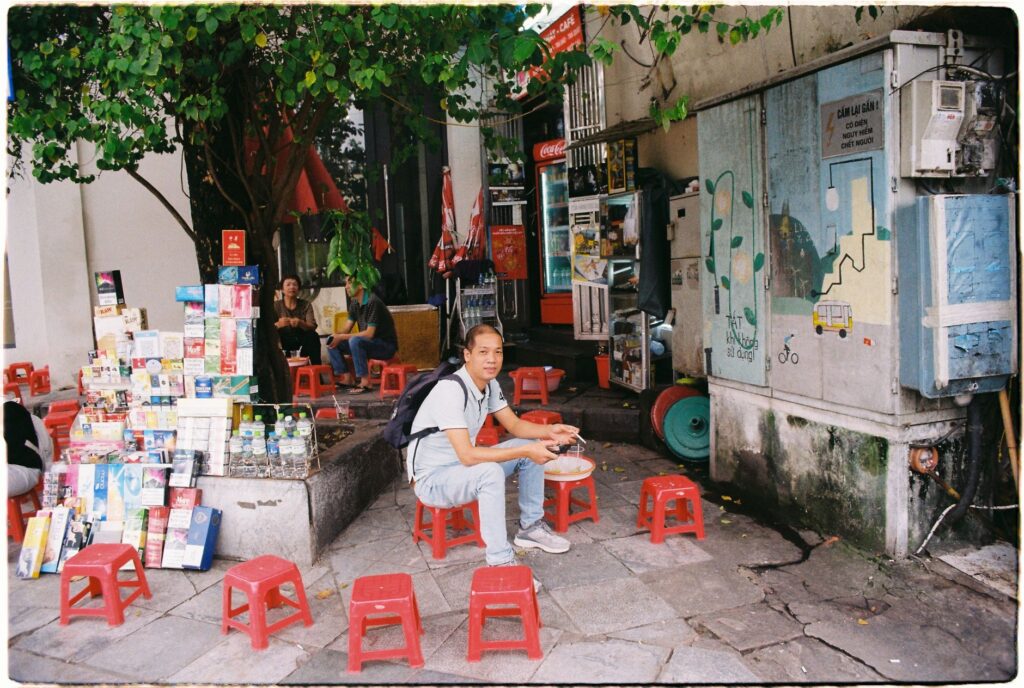
To understand Vietnam’s culinary sociology, one must rise before dawn and walk through traditional markets. In places like Châu Long market in Hanoi or the central market in Da Nang, community life organizes itself around produce stalls. The female vendors, popularly known as cô or bà, display their goods on straw mats on the ground or on wooden tables worn down by decades of continuous use.
It is in these spaces that the true social fabric of the country is forged. Families do not visit the market solely to buy provisions; the act of eating breakfast at communal stalls—a quick bowl of phở or a plate of bún chả—constitutes a morning ritual of socialization. The tables are low, shared with complete strangers, and the steam rising from bubbling broths creates an atmosphere of democratic equality where business owners and laborers share the same bench.
Street food in Vietnam is not fast food; it is the public dining room of a society that lives the majority of its life out on the street.
The Phenomenon of Phở and the Evolution of Broth
No dish better symbolizes Vietnamese national identity than phở. Although it is now consumed everywhere from the humblest street stalls to international fine dining restaurants, its origins are relatively modern and reflect the complexities of the French colonial period in the early 20th century. Emerging in the North, in Nam Định province and the streets of Hanoi, phở combined the Chinese tradition of rice noodles with the French taste for consuming beef, an animal previously used in Vietnam almost exclusively as agricultural draft labor.
Crafting a good phở broth is an almost alchemical discipline requiring hours of slow simmering of beef bones, charred onions, ginger, and a precise blend of toasted spices like star anise, cloves, and cinnamon. The result is a crystal-clear yet deeply umami liquid capable of comforting and restoring. A cook’s mastery is measured by the clarity and complexity of their broth, which should never be masked by heavy sauces.
Central Synthesis and Imperial Heritage
If the North is home to aromatic minimalism, the Central region, with Huế as its historic epicenter, represents the baroque sophistication of Vietnamese cooking. For centuries, Huế was the capital of the Nguyễn dynasty, and its imperial cuisine demanded dishes that were both a feast for the palate and a visual work of art. Royal banquets could consist of dozens of small courses, each meticulously sculpted into the shapes of phoenixes, flowers, or dragons.
Yet, Huế’s cuisine also stands out for its popular, equally complex facet. Dishes like bún bò Huế—a rice noodle soup with beef, lemongrass, and fermented shrimp paste—offer a markedly spicy and robust flavor profile that contrasts with the mildness of the North. This intensity reflects the character of a geographic region exposed to recurring typhoons and harsher agricultural conditions, where spicy food helped stimulate appetite and preserve provisions.
The South: Tropical Abundance and Fermentation
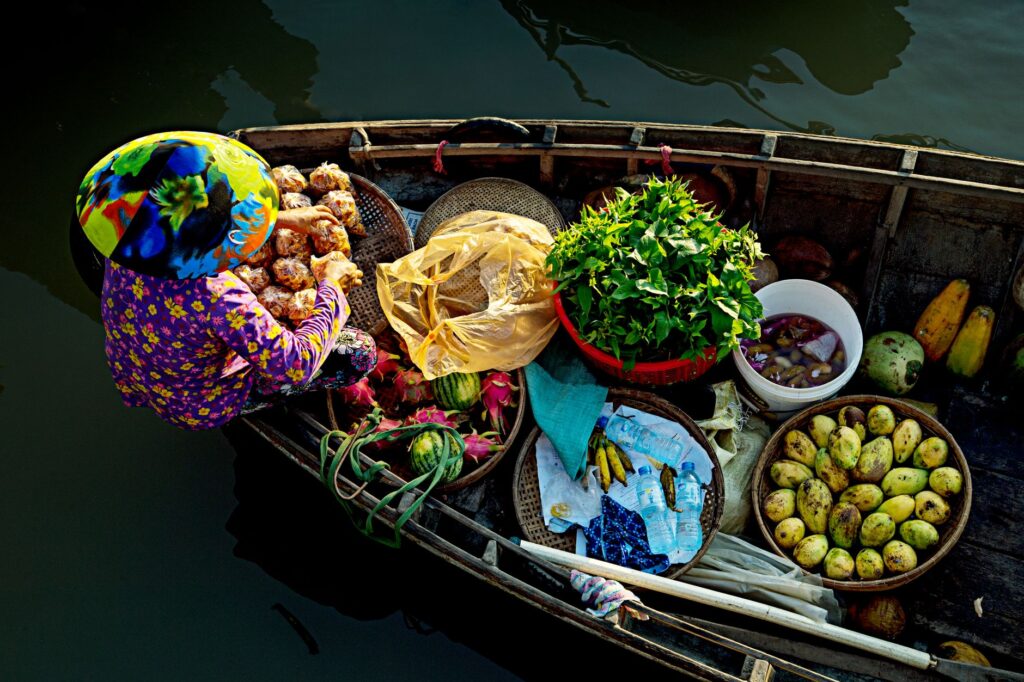
Descending toward the South, the landscape changes radically: rice paddies give way to the aquatic labyrinths of the Mekong Delta, where the river nourishes an inexhaustible pantry of tropical fruits, freshwater fish, and aquatic greens. Southern cuisine is more inclusive, open to Khmer, Chinese, and even Western influences. Here, the use of palm sugar, coconut milk, and tamarind brings distinct bittersweet flavor profiles.
A key element in Southern gastronomy is the culture of dry noodles and herb salads, such as bún thịt trộn, or fresh rice paper spring rolls (gỏi cuốn). Unlike the North, where dishes are served hot and simple, the South adores abundance and customization: each diner receives a platter brimming with fresh herbs, chopped chilies, limes, and bean sprouts to adjust the dish to their exact preference.
Eating in Southern Vietnam is participating in a communal feast where nature’s bounty is shared without reservation.

The Silent Role of Nước Mắm
No exploration of Vietnamese culinary art would be complete without examining the invisible soul of its kitchen: nước mắm (fermented fish sauce). Made through the prolonged maceration of anchovies and sea salt in large wooden vats under the tropical sun, this golden, savory sauce is the secret that unifies all the nation’s flavors.
Far from being an aggressive condiment, high-quality nước mắm provides an irreplaceable umami depth. Its production is an ancient art concentrated in coastal regions like Phú Quốc and Phan Thiết, where family techniques have been passed down for generations. It is the guiding thread that balances acid, sweet, and spicy notes in almost every Vietnamese preparation.
Practical Information for the Culinary Traveler
For those wishing to delve into Vietnam’s food culture from a respectful and authentic perspective, the following practical guidelines should be kept in mind:
- Best time to visit: From November to April, when the weather in the Central and Southern regions is drier, facilitating open-air market explorations.
- Table etiquette: It is customary to use chopsticks to bring food to your own bowl before consuming it. Leaving chopsticks stuck vertically in a bowl of rice is strictly prohibited due to its association with funeral rituals.
- Water and ice: At traditional street stalls, ice is usually factory-made and safe, but strict caution is advised with tap water.
- Cooking classes: Cities like Hội An and Hanoi offer workshops taught by local cooks in traditional markets, an excellent way to learn about ingredient traceability.
- Hygiene: Select street food stalls that feature a high turnover of local customers; constant turnover guarantees maximum food freshness.
Epilogue: The Table as a Gathering Space
Ultimately, Vietnam’s gastronomy reveals itself as much more than a collection of successful recipes. It is a living map of collective memory, a language that transcends linguistic barriers and connects the traveler with the daily life of a country in constant reinvention. In every bowl of broth shared on a Hanoi sidewalk or every bite wrapped in mint leaves in the Mekong Delta, Vietnam tells its own story of survival, elegance, and joy of living.
Source in EN: Adapted and verified from cultural and gastronomic reports by Vietnam.vn (https://news.google.com/rss/articles/CBMiZkFVX3lxTE43elFrRVAxOXpDZzdPTEg0MFo0ZkVVaDVuV1gzTFQ2STFWWW85ZWR5aFdpOS03MVl4aEdfNjlDeEdHM2JWLVloVjdLc3V5RDFkYmF6NG4zVm5fOTFabno3THRwbnh4dw?oc=5).