
The Invisible Texture of a City Between Two Rivers
There are urban geographies that explain themselves through administrative maps and others that unfold across a bakery counter before dawn breaks. In Rennes, the capital of the Brittany region in France, daily life is not measured in grand monumental milestones, but in the steady cadence with which medieval cobblestones receive the bustle of delivery carts and wicker baskets. Here, where the Ille and Vilaine rivers converge, everyday cooking responds to a logic of damp soils, Atlantic breezes, and a persistent peasant memory that has seamlessly integrated into the fabric of a university city with over two hundred thousand residents. This is not a tourist stage set designed for rapid consumption, but a living pantry where every ingredient maintains a direct correspondence with the surrounding landscape.
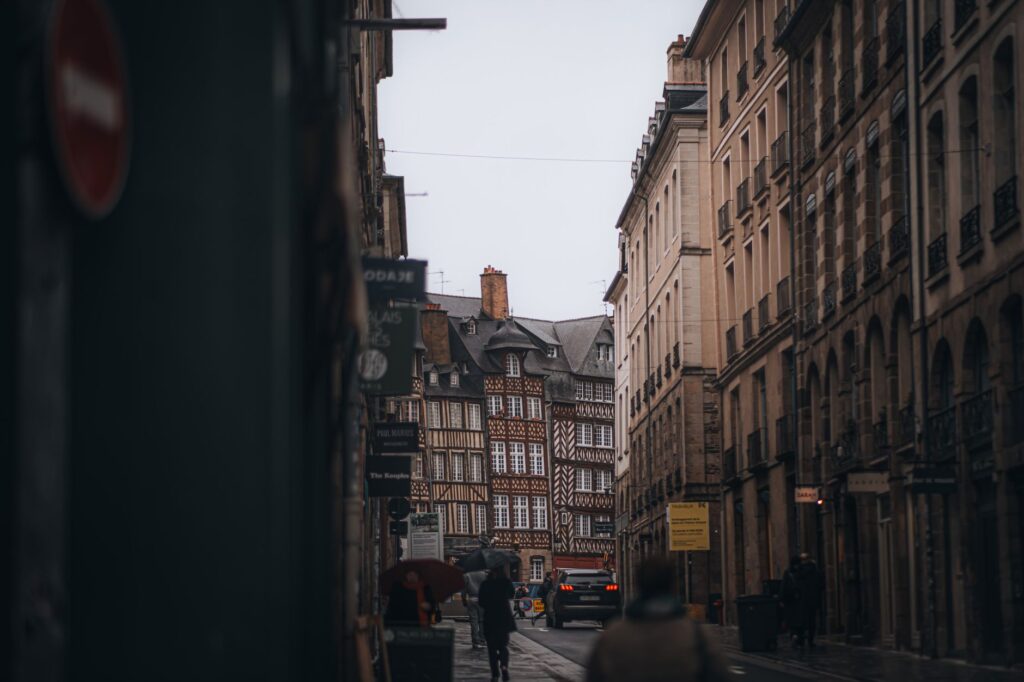
The layout of the old town, with its timber-framed structures and ochre-toned facades that survived the devastating fire of 1720, functions as a tactile map. The streets preserve guild names that recall ancient trades of leather, wool, and flour. Wandering beneath the arcades of the Place des Lices, one realizes that architecture is not merely a matter of aesthetics or historical engineering, but the physical container of a method for securing daily sustenance. The three- and four-story houses, slightly leaning from the passage of centuries, cast a cool shadow over the street stalls, protecting dairy products and seasonal vegetables from the rigors of summer sun and the dampness of the Breton winter.
The Square of Agricultural Memory and the Stalls of Place des Lices
Every Saturday morning, the Place des Lices transforms into the absolute epicenter of the city’s social and culinary life. Considered one of the oldest and most important markets in France, this open space welcomes local producers who have spent generations cultivating the market gardens of the Ille-et-Vilaine department and its surroundings. Here, the relationship between grower and consumer bypasses the impersonal intermediaries of large supermarkets. People discuss the weather, the delay of the first frosts, and the yield of cauliflowers with an almost scientific precision that denotes a profound respect for natural cycles.
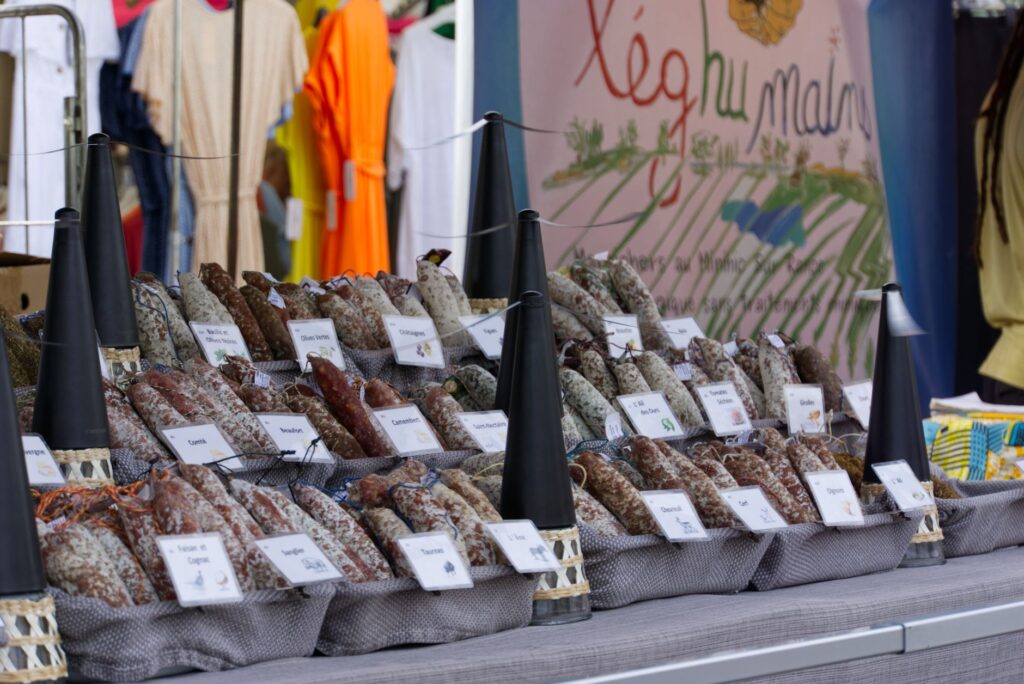
Among the white awnings, raw milk cheese stalls succeed one another, where artisanal camemberts and small fermière batches coexist with blocks of semi-salted butter wrapped in waxed paper. Butter with salt crystals from Guérande is not a mere condiment in Brittany; it constitutes the invisible foundation upon which all local pastry rests. Vegetables are displayed with earth still clinging to their roots, an irrefutable proof that they have just been pulled from the soil. Local artichokes, autumn turnips, and chard occupy wooden crates that emit an earthy, damp, and deeply comforting aroma for the senses.
Buckwheat and the Liturgy of the Galette
If there is one element that synthesizes the agronomic history of this northwestern corner of France, it is buckwheat, locally known as blé noir. Unlike common wheat, this rustic plant thrives in the acidic, poor soils of Brittany, which guaranteed the food survival of the population during centuries of famines and crop failures. Today, the grayish flour with its intense toasted aroma transforms into the iconic galette, a thin, crispy disk cooked on hot cast-iron plates called biligs.
In the small workshops scattered through the neighborhoods of Saint-Melaine and Thabor, artisans handle the wooden rake with hypnotic dexterity to spread the fluid batter with absolute uniformity. Cooking requires patience: the edge must turn golden until it acquires a brittle texture while the center absorbs the melted butter, white ham, and farm egg. This culinary ritual, seemingly simple, encloses a complex chain of responsible decisions where local millers select grains cultivated without aggressive chemical fertilizers, ensuring that the primordial flavor of the cereal remains unaltered in every bite.
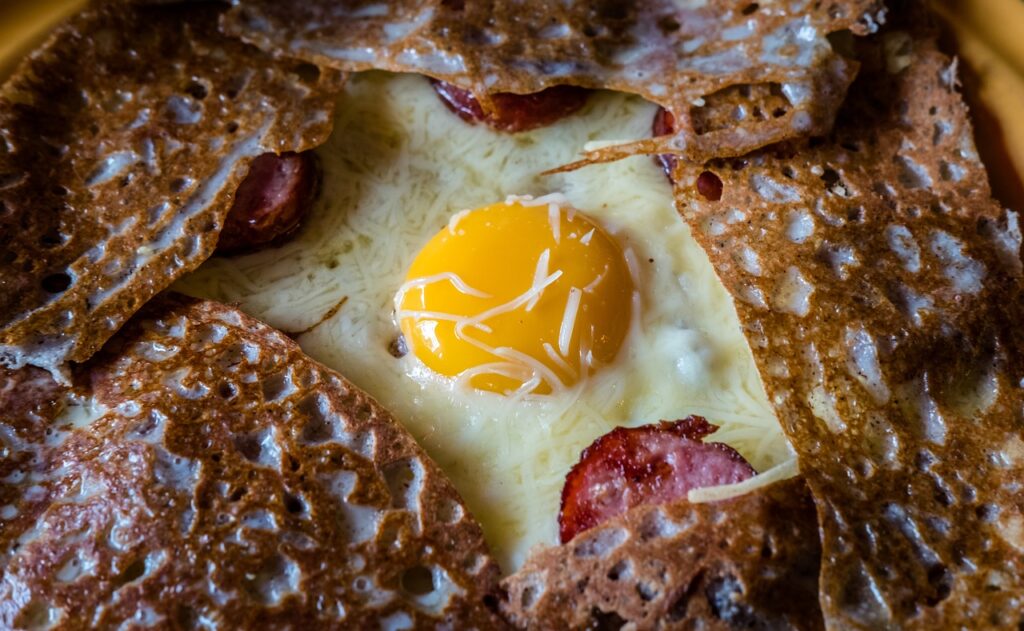
The cooking of this region does not seek the artifice of grand dining rooms, but the unappealable truth of a land cultivated with patience and served without haste.
Neighborhood Markets and Daily Shopping
Beyond the great Sunday or Saturday market, the true gastronomic health of Rennes is verified in its neighborhood food halls, such as the Sainte-Thérèse market or the Bachût market. These covered spaces act as social thermometers where residents routinely go to sort out the week’s meals. Here there is no room for culinary ostentation; priorities are freshness, fair pricing, and product traceability. Fishmongers display sea bass, turbot, and prawns freshly unloaded from the ports of the northern Breton coast, such as Saint-Malo or Cancale, reminding visitors that the sea is never truly far from the urban table.
The dialogue between the shopkeeper and the regular customer becomes a daily choreography of culinary recommendations. Fish broth recipes are exchanged, the exact boiling point of new potatoes is discussed, and advice is given on which cuts of pork are ideal for a weekend stew. This network of proximity businesses keeps the side streets alive, preventing neighborhoods from turning into mere impersonal dormitories. The figure of the shopkeeper acts as a custodian of oral tradition, passing on by word of mouth the secrets of a home cooking that renews itself every season without losing its roots.
The Sweet Heritage: Far Breton and Kouign-Amann
The pastry of Rennes represents a perfect synthesis between historical resource scarcity and the caloric generosity necessary to endure Atlantic winters. In traditional pastry shops of the historic center, the aroma of baked butter impregnates the sidewalk air from early morning. Far breton, a dense and compact cake made from flour, milk, eggs, and prunes, is cut into generous portions that customers consume warm accompanied by a cup of coffee or local cider.
Meanwhile, the kouign-amann—whose name comes from the Breton words for cake and butter—is a masterpiece of laminated baking that defies any modern dietary calculation. Superimposed layers of bread dough are kneaded with buttery abundance and sugar that caramelizes during baking, creating a crunchy surface and a tender, melting interior. Its preparation is an exercise in technical precision and respect for resting times that the city’s bakers continue to execute by hand, defending artisanal heritage against industrial standardization.
Cider and the Landscape of Apple Orchards
No approach to the Breton table would be complete without mentioning cider, the fermented drink par excellence of this French region. A few kilometers from the urban bustle, apple trees extend in orderly rows over gentle hills, adapting perfectly to the oceanic climate and the soil’s acidity. In the markets of Rennes, local producers offer bottles of artisanal cider whose labels specify the degree of sweetness and the variety of apple used, ranging from bitter to acidic and sweet.
Cider tasting in traditional earthenware bowls—a custom inherited from old farmhouses—naturally accompanies both savory galettes and local cheeses. This direct link between the drink and the surrounding landscape reinforces the territorial identity of the community. The city’s restaurateurs and wine merchants work hand in hand with small independent cider houses, ensuring that local bistros’ wine lists always feature proximity beverages produced through natural fermentation, without artificial additives or commercial haste.
Practical guide
How to get there: Rennes has the Rennes railway station (Gare de Rennes), regularly connected to Paris (Montparnasse) via the TGV high-speed service, with journeys taking approximately one hour and thirty minutes. Rennes-Saint-Jacques Airport offers short-haul domestic and international connections.
How to get around: The historic center is pedestrianized and easily explored on foot or by bicycle thanks to the extensive municipal bike lane network. For wider travel, the metro and bus network managed by STAR efficiently covers the entire urban agglomeration.
When to go: Spring and autumn offer moderate temperatures ideal for strolling through open-air markets and enjoying the garden produce season. Saturday mornings are essential to experience the atmosphere of Place des Lices.
Where to eat and shop: The surroundings of Place des Lices and the Saint-Melaine neighborhood host the best traditional crperies and local product shops. Establishments highlighting the use of 100% local buckwheat flour and artisanal butter are recommended.
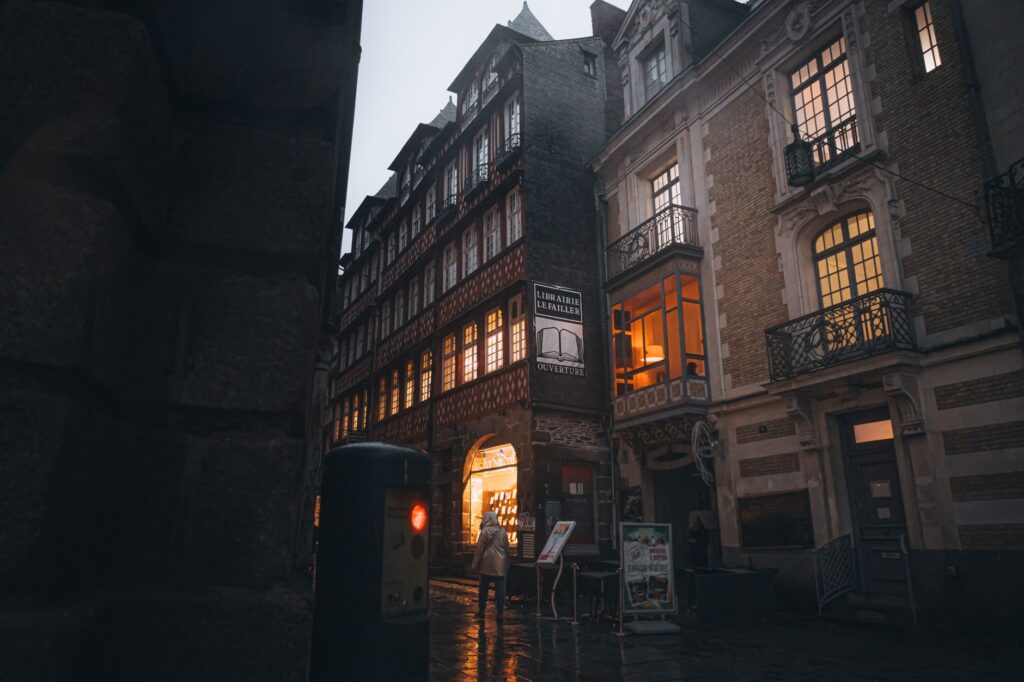
Accommodation: There is a wide range of charming small hotels in restored timber-framed houses in the old town, as well as functional options near the railway station.
The Daily Pulse at Dusk
When evening light begins to dye the stone and timber facades of the historic center, the rhythm of Rennes undergoes a subtle transformation. Café terraces fill with students, neighbors, and artisans sharing a final glass of cider before returning home. On street corners, the aroma of freshly baked bread mingles with the cool breeze descending through the Vilaine valley. Far from mass tourism circuits, this Breton capital proudly preserves a way of understanding life where respect for the land, product demand, and the value of daily conversation remain the true pillars of collective identity.