Introduction to a sacred territory
Naples is not a city to be visited with a conventional map; it is navigated through the sense of smell, guided by the unmistakable aroma of sourdough, hand-crushed San Marzano tomatoes, and beechwood burning in dark cavities. For the traveler landing in Campania with the expectation of eating a simple slice, the Neapolitan reality strikes with the force of an unshakeable ritual. Here, pizza is neither fast food nor a gastronomic trend: it is an act of cultural resistance, an edible historical document that encapsulates the tensions, poverty, ingenuity, and proud identity of a people who have turned hunger and flour into a universal art.
Over decades of coming and going through the Spanish Quarters, Vomero, and the labyrinths of Via dei Tribunali, the palate learns to distinguish media noise from genuine excellence. The endless queues outside the most Instagram-famous spots often contrast with the silent modesty of neighborhood pizzerias where the dough rests for the exact hours and the pizzaiolo works with the concentration of a monk. This report offers a rigorous and honest journey to decode where and how to eat true pizza in the cradle of the Margherita, understanding the social context that sustains it and the technical nuances that set it apart from any global imitation.
The birth of the Margherita and the weight of history
To understand modern pizza, it is imperative to go back to the 19th century, when this food was the exclusive sustenance of the most humble sectors of Naples. Consumed standing up on street corners, folded in four—known as a libretto—pizza was inexpensive, caloric, and deeply popular. It did not systematically carry mozzarella or basil; garlic, lard, grated cheese, and small fish constituted the usual toppings for a working class that needed cheap energy to endure exhausting shifts.
The turning point came in the summer of 1889, according to historiographical tradition recorded by the Associazione Verace Pizza Napoletana. On the occasion of the visit of the King and Queen of Italy, Umberto I and Margherita of Savoy, master pizzaiolo Raffaele Esposito was summoned to the Palace of Capodimonte to prepare different specialties. Among them, he created a tricolor variant that emulated the national flag: red tomato, white mozzarella, and green basil. The queen was so fascinated that she sent a letter of thanks that forever baptized the creation with her name. However, historians recall that this dish already existed in previous local culinary treatises; the royal visit served, above all, to socially legitimize a street food that had hitherto been despised by the aristocracy.
The alchemy of dough: Science and patience at the workbench
The best-kept secret of Neapolitan pizza does not reside exclusively in the oven or the quality of superior ingredients, but in the infinite patience applied to the fermentation process. Traditional dough consists of four basic elements: type 00 soft wheat flour, water, fresh brewer’s yeast, and sea salt. There are no added fats, sugars, or oils. The magic happens thanks to resting time, which can range between eight and twenty-four hours at room or controlled temperature.
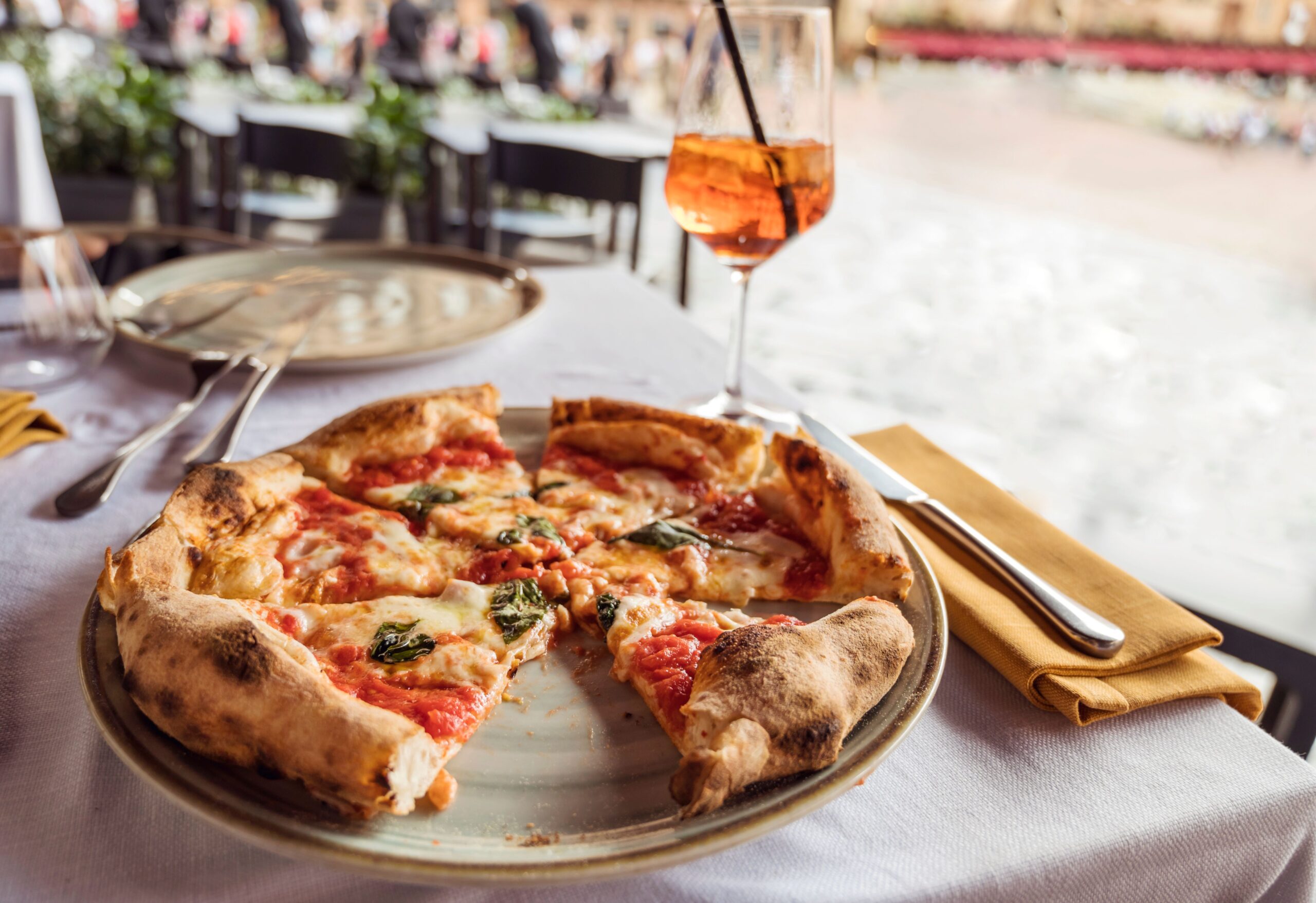
In historic pizzerias, kneading is traditionally done by hand or using plongeurs-arm mixers that mimic human movement so as not to heat the mixture. The resulting elasticity allows the pizzaiolo to stretch the dough ball using only the palms of the hands and fingertips, pushing the air from the center to the edges to create the characteristic cornicione. This blown and alveolar crust is the visual proof of optimal fermentation; upon coming into contact with the extreme heat of the oven, carbon dioxide bubbles expand, generating a light texture, crisp on the outside and tender on the inside.
Authentic Neapolitan pizza is an exercise in imperfect geometry and invisible chemistry; a fragile balance that is destroyed if time is accelerated or the purity of basic ingredients is betrayed.
The temples of the historic center: Between tradition and bustle
Walking through Via dei Tribunali and Via Pignasecca is stepping into the emotional epicenter of Neapolitan pizza. Here, refractory stone ovens have been lit for over a century, fueled by the chaotic energy of a city that never sleeps. In this environment, pizzerias like Di Matteo or L’Antica Pizzeria da Michele operate as civil institutions. In the latter, founded in 1870, the menu is strictly reduced to two options: Marinara and Margherita. There is no room for contemporary experiments or concessions to passing fads.
The diner who manages to secure a table in these establishments must be prepared for fast, almost martial service, where priority is given to rotation and respect for the freshly baked product. The aroma of wood smoke mixes with the shouting of waiters calling out orders to the cooks. Eating here is not a relaxed gastronomic experience in the modern sense, but an anthropological immersion into the life rhythm of Naples. Every bite of Da Michele’s Margherita reveals the balanced acidity of the tomato, the unctuousness of buffalo mozzarella or fior di latte, and the balsamic touch of fresh basil crowned with a drizzle of extra virgin olive oil.
Beyond the center: Innovation and mastery in Vomero and Posillipo
Although the historic center monopolizes the weight of the romantic narrative, the bourgeois periphery of Vomero and the residential neighborhoods descending toward the sea in Posillipo house a generation of pizzaiolos who have elevated artisanal technique to fine art. Establishments like Starita a Materdei or the historic Pizzeria Brandi—where the official Margherita supposedly originated—prove that excellence is not the exclusive patrimony of a single street.
In these establishments, the search for raw materials with protected designation of origin has become an obsession. Pizzaiolos collaborate directly with small farmers from the Vesuvius plain to source Piennolo del Vesuvio tomatoes, grown in mineral-rich volcanic soils that provide an unmistakable natural sweetness. Likewise, milk selection for cheeses is carried out under strict traceability controls, prioritizing Campania buffalo mozzarella DOP over cheaper industrial alternatives. This demand has transformed the Neapolitan culinary landscape, proving that tradition can evolve without losing its soul.
The role of the oven: Squaring the circle at 480 degrees
No conversation about Naples pizza is complete without analyzing the instrument that brings it to completion: the traditional wood-fired oven, built with refractory bricks and volcanic ash at the base. A good Neapolitan oven reaches temperatures close to 450 or 480 degrees Celsius. At such caloric intensity, pizza baking is lightning fast: it barely lasts between sixty and ninety seconds.
This record time is essential. It allows the base to be cooked and slightly toasted with the characteristic leopard spots—small dark marks produced by the caramelization of the flour’s natural sugars—while the wet ingredients in the center, such as tomato and cheese, retain their freshness and do not excessively dehydrate. Handling the peel and positioning the pizza inside the oven mouth require millimeter-precise physical dexterity by the pizzaiolo, who must rotate the dough disk in seconds to ensure homogeneous cooking against the live flame.
Economy, tourism, and the future of intangible heritage
Today, pizza in Naples faces a double challenge: the pressure of mass tourism threatening to trivialize the experience, and real estate speculation driving up commercial rents in traditional neighborhoods. Despite these challenges, the inscription of the Traditional Art of the Neapolitan Pizzaiuolo on UNESCO’s Representative List of the Intangible Cultural Heritage of Humanity in 2017 provided institutional backing protecting knowledge transmitted from generation to generation.
Local guilds and oversight associations closely monitor new establishments to ensure they comply with strict specifications. For the informed traveler, this oversight is a guarantee, but also a call to responsibility: patronize small family businesses, respect local waiting times, and reject establishments that adapt their recipes to international tastes by denaturing the original product.
Practical guide
- Getting there: Naples-Capodichino International Airport connects with major European capitals. From the terminal, the Alibus urban bus or a regulated taxi takes you to the historic center in under twenty minutes.
- When to go: Spring and autumn offer optimal temperatures for walking the city. Avoid peak summer months when heat trapped in narrow streets makes extended walks difficult.
- Estimated costs: A classic Margherita pizza in traditional venues ranges between 6 and 9 euros. Be wary of prices that are too cheap as well as those exceeding 15 euros without verified artisanal justification.
- Local etiquette: In the vast majority of traditional pizzerias, tables are not reserved for small groups; be prepared to queue at the door. It is customary to consume the whole pizza individually, cutting it with a knife and fork or folding it according to street tradition.
Emotional epilogue: Wood smoke and the memory of stone
When evening falls over the gulf and boat lights turn on against the imposing profile of Vesuvius, Naples reveals its true poetic dimension. In a small corner of the Materdei neighborhood, an elderly pizzaiolo cleans the hearth of his oven with unhurried gestures, removing the last ashes of beechwood. That age-old routine, repeated night after night for centuries, encapsulates the true essence of a city that has turned the elementary act of eating into a declaration of love for life. Sitting down at a table in Naples is not merely satisfying an appetite, but letting oneself be embraced by a history made of ash, fire, flour, and living memory.
Source in EN: Condé Nast Traveler