Introduction to the Insular Geography of the South Pacific
The vastness of the Pacific Ocean conceals one of the most fragmented and challenging territories on the planet: French Polynesia. With a maritime surface area equivalent to that of continental Europe, this overseas collectivity scatters its 118 islands and atolls across five main archipelagos: the Society Islands, the Tuamotus, the Austral Islands, the Gambier Islands, and the Marquesas. For travelers and residents inhabiting this oceanic frontier, distance is not a mere metric measurement, but a decisive factor conditioning every aspect of daily life, from the supply of basic commodities to passenger mobility between islands that appear to float in the vast blue expanse.
Unlike continental destinations where terrestrial infrastructure dominates travel planning, connectivity here depends almost exclusively on a complex multimodal transport network where the sky and the sea act as the only viable arteries. Understanding the logistics of this territory requires looking beyond the tourist postcards of overwater bungalows and delving into the intricate machinery of cargo vessels, airstrips carved into coral reefs, and inter-island ferries that sustain the economic and social heartbeat of the region.
The Vital Role of Cargo Schooners and Ferries
For centuries, the umbilical cord keeping insular communities alive has been the local merchant marine. Traditional cargo schooners, known in Tahitian as tinito or mixed vessels, represent much more than a simple means of transportation: they are authentic floating markets and the primary link to the outside world for the most isolated atolls of the Tuamotus or the rugged coasts of the Marquesas. Vessels like the Aranui 5 have revolutionized this concept by merging essential logistical supply with passenger transport in a mixed-voyage format that delivers fuel, food, and construction materials while carrying travelers eager for authenticity.
In the Society archipelago, where the highest population density is concentrated around Tahiti and Moorea, maritime connectivity adopts a more dynamic format thanks to high-speed ferries. These catamaran vessels transport thousands of passengers and vehicles daily, turning the Moorea channel into a bustling aquatic highway. The punctuality and efficiency of these services are fundamental for the local economy, allowing commuting workers, students, and tourists to move without the complications of short-haul commercial aviation.
The sea does not separate the islands of French Polynesia; it is the only available highway uniting the dispersed fragments of a shared oceanic culture.
Regional Aviation as an Emergency Network and Cohesion Tool
When the ocean becomes too formidable for daily navigation, regional aviation steps in as the ultimate tool for territorial cohesion. Air Tahiti, the reference domestic airline, operates a fleet specifically adapted to the unique geographical conditions of the South Pacific. With aircraft capable of taking off and landing on short paved strips built upon narrow coral atolls—such as the airports in Rangiroa or Manihi—the company connects remote airfields with the international hub at Faa’a in Tahiti.
This air network is not merely a tourist luxury, but an essential public service. For a resident of the Austral Islands, a flight to the administrative capital represents the only rapid route to access specialized medical treatments, government paperwork, or higher education. Planning these routes requires extreme meteorological precision, as trade winds and tropical storms can alter flight schedules without warning, forcing crews to rely equally on modern navigation technology and deep local experience.

Airport Infrastructure on Coral Atolls
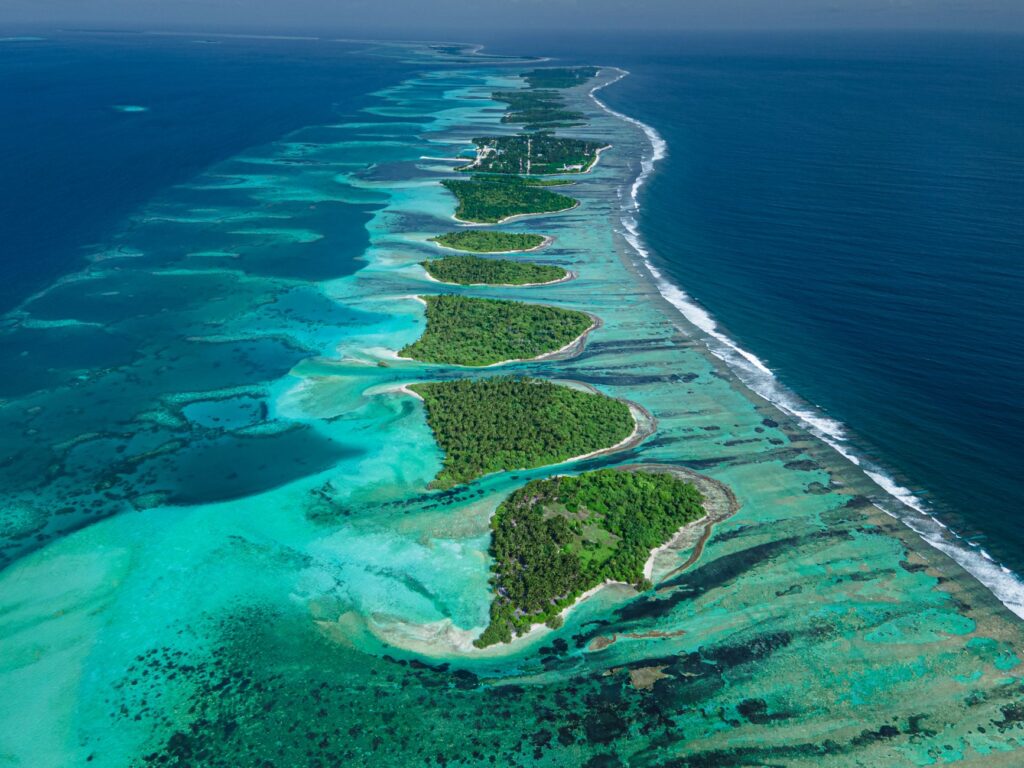
Constructing and maintaining airport infrastructure amidst a coral atoll is one of the most notable engineering feats in Oceania. Runways must be raised upon narrow strips of dry land or motus, bordered on both sides by the turquoise waters of the ocean and the interior lagoon. Engineers must cope with constant marine corrosion, a scarcity of suitable local materials, and the need to protect fragile surrounding ecosystems from erosion and contamination.
Despite these logistical hurdles, French Polynesia’s airport network is maintained under strict international aviation safety standards. Each terminal, although often reduced to a simple open-air structure with woven palm fronds for natural ventilation, features advanced communication systems and night lighting at strategic enclaves. This ensures that emergency medical evacuations can take place even after sunset, saving lives in communities situated hundreds of kilometers from the main hospital in Papeete.
Logistical Challenges in Supply Routes
The supply chain in French Polynesia is a constant exercise in economic equilibrium and meticulous planning. Virtually all manufactured products, from heavy machinery to daily consumer goods, must be imported from markets as distant as Europe, North America, or East Asia, entering the territory through the autonomous port of Papeete. From this central node, goods are redistributed to the peripheral archipelagos via a fleet of coastal vessels that must deal with high operating costs driven by distance and international fuel prices.
This logistical model exposes the territory to intrinsic vulnerability against global market fluctuations and crises in international maritime transport chains. To mitigate this dependence, local authorities and island cooperatives actively promote self-sufficiency in key sectors such as aquaculture, copra production, black pearl farming, and terrace agriculture, reducing pressure on cargo ships and guaranteeing food security in the event of severe weather delays.
Sustainable Tourism and Its Impact on Local Routes
The sustained growth of international tourism has profoundly transformed the dynamics of transport routes in the South Pacific. While the arrival of large cruise ships brings a significant volume of visitors to major ports, it also poses considerable environmental and waste management challenges for small islands with limited water resources. In response to this pressure, recent public policies promote a low-density tourism model that prioritizes the use of local vessels and small family-run guesthouses in the outer islands, distributing economic benefits more equitably among rural communities.
This transition toward more sustainable practices forces a rethinking of connectivity from an ecological perspective. Shipping and aviation companies are beginning to explore energy-efficient alternatives, such as the use of marine biofuels, route optimization via meteorological artificial intelligence, and the gradual electrification of cargo handling equipment on insular docks, seeking to preserve the fragile natural balance that draws travelers to the edge of the world.
Travel Planning: Practical Mobility Tips
For travelers deciding to explore French Polynesia beyond conventional circuits, rigorous mobility planning is the deciding factor between an unforgettable experience and a frustrated itinerary. Unlike urban destinations, improvising last-minute transfers between remote islands can prove complex and costly due to the high occupancy of air seats and the limited frequency of cargo schooners.
Acquisition of Regional Air Passes: Air Tahiti offers multi-trip packages known as Pass Îles, specifically designed to bundle several segments between different archipelagos with more advantageous rates than purchasing individual tickets.
Flexibility in Dates: South Pacific weather conditions can force modifications to ferry departures and domestic flights, making it advisable to leave a margin of at least 24 hours before catching international return flights.
Optimized Luggage: Weight restrictions on regional prop flights are typically strict (usually between 10 and 20 kilograms per passenger), making light travel essential.

Advance Booking of Local Transport: On smaller islands where terrestrial public transport is nonexistent, securing vehicle rentals or transfers with local accommodations prior to arrival is vital.
The true magic of Polynesia does not lie in the speed of reaching a destination, but in the patience of learning to synchronize one’s own pace with the rhythm of the ocean.
Conclusion: The Future of Oceanic Connectivity
The future of French Polynesia critically depends on its ability to adapt transport infrastructure to 21st-century demands without losing the identity defining its people. Port modernization projects, the renewal of the merchant fleet under lower carbon footprint criteria, and the continuous improvement of digital communications in the most remote atolls are essential steps to ensure insularity does not become synonymous with isolation.
Ultimately, keeping the sea and air routes alive in this corner of the planet is an act of cultural and economic resilience. The schooners furrowing the horizon, the planes defying the wind over the reefs, and travelers respecting the unhurried rhythm of these communities demonstrate that distance, rather than an insurmountable obstacle, is the framework where the fascinating and fragile web of oceanic life is woven.