


Introduction to the French Finisterre
At the westernmost tip of France, where the European continent seems to surrender to the vastness of the Atlantic Ocean, stands one of the most formidable maritime heritage sites in the world: the lighthouses of Brittany. This coastline, battered by storms, fog, and some of the most violent tides in Europe, is not only a scenic paradise but also the stage for one of the most daring engineering epics in modern history. For centuries, navigating the waters of the English Channel and the Iroise Sea was tantamount to entering a maritime graveyard. The solution to this age-old danger changed forever when human ingenuity decided to conquer the most isolated and exposed rocks in the ocean to erect granite towers capable of resisting the furious pounding of the waves.
The geography of danger and historical navigation
The Breton coastline is characterized by a complex network of submerged reefs, unpredictable currents, and fiercely changing weather. Before the advent of modern light signaling, thousands of vessels perished off these rugged shores. Local chronicles are full of tragic shipwrecks that mobilized coastal communities, whose traditional economy depended as much on fishing as, on dark occasions, the rescue of shipwreck cargoes. The Molène archipelago and the island of Ouessant marked the threshold between open sea and the relative safety of the Bay of Biscay and the English Channel. The urgency to plot safe routes prompted the French administration to devise an unprecedented buoyage system that would culminate in the so-called ‘infernal’ towers: solitary outposts situated in the open sea where human life bordered on the impossible.

The engineers of stone and iron
Building on a rock battered by giant waves required bold technical solutions. In the mid-nineteenth century, brilliant engineers such as Léonce Reynaud and Alphonse Allard developed revolutionary methods for foundation work and stone block assembly. Stacking granite was not enough; each piece had to fit millimetrically with its neighbor using dovetails and special hydraulic mortars that cured underwater. These cylindrical or conical structures were aerodynamically designed to deflect the kinetic energy of the waves, allowing water to surge and pass over the lantern without collapsing the shaft. Construction took years, constantly interrupted by storms, and demanded superhuman effort from the masons and sailors who transported materials under extreme risk.
The classification of offshore towers
Maritime tradition in France classifies its lighthouses according to their location and level of isolation. At the pinnacle of this hierarchy are the lighthouses popularly known as ‘the infernals’, those erected in the open sea with no land connection whatsoever, such as Ar Men, La Jument, and Kéréon. These are followed by ‘the purgatories’, located on small islands or islets accessible only in highly favorable weather conditions, such as Sein or Ouessant. Finally, ‘the paradises’ correspond to those emplaced on the mainland, on accessible capes like Saint-Mathieu or Penmarc’h. Each of these categories implied a radically different way of life for the keepers, the guardians of the fire who for generations watched over the safety of navigators in absolute solitude.
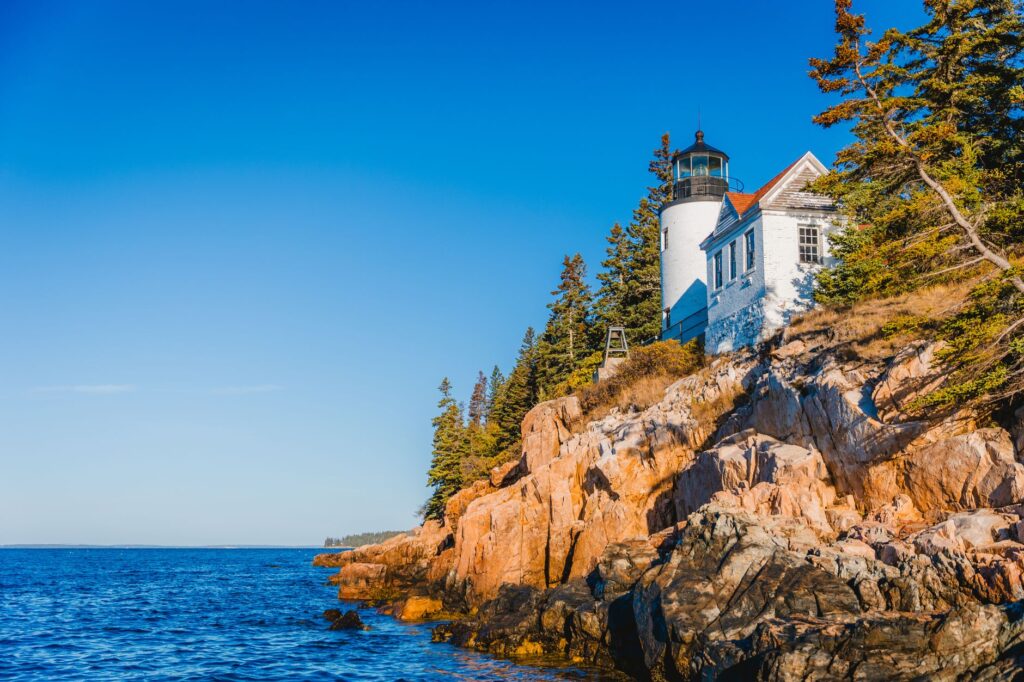
Building an offshore lighthouse is not merely a work of civil engineering; it is an act of human sovereignty over the chaos of the ocean.
The daily life of the fire guardians
The figure of the Breton lighthouse keeper is part of the collective European imagination. Confined for weeks or months in cramped spaces, enduring the deafening hum of the wind and the constant beating of water against the glass, these men developed an iron routine based on the maintenance of Fresnel optics, the cleaning of oil burners—and later electrical systems—and meteorological observation. The arrival of helicopters in the second half of the twentieth century and, above all, the progressive automation of light signals during the 1980s and 1990s, marked the end of a golden era. Today, all offshore lighthouses in Brittany are automated, controlled remotely from mainland centers, but the echo of those solitary lives still resonates within the granite walls.
Monumental architecture and functional design
Beyond their technical utility, the great lighthouses of Brittany are authentic masterpieces of monumental architecture. The use of gray and pink granite quarried locally confers an unshakeable aesthetic dignity upon these towers. Inside, the spatial layout strictly responded to criteria of survival and functionality: the ground floor was reserved for fuel and provision stores, the intermediate floors housed living quarters and the kitchen, and the summit crowned the ensemble with the exterior gallery and glazed lantern. Cast-iron spiral staircases, oak wood paneling to combat humidity, and hand-forged handrails demonstrate a dedication to artisanal detail that contrasts sharply with the brutality of the natural environment.

The Ar Men lighthouse: legend of the end of the world
If there is a definitive symbol of this epic, it is Ar Men, christened by sailors as ‘the lighthouse of lighthouses’. Located at the western extremity of the Sein reef, its construction began in 1867 and lasted fourteen years due to the extreme difficulty of setting a single foot on the rock. Workers had mere minutes between waves to drill the stone and secure the first iron rods. The isolation of Ar Men and the virulence of the storms turned it into a literary and cinematic myth. Surviving there required nerves of steel and robust health, enduring constant vibrations that made furniture tremble and absolute isolation that tested the mental stability of the keepers.
Augustin Fresnel’s optical technology
No account of lighthouses would be complete without mentioning the technological revolution that made their efficiency possible: the stepped lens invented by Augustin Fresnel in the early nineteenth century. Before his invention, lamp light dispersed weakly or required heavy, inefficient metallic mirrors. Fresnel’s system concentrated luminous rays into a long-range horizontal beam using concentric glass rings that refracted light optimally. This innovation multiplied the visibility radius of Breton lighthouses tenfold, radically transforming the safety of nocturnal navigation throughout the entire Atlantic world.
Contemporary heritage and cultural tourism
Today, the role of lighthouses has evolved toward cultural preservation and sustainable tourism. Although they no longer guide ships in the same way as before—largely supplanted by GPS satellite navigation systems and radar—they remain indispensable landfall beacons and unmistakable visual reference points. Heritage associations, French cultural ministries, and coastal municipalities have promoted ambitious restoration programs to prevent the ruin of these centennial structures. Visiting sites such as Pointe du Raz, the Eckmühl lighthouse, or taking boat excursions to the foot of La Jument allows contemporary travelers to comprehend the magnitude of this human feat.

Maritime heritage is not an inert vestige of the past, but the tangible proof of our collective capacity to overcome geographical limits.
Practical information for the traveler
Planning a cultural trip focused on the lighthouse heritage of Brittany requires taking into account the seasonality and unpredictable weather of the region. The best time to visit the capes and undertake maritime crossings spans from late May to September, when sea conditions are more benign. It is advisable to rent a vehicle to tour the Atlantic corniche from Brest to Quimper, passing through the Crozon peninsula and the Ouessant archipelago. To access the islands and view offshore lighthouses from the water, local ferry companies operate from ports such as Le Conquet and Audierne. Booking ferry tickets well in advance during the summer months is strongly recommended, along with packing waterproof and windproof clothing, as coastal weather can change drastically within hours. Furthermore, interpretive centers such as the Museum of Lighthouses and Beacons on the island of Ouessant offer an essential educational overview to contextualize the technical and human history of these constructions.
Conclusion: eternal sentinels of the ocean
The lighthouses of Brittany transcend their original function as mere navigational aids to stand as monuments to human tenacity. In an era dominated by digital speed and virtuality, these granite towers remind us of the physical value of effort, the importance of collective safety at sea, and the austere beauty of architecture adapted to hostile environments. Visiting this Atlantic edge is an exercise in historical memory and aesthetic contemplation that invites reflection on our ancestral relationship with the most powerful natural elements on the planet.


