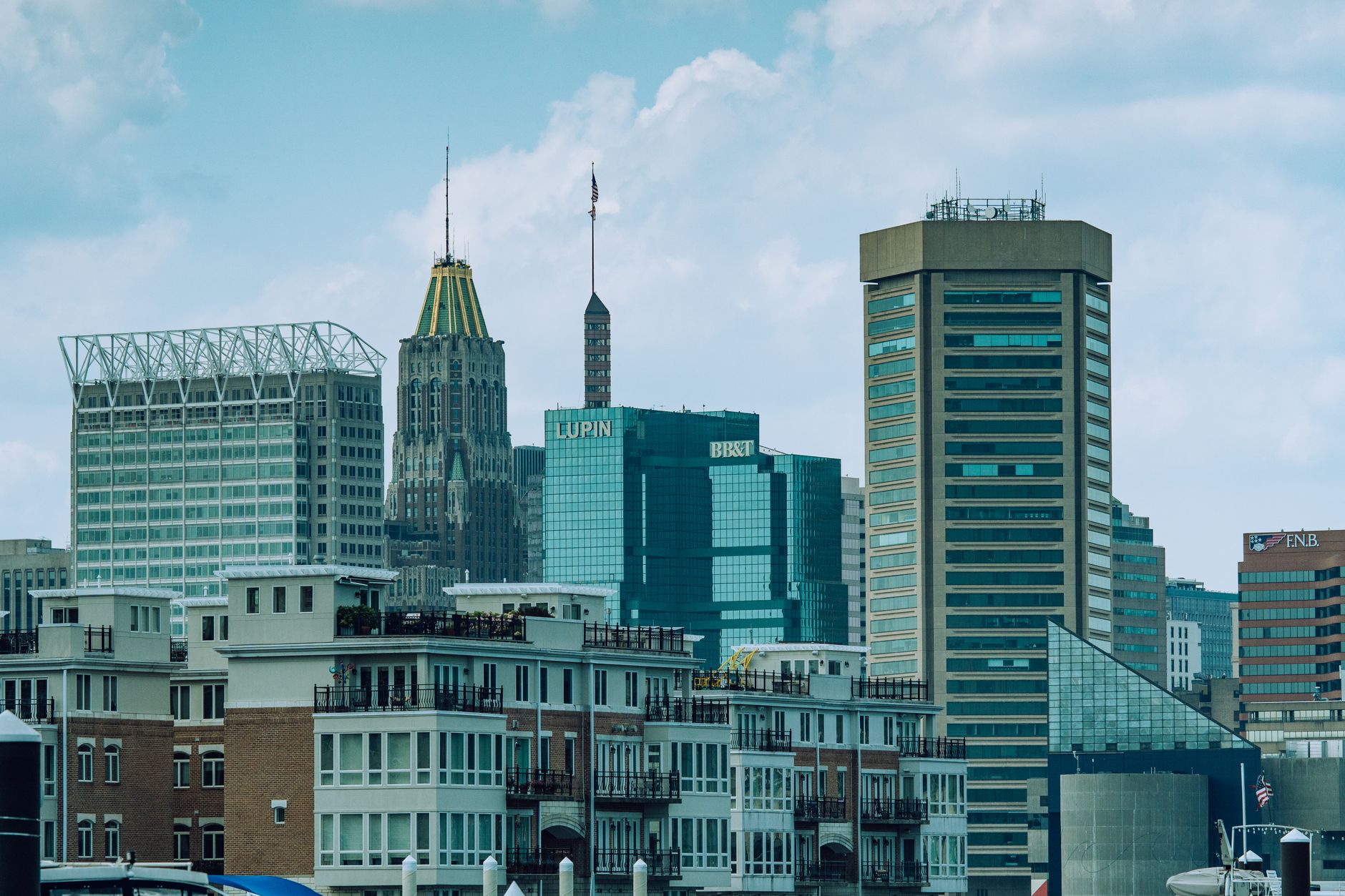

Baltimore, in the state of Maryland, United States, is a city built and rebuilt alongside the water. Its inner harbor, its rows of rowhouses and its cultural institutions tell a story of trade, industry and community that remains alive in everyday life. For the visitor, the city offers something unusual: an urban heritage that is not observed from a distance but walked, bought in markets and discussed on street corners.
This report proposes a reading of Baltimore through its local identity, its daily life and the responsible decisions available to those who arrive with curiosity. It is not a list of attractions but a journey through the places where the city’s memory becomes present and where the traveller can choose how to relate to it.
A harbor that shaped the city
Baltimore’s geography is defined by its position at the head of the Chesapeake Bay. That inland-port condition explains much of its history: maritime trade, industry and immigration shaped an urban fabric of docks, warehouses and working-class neighbourhoods. Today, the Inner Harbor is the city’s best-known face, but it is worth remembering that this is a recent transformation of a space that for decades was primarily a place of work.
Walking the waterfront reveals that dual condition. Historic buildings sit alongside cultural venues and promenades, and the water acts as an axis connecting very different neighbourhoods. The key for the visitor is not to stay only with the postcard view: a few streets away lies the city that lives all year round, with its markets, schools and routines.

Baltimore cannot be explained from the harbor overlook alone: it is understood when you walk the streets where people go about their daily lives.
Rows of rowhouses and sidewalks with memory
One of Baltimore’s most recognisable features is its residential architecture. Rows of rowhouses, many with brick facades and marble stoops, define the landscape of neighbourhoods such as Federal Hill, Fells Point and Canton. This typology is not merely aesthetic: it reflects a dense, communal way of living in which the sidewalk serves as a meeting place.
Exploring these neighbourhoods on foot is one of the best ways to approach local identity. Facades vary in colour and detail, and they record the history of the successive waves of people who arrived in the city. The responsible visitor avoids treating these neighbourhoods as a stage set and remembers that people live there: keep voices low, respect private entrances and do not intrude on gardens or stoops.
Fells Point and the memory of dock work
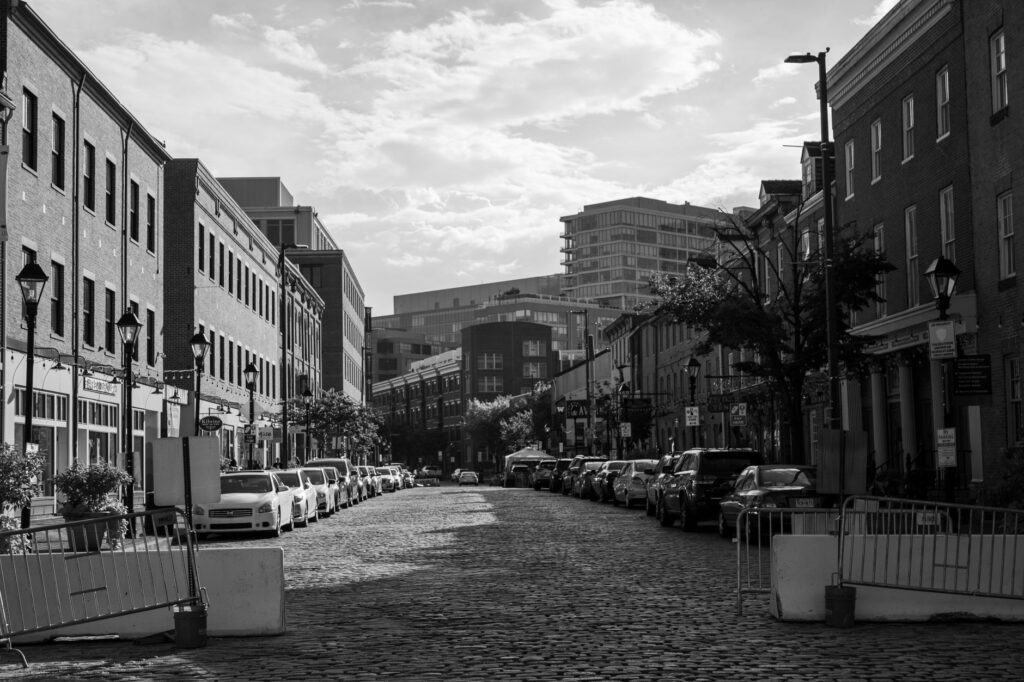
Fells Point is one of Baltimore’s best-known historic districts. Its cobbled streets and eighteenth- and nineteenth-century buildings recall the era when the neighbourhood was a centre of shipbuilding and port activity. Today it combines housing, shops and a lively nightlife, but its main interest for the attentive traveller lies in the trace of maritime work that is still perceptible in the scale of its buildings.
A walk through its streets shows how heritage has been rehabilitated without entirely erasing its character. It is a good place to pause, read old signs and understand that urban conservation is not only about facades but about maintaining uses and communities. Choosing local businesses and quieter hours is a concrete way to help the neighbourhood remain a livable place.
The market as a gauge of daily life
Public markets are among Baltimore’s most cherished institutions. Places such as Lexington Market and Cross Street Market have for generations been meeting points where people buy food, talk and keep alive a food culture closely tied to the sea and local tradition. Visiting a market is a direct way to understand how the city works from the inside.
For the traveller, the advice is simple: take your time, watch the stalls, ask questions respectfully and try what the vendors offer. The market is not a museum but a workplace, and that distinction changes the experience entirely. Buying from local traders and avoiding the busiest hours are small gestures that help sustain these places.
Museums, art and a cultural identity of its own
Baltimore has a dense cultural life for its size. The Baltimore Museum of Art and the Walters Art Museum hold collections of international relevance, while smaller institutions and independent spaces sustain an active art scene. That combination of major museums and neighbourhood projects reflects a city that produces culture as well as consuming it.
Beyond the well-known names, pay attention to local programming: galleries, theatres and community centres that organise activities throughout the year. Checking opening times and access conditions before your visit is essential, as many spaces have variable schedules. Culture in Baltimore is best understood as part of everyday life rather than a closed circuit for tourists.
Edgar Allan Poe and literary memory
Baltimore’s connection with Edgar Allan Poe is one of the city’s most singular cultural links. The house where the writer lived and Westminster Cemetery, where his grave is located, form part of a literary itinerary that attracts readers from around the world. Beyond the myth, these places invite reflection on how a city builds and cares for its cultural memory.

For those visiting these sites, the advice is the same as elsewhere on this journey: research beforehand, respect opening hours and avoid turning the visit into a mere photo stop. Literary memory is best enjoyed with context, reading a little about Poe’s work and about nineteenth-century Baltimore, when the city was an expanding publishing and commercial centre.
Eating in Baltimore: maritime tradition and neighbourhood cooking
Baltimore’s cooking is marked by its proximity to the Chesapeake Bay. Seafood, and blue crab in particular, occupies a central place in local food tradition. But reducing the city to a single dish would be unfair: its neighbourhoods bring together the cooking of different communities, from African American tradition to the contributions of European, Latin American and Asian immigrants.
For the visitor, the best strategy is to eat where the city’s residents eat: markets, neighbourhood spots and family restaurants. Asking about seasonal dishes and local produce is a way to approach the real kitchen, away from menus designed only for tourists. Food here is also a way to understand the history of work and migration.
Getting around the city with judgement
Baltimore has a public transport network that includes buses, light rail and commuter trains, as well as highly walkable areas in the centre and the historic neighbourhoods. The city is also known for its trail network and green spaces, which allow urban visits to be combined with outdoor walks. For the traveller, the important thing is to plan journeys in advance and check current service conditions.
As in any large American city, it is worth researching the areas you plan to visit and choosing routes that fit the time available. Caution and up-to-date information are better allies than any list of generic recommendations. Walking is an excellent option in the historic neighbourhoods, but it should be combined with public transport for longer distances.

Practical guide
Before travelling, check official information on transport, museum hours and access conditions for heritage sites. Baltimore is best explored with a flexible plan that combines the centre and the historic neighbourhoods with time to pause in markets and squares. Spring and autumn usually offer milder temperatures for walking, although the region’s weather can be variable.
- Documentation: verify entry requirements for the United States according to your country of origin and current conditions.
- Transport: check current public transport routes and schedules before each journey.
- Heritage: respect the visiting rules of museums, historic cemeteries and private buildings.
- Local spending: prioritise markets and neighbourhood businesses to support the local economy.
- Safety: research the areas you plan to visit and avoid night walks through poorly lit areas.
A visit to Baltimore improves when you accept that the city does not give itself up immediately. It requires time, walking and a willingness to listen. That is perhaps the best way to respect its heritage and its daily life.
A city remembered on foot
At the end of the journey, Baltimore leaves an impression that does not depend on a single monument. What remains is the sum of small scenes: a marble stoop, the smell of a market, a cobbled street by the water, a conversation at the door of a rowhouse. The city is remembered on foot, and that memory is what the traveller takes away.