
Brescia is not a stopover between Milan and Venice. In the heart of Lombardy, this Italian city of around 200,000 inhabitants preserves a heritage recognized by Unesco since 2011: the Santa Giulia area and the Roman forum of Brixia, alongside the monastery of San Salvatore. But the visitor who arrives with time discovers something harder to catalogue: a daily life that unfolds among porticoed squares, neighborhood markets and streets where cars do not always rule.
The question guiding this report is simple: how do you walk Brescia without reducing it to a list of monuments? The answer lies in the rhythm. Here heritage is not isolated behind a fence; it is woven into the routine of those who cross Piazza della Loggia every morning.
A city of two eras
Brescia is organized around two historic cores. The first is Roman Brescia, with the Capitolium, the theatre and the remains of the forum now visited within the Santa Giulia complex. The second is medieval and Venetian Brescia, unfolding around Piazza della Loggia and Piazza Paolo VI, where the old and new cathedrals stand side by side.
That duality is not an archaeological detail: it shapes the way you walk the city. The visitor moves from a broad, monumental square to narrow alleys in minutes, without needing transport.
Understanding this structure before setting out helps avoid the most common mistake: treating the Roman remains and the Renaissance squares as separate excursions. They belong to the same urban fabric, and the distance between them is measured in footsteps rather than bus stops. A morning that begins among the columns of the Capitolium can end under the arcades of the Venetian palace without any sense of rupture.
Piazza della Loggia, the city’s living room
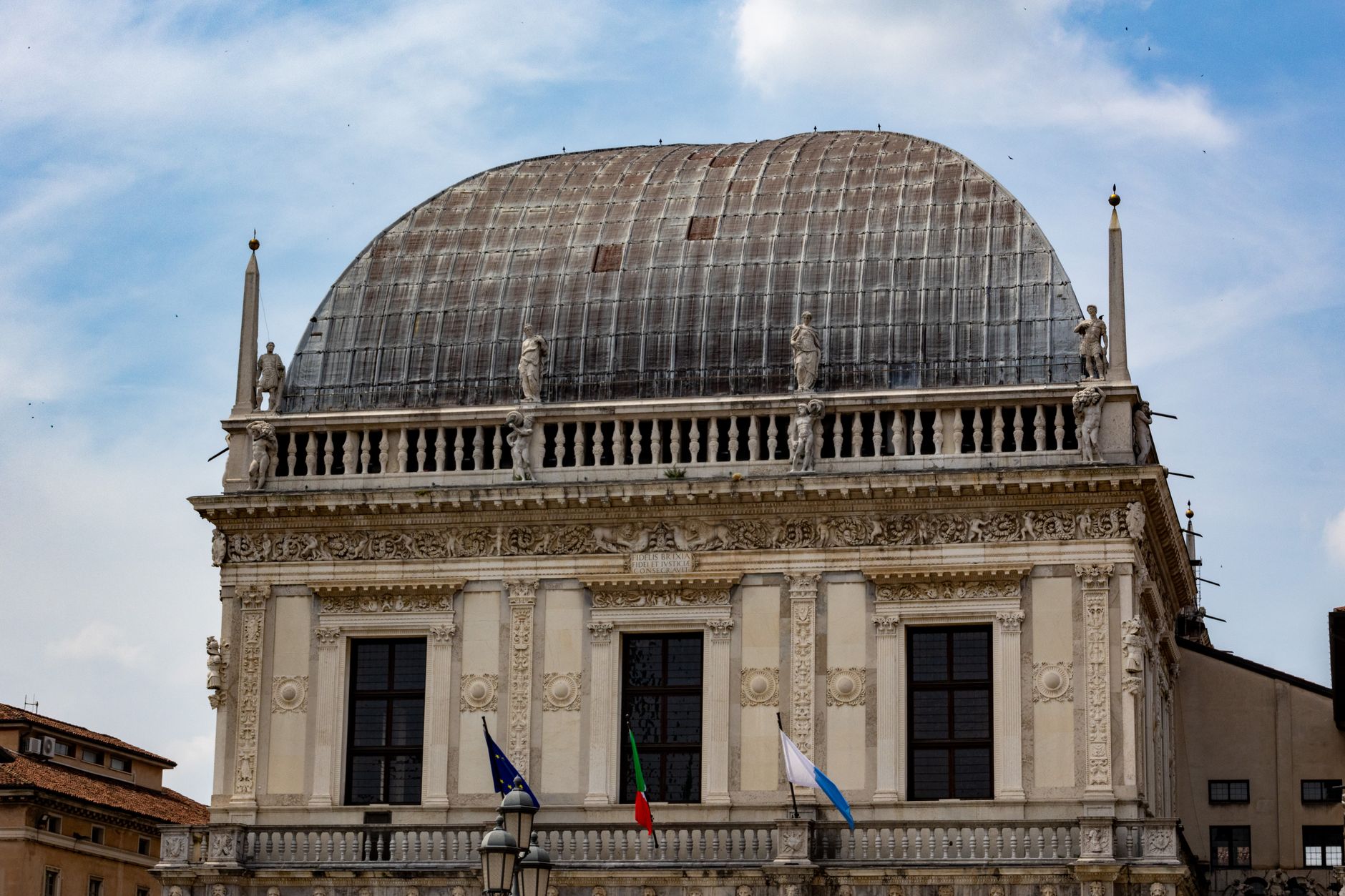
Piazza della Loggia is Brescia’s civic heart. Its Renaissance palace, begun in the 15th century, presides over a porticoed space that functions as an urban living room: cafés, shops and offices share the arcades. At one end, the astronomical clock and the two statues flanking it recall the Venetian power that governed the city for centuries.
This is not a museum square. It is a square where people wait, talk and cross the city. For the visitor, the advice is simple: sit for a while and observe before moving on.
The square also rewards a second visit at a different hour. In the morning it belongs to those heading to work; in the evening the terraces fill and the light under the porticoes changes the character of the stone. Neither version is more authentic than the other, and comparing them is one of the quiet pleasures the city offers.
Brescia’s heritage is not contemplated from outside: it is crossed on foot, amid the noise of terraces and the steps of those going to work.
Santa Giulia and the Roman forum
The Santa Giulia complex brings together within one enclosure a female monastery of Lombard origin, the basilica of San Salvatore and the archaeological area of the Capitolium. It is the place where Brescia’s history becomes most legible: Roman, medieval and Renaissance layers coexist in the same space.
The visit requires time. Those who explore the complex calmly will understand why Unesco included this site among the Lombard art treasures in Italy. But it is also worth remembering that this is a living museum, with cultural activities and a garden that invites pause.
For the traveler interested in context rather than a checklist, the sequence matters. Beginning with the archaeological area and then moving into the monastic spaces allows the layers to register gradually. Rushing through in an hour flattens the experience; two or three hours, with a pause in the garden, restore the sense of continuity that defines the site.

The old and new cathedrals
Piazza Paolo VI concentrates two cathedrals facing each other. The old Duomo, with its Romanesque plan and medieval crypt, preserves a sober and somewhat unexpected interior. The new Duomo, with Baroque and classical lines, dominates the square with its unfinished façade.
The coexistence of both buildings sums up Brescia’s character: a city that accumulates layers without erasing the previous ones. The visitor can enter both and compare without moving more than fifty meters.
It is worth noting that these are active places of worship, not only monuments. Dress respectfully, keep voices low and check whether a service is underway before walking through. That small courtesy is part of what keeps the square functioning as a neighborhood space rather than a stage.
The castle and the view over the city
At the top of the Cidneo hill, Brescia’s castle offers one of the few real panoramic views of the city. It is not a fairy-tale castle: it is a fortress with centuries of modifications, from the Visconti to Venetian and Austrian rule. Today it houses the Museo delle Armi and a public park.
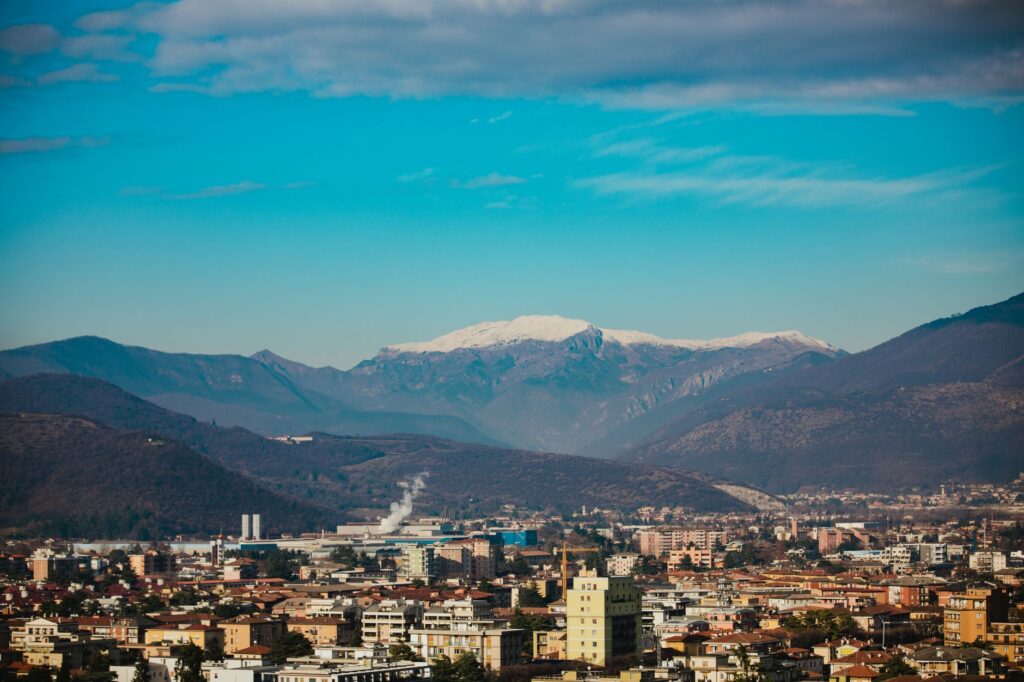
Walking up from the center takes just over twenty minutes. The reward is not only the view: it is understanding the city’s geography, its relationship with the Po plain and the strategic position that explains much of its history.
The climb is best done in comfortable shoes and, in warm months, early in the day. The park is a local destination as much as a tourist one, so weekends bring families and joggers alongside visitors. Sharing the space calmly is part of the experience.

Markets and neighborhood life
Beyond the monumental axis, Brescia works as a city of neighborhoods. The market at Piazza della Vittoria and the shops along Via San Faustino show a daily life that does not depend on tourism. Here people shop, greet each other and argue with the same naturalness with which they visit a church.
For the traveler, the advice is to dedicate at least half a day to walking aimlessly through these areas. The city is not large and public transport works, but real discovery happens on foot.
These streets also reveal the city’s working identity, shaped by industry and craftsmanship as much as by art history. Observing shop windows, hearing the local dialect and watching how commerce organizes around daily routines offers a counterweight to the monumental narrative. It is not a performance for visitors; it simply happens, and the visitor is welcome to move through it with discretion.
Eating and drinking with judgment
Brescia’s gastronomy combines Lombard tradition and mountain products. Spoon dishes, local cheeses and the wines of Franciacorta, a short distance away, are part of the local identity. The point is not to seek fine dining but to eat where the neighborhood eats.
The trattorias in the center and nearby neighborhoods offer reasonable value, especially at lunch. It is worth booking at weekends and avoiding peak hours if you seek calm.
A simple rule helps: look at who is sitting at the tables. If the clientele is mostly local and the menu is short, the odds of a good meal rise. Menus translated into several languages are not a warning in themselves, but they rarely signal the kind of place where the city eats on an ordinary Tuesday.

Traveling to Brescia with judgment means accepting that the city is not designed for the visitor: it is designed for those who inhabit it.
Heritage and responsible decisions
Unesco recognition has increased Brescia’s visibility, but it has not turned the city into a crowded destination. That is both an advantage and a responsibility. The visitor can help maintain the balance by shopping in local businesses, respecting church hours and avoiding noise in residential areas.
It is also worth checking the rules for accessing monuments, which may vary by season, and consulting official opening hours before organizing the visit.
Responsible travel here is less about grand gestures than about small ones: using public transport or walking, carrying water instead of buying bottles at every stop, and treating the porticoes as shared space rather than a backdrop. The city’s charm depends on the ordinary life that occupies it, and that life needs room to continue.
Practical guide
Getting there and getting around
Brescia is well connected by train to Milan, Bergamo and Verona. The central station is about twenty minutes on foot from the historic center. Within the city, the center is easily walked; for longer distances, there are urban buses and a light metro network.
When to go
Spring and autumn offer mild temperatures and fewer crowds. Summer can be hot on the plain, although porticoed squares and courtyards provide shade. Winter is cold but quiet, with fewer visitors.

What not to miss
- The Santa Giulia complex and the Capitolium.
- Piazza della Loggia and Piazza Paolo VI.
- The Cidneo castle and its view over the city.
- A walk along Via San Faustino and the neighborhood markets.
Visiting tips
It is worth booking visits to the main museums in advance during high season. Churches usually require appropriate dress. For meals, it helps to move away from the most touristy areas and look for places frequented by residents.
The city invites a slow pace: two days allow a complete visit without haste, and three allow for a nearby excursion, such as Lake Garda or the Franciacorta wineries.
A city that rewards attention
Brescia does not compete with the postcard cities of northern Italy, and it does not seem to want to. Its appeal is cumulative: a Roman column, a Venetian clock, a market stall, a plate of something warm in a room full of regulars. None of these elements is spectacular on its own; together they form a place that feels inhabited rather than staged.
That is also the reason it asks something of the visitor. It asks for time, for attention and for the willingness to accept that not every corner has been arranged for consumption. The reward is a city that behaves like itself, even when someone is watching.
At the end of the day, when the terraces of Piazza della Loggia fill up and the lights come on under the arcades, Brescia shows its true dimension. It is not a city that dazzles immediately: it is a city that reveals itself to those who walk it with attention, accepting that heritage is also measured by the life around it.