Frederiksberg: The Danish Market You Shop Week to Week
Frederiksberg rarely appears on gastronomic itineraries. It is an independent municipality of roughly 95,000 people, enclosed by Copenhagen, with wide avenues, parks and a retail life that runs all year. And there, in that retail life, lies its culinary lesson: small, frequent, seasonal shopping is still the norm in Denmark.
This is not a restaurant guide or a travel diary. It is a reading of the market as a daily institution: what is sold, how the week is organised, what the shopper decides and what a visitor can learn from spending with judgement in Denmark.
A municipality organised around the weekly shop
Frederiksberg holds its own administrative status within greater Copenhagen. That autonomy translates into a dense commercial network: streets of specialist shops, bakeries, greengrocers, butchers and neighbourhood markets that serve residents throughout the year. Shopping is not concentrated in one monumental building; it is distributed across the municipality.
It helps to understand that Frederiksberg is neither an outlying district nor an absorbed village: it keeps its own town hall, services and a distinct administrative identity. That condition partly explains the density of its local commerce, which serves a stable population and not only visitors passing through.
For the visitor, the practical consequence is clear: Frederiksberg’s food culture is walked, street by street, and cannot be resolved in a single photogenic stop. Here the market is an urban habit, not a compulsory sight.
What seasonal shopping means in Denmark
The Danish climate imposes a short calendar for many fresh products. Spring and summer bring strawberries, peas, asparagus and leafy greens; autumn brings apples, mushrooms and roots; winter pushes shoppers towards preserves, tubers and stored goods. That constraint has shaped a pantry-based cuisine and a culture of using things up.
At Frederiksberg’s stalls, seasonality is not a slogan: it is practice. What is out of season simply is not there, or appears in smaller quantities at a different price. Regular shoppers accept this as part of the system.
Seasonality is not a limitation of the Danish market: it is how the year is organised.
For anyone arriving from a country with permanent global supply, this detail changes how the counter is read. The absence of a product is not a failure of the shop but information about the calendar. Learning to read it allows better buying and explains why Nordic cooking leans so heavily on preservation.
Bread, dairy and pork: three everyday pillars
The bakery holds a central place in Danish routine. Sourdough rye, dark and dense, underpins breakfasts and cold meals; cinnamon buns and butter pastries appear in neighbourhood bakeries. In Frederiksberg, many of these shops double as morning meeting points.
Milk and dairy products are also part of daily life, and pork is one of the protein foundations of Danish cooking. None of these products needs a spectacular presentation: they are sold on quality and consistency.
This triad helps explain the structure of the weekly shop: a pantry product that keeps for days, a dairy item consumed quickly and a versatile protein. It is not a fashionable choice but a practical answer to a demanding climate and to domestic life with limited storage space.
Neighbourhood markets versus large supermarkets
Denmark is a country of efficient supermarkets, and Frederiksberg is no exception. The interesting question is not whether the market survives against the large store, but how shopping is divided: the everyday in the supermarket, the specific in the stall or specialist shop.

That division explains why neighbourhood markets still make sense. They do not compete on price across the board; they compete on a particular product, direct dealing and knowledge of the customer. A market survives where it offers judgement, not where it only offers volume.
A visitor who grasps this division stops looking for «the market» as a single attraction and starts noticing the sum of small shops. It is a slower reading, but also a truer one to how a city actually shops.
A culture of small, frequent purchases
In many Danish households, shopping happens several times a week and in modest quantities. A small fridge, the bicycle as a habitual means of transport and the proximity of shops all favour that pattern. The result is less domestic waste and faster turnover of fresh produce.
This pattern also has an economic dimension: buying little and often reduces the temptation to stockpile and makes it easier to adjust spending. In an expensive country, that discipline weighs as much as the choice of product.
For the visitor, this habit has a practical translation: do not make one large purchase for the whole stay. Buy little, come back and try. Frederiksberg invites that rhythm.
The bakery as a social space
The neighbourhood bakery serves a function beyond bread: it is where neighbours cross paths, exchange news and keep the pulse of the area. In Frederiksberg, some of these shops maintain a relationship of trust with customers built over decades.

That social dimension is hard to measure, but it shows in conversation and in the familiarity of the counter. It is one of the intangible heritages a visitor can observe without inventing any testimony.
For the traveller, the advice is simple: go in, look, order calmly and do not turn the counter into a backdrop. The bakery works as living heritage precisely because it remains a place of use, not a display case.
What a visitor can learn about waste
Denmark’s culture of using things up is expressed in home cooking: leftovers turned into soups, stale bread reused in preparations, whole vegetables. In the market, that logic appears in the sale of imperfect produce and in the planning of the shop.
A visitor who wants to align with that culture can do three things: buy small quantities, ask about seasonal produce and avoid buying what will not be eaten. It is a responsible decision that requires no rhetoric, only habit.
To shop well in Denmark is, above all, to buy what you are going to eat.
This idea connects to a broader debate on food waste, but no statistics are needed here: it is enough to observe how a counter is arranged and how a weekly shop is planned.
Frederiksberg beyond the counter
The municipality offers parks, residential architecture and a network of shopping streets that allow errands to be combined with a walk. It is not a tourist district in the conventional sense, and precisely for that reason it retains a human scale that makes observation easy.
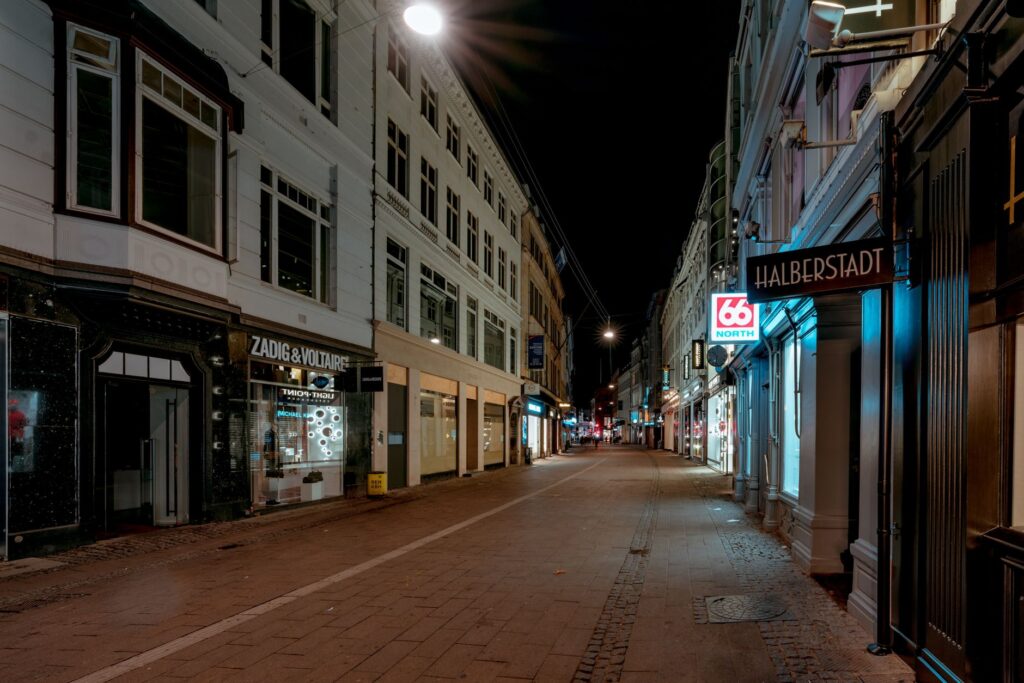
For those visiting Copenhagen, Frederiksberg works as a quiet, everyday extension of the city. The recommendation is to fold it into a day of walking rather than treat it as a separate excursion.
That walk makes clear that a place’s gastronomy is not only on the plate but in the infrastructure that makes it possible: the shop that opens early, the stall that knows its customers and the street that connects both.
Heritage and context: what is kept without a museum
Frederiksberg preserves a commercial heritage that is rarely explained on panels. It consists of habits, opening hours and relationships that sustain neighbourhood life. A visitor can recognise it in the continuity of the bakeries, the presence of specialist commerce and the way shopping is woven into the daily routine.
There is no need to invent stories or attribute testimonies: it is enough to observe that local commerce still holds a central place in the organisation of the municipality. That continuity is, in itself, a form of everyday heritage.
Practical guide
- When to go: weekday mornings are quieter; Saturdays concentrate more activity in bakeries and shops.
- Getting around: the municipality is easy on foot and by bicycle; public transport connects with central Copenhagen.
- What to buy: rye bread, seasonal produce, dairy and bakery specialities.
- Budget: Denmark is expensive; set a limit and prioritise fresh produce over souvenirs.
- Language: Danish is the local language; English works in most shops.
- Respect: do not photograph stalls without permission and do not block the way during shopping hours.
- Planning: buy little and come back; avoid one large purchase for the whole stay.
A pantry to be walked slowly
Frederiksberg does not offer a spectacular market, and perhaps that makes it more useful as a lesson. It shows that a place’s food culture is also read in the daily shop, in the corner bakery and in the decision not to fill the fridge more than necessary. A visitor who accepts that rhythm takes away something more lasting than a photograph: a way of looking at what they eat.