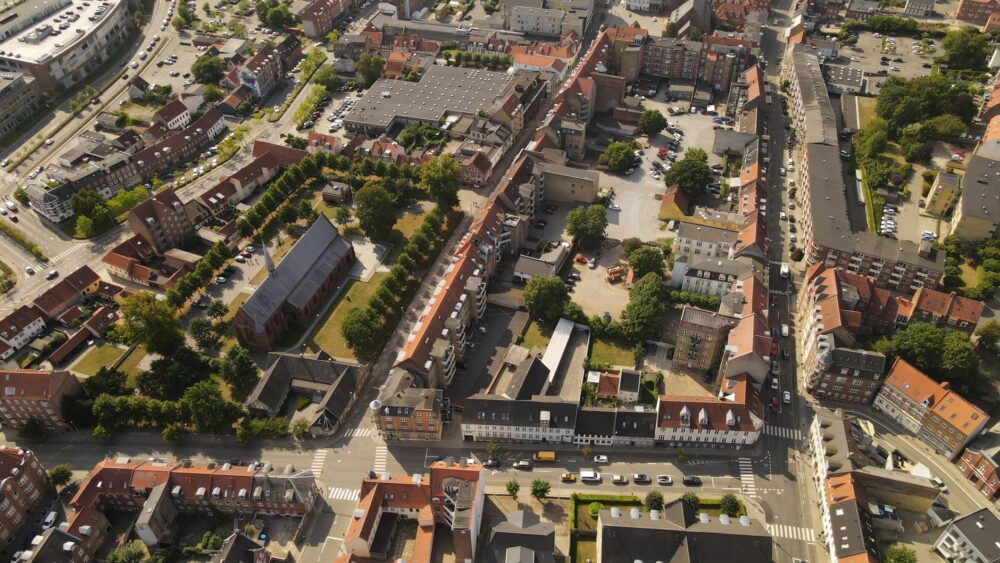
Basel occupies an unusual corner of the European map: Swiss by sovereignty, yet minutes on foot from both the German and French borders. That position explains much of its character, but it does not exhaust it. The city is better defined by what happens at street level: the tram crossing the middle bridge, the Rhine banks used as an improvised terrace, the museums that sustain a cultural life out of proportion to the city’s size.
With roughly 177,000 residents according to available geographic records, Basel does not compete on scale with Zurich or Geneva. It competes on density: heritage, art, commerce and a relationship with the river that structures the calendar. Understanding that relationship is the difference between visiting the city and passing through it.
A city best read from the bridge
The Middle Bridge is probably the best starting point for understanding Basel. Not for its isolated monumental value, but because from there you can see how the city organizes itself into two banks that face each other without a clear hierarchy. Grossbasel, the larger bank, concentrates the old town, the cathedral and commerce. Kleinbasel, the smaller one, brings a more residential tone and a neighborhood life that sustains itself far from the fast circuits.
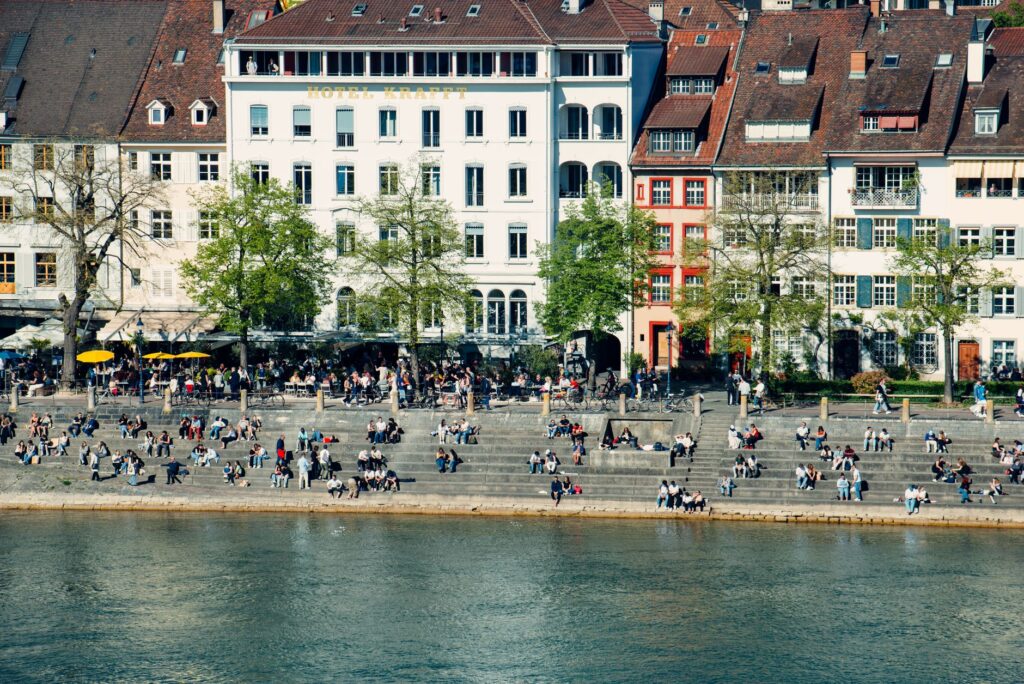
Crossing that bridge on foot, in any season, offers an immediate reading: the Rhine is not a backdrop, it is everyday infrastructure. In summer, its banks fill with people eating, reading or simply sitting. There is no special ceremony around it; it is part of the routine.
In Basel, the river is not contemplated from a distance: it is used, crossed and inhabited as an extension of the street.
The tram as urban grammar
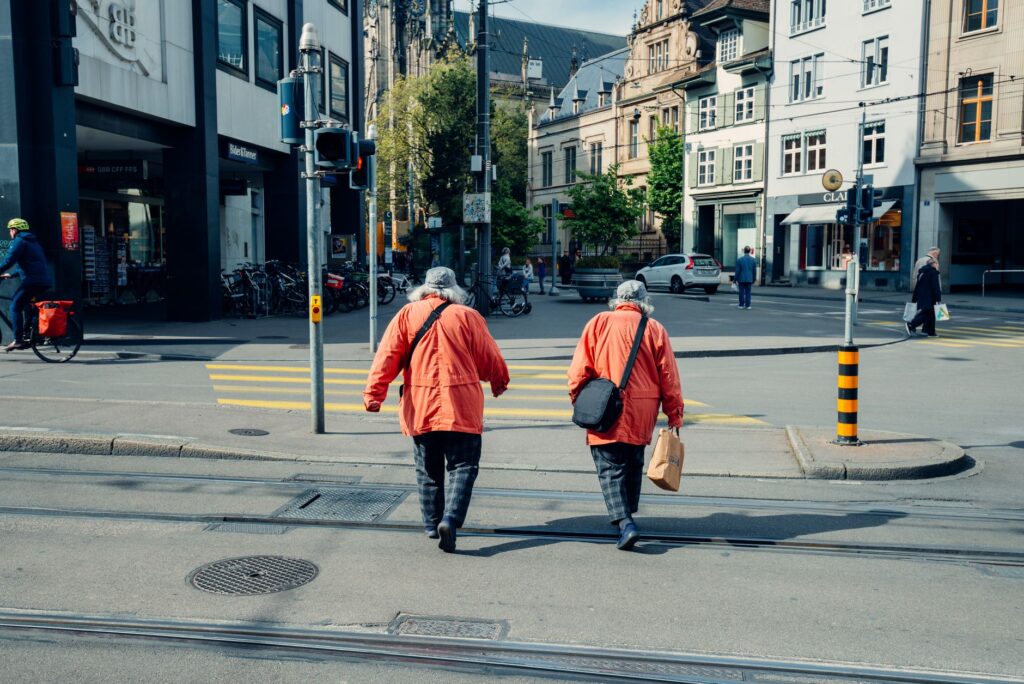
Few European cities have as close a relationship with the tram as Basel. The network is not just transport: it is a way of orienting yourself. The lines connect neighborhoods, stations and museums with a logic that residents internalize without thinking. For the visitor, understanding that grammar saves time and avoids the temptation to walk everything without criteria.
The tram also reveals hierarchies. Some stops function as small centers: there you find shops, cafes and the movement of a neighborhood that does not need grand avenues to exist. Watching who gets on and who gets off at each stop is a discreet way of reading the city without additional data.
Heritage that does not end at the museums
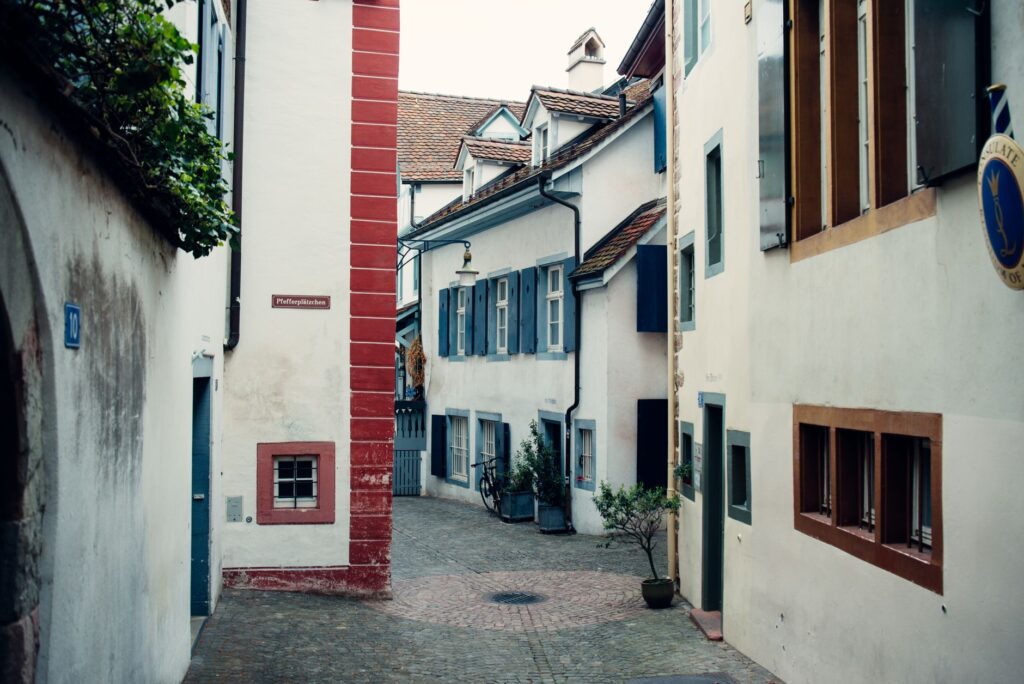
Basel is known for its museums, and rightly so. But reducing it to that would be a mistake of perspective. Urban heritage includes buildings from different periods, squares that retain their commercial function and a residential architecture that rarely appears in guidebooks. Walking without a fixed route through Grossbasel, beyond the cathedral and the market square, reveals that less-promoted layer.
The cathedral, the Münster, remains an inevitable reference. Its elevated position above the Rhine offers a view that organizes the city in the visitor’s memory. But the value lies in the descent: going down into the narrow streets and finding everyday commerce functioning as always.
The smaller bank and the life that is not displayed
Kleinbasel has a reputation as the livelier neighborhood, with a cultural and nightlife scene sustained in small spaces. It is not a destination for grand monuments, but it is a place where the city shows itself less conscious of itself. Its streets host workshops, bookshops and venues that do not depend on tourism to survive.
For the visitor, that difference matters. It allows you to understand that Basel is not a uniform stage set, but a sum of neighborhoods with different functions. Choosing where to spend time means deciding what kind of city you want to see.
Borders crossed without drama
One of Basel’s particularities is its relationship with France and Germany. The shared airport is an example of that cross-border logic. But in daily life, the border is crossed with the naturalness of someone changing neighborhoods. That condition is not a tourist claim; it is a structural reality that explains part of the commerce, culture and composition of the population.
For those visiting the city, that proximity helps explain that Basel does not end within itself. But it is worth resisting the temptation to turn it into a base for three countries. The city deserves its own time.
The market as a thermometer
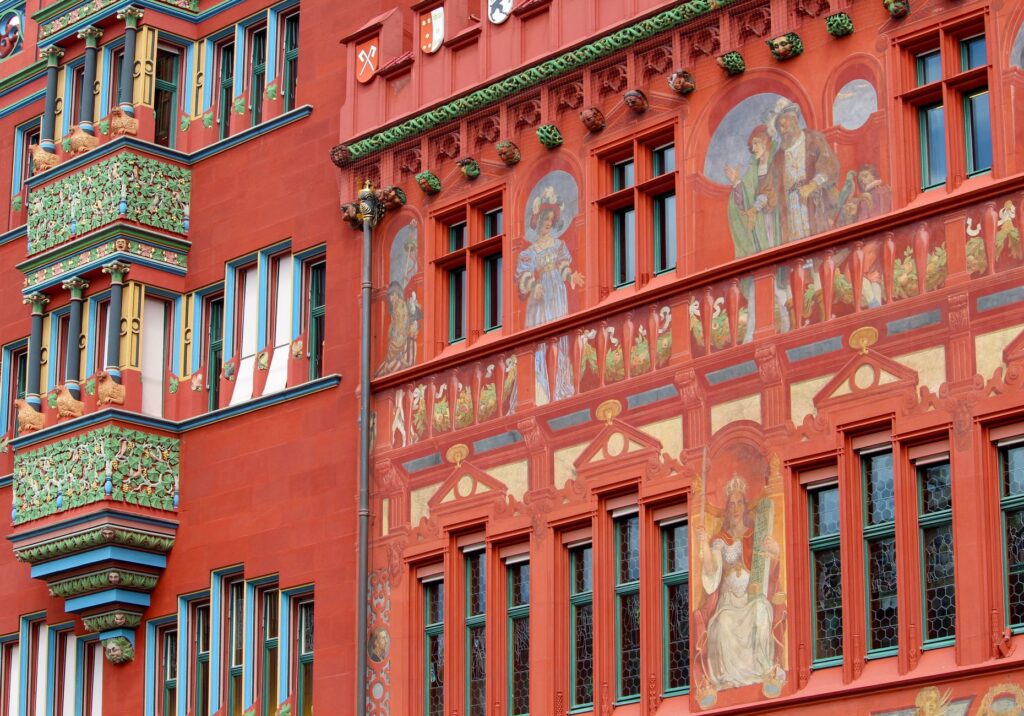
The market square, in front of the town hall, functions as a thermometer of local life. On market days, the space fills with stalls and an activity that is not designed for the visitor. It is one of those places where the city shows its most functional version and, precisely for that reason, its most interesting one.

There you understand that heritage is not always monumental. Sometimes it is the continuity of a commercial practice that has occupied the same space for centuries.
Art, industry and a dual identity
Basel has a historical relationship with the pharmaceutical industry that has marked its urban development and its cultural patronage. That connection explains the existence of world-class art collections and a program that does not depend only on tourism. The visitor who arrives looking only for the old town misses an important part of local identity.
It is not about turning the city into an industrial tour, but about recognizing that its cultural life has concrete material roots. Museums, foundations and art spaces do not float in a vacuum: they respond to a specific economic history.
What to look at and what to avoid
Basel invites you to walk, but also to stop. The temptation to accumulate visits can ruin the experience. Some practical recommendations, without claiming to be exhaustive:
- Use the tram to orient yourself, not just to move around.
- Reserve time for one bank per day, rather than crossing the river without criteria.
- Visit the market on a weekday to see the city in its everyday version.
- Choose one museum and explore it calmly rather than trying to cover several.
- Avoid comparing Basel with other Swiss cities: its logic is different.
It is also worth remembering that Switzerland has clear rules of coexistence, especially in shared spaces. Respect for silence, for schedules and for public space is part of the experience, not an accessory detail.
Practical guide
When to go: the city works all year round, but the relationship with the river changes with the season. Spring and autumn offer moderate temperatures and a constant cultural activity.
How to get around: the tram is the most efficient option for medium distances. Walking is the best way to explore the old town and the Rhine banks.
What to avoid: packing too many visits into a single day and treating residential neighborhoods as if they were attractions.
Budget: Switzerland is an expensive destination in general terms. Plan with margin and prioritize what really interests you.
Language: German is the main language, although English works well in tourist contexts. The local greeting, in dialect, is not obligatory for visitors.
A city that asks for its own rhythm
Basel does not give itself to those who rush through it. Its appeal lies in the accumulation of layers: the bridge, the tram, the market, the bank, the museum. None of those pieces explains the city on its own. Together, they form a system that the visitor can learn to read if they accept that not everything can be seen in one afternoon.
The image that remains, in the end, is not that of a specific monument, but that of a city that keeps functioning when the visitor leaves. That continuity, more than any postcard, is what makes Basel worth the time devoted to it.