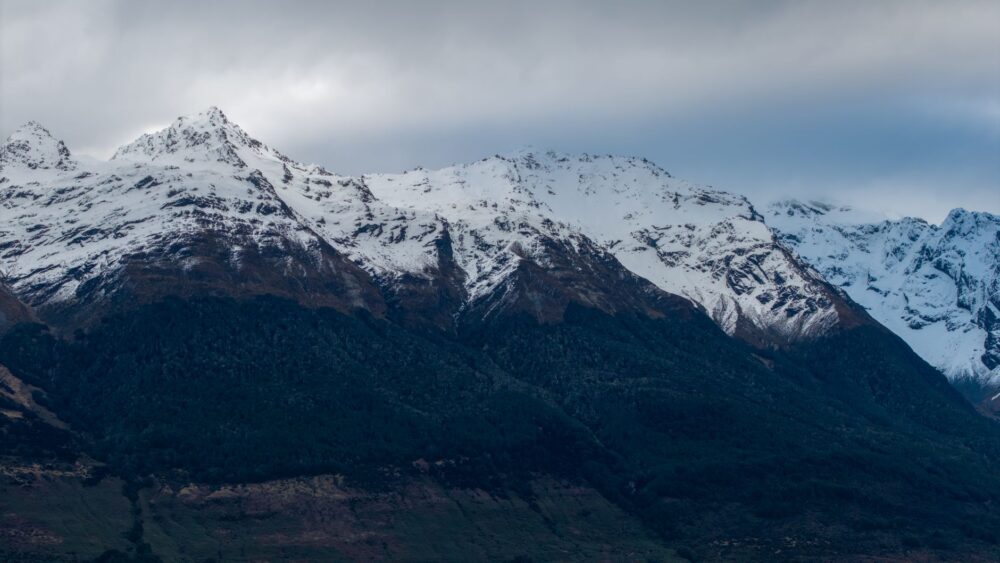

Muscat cannot be understood without its geography. Oman’s capital unfolds between the Gulf of Oman and the Al Hajar mountains, a natural amphitheatre of bare rock that embraces low, white neighbourhoods. Here the landscape is not a backdrop: it is an actor that imposes schedules, orients houses towards the sea and decides where the city can grow. Unlike other Gulf capitals, Muscat has chosen horizontality and light colours, a decision that dialogues with the desert and the extreme heat.
The result is a city of six wilayats — Muttrah, Ruwi, Bawshar, Seeb, Al Amerat and Muscat proper — that function as parts of a single mechanism. Each has its own character, yet all share the same logic: adapting to the terrain and the climate. Walking through them is to understand how a society builds its daily life from what the land offers.
A capital read from the water
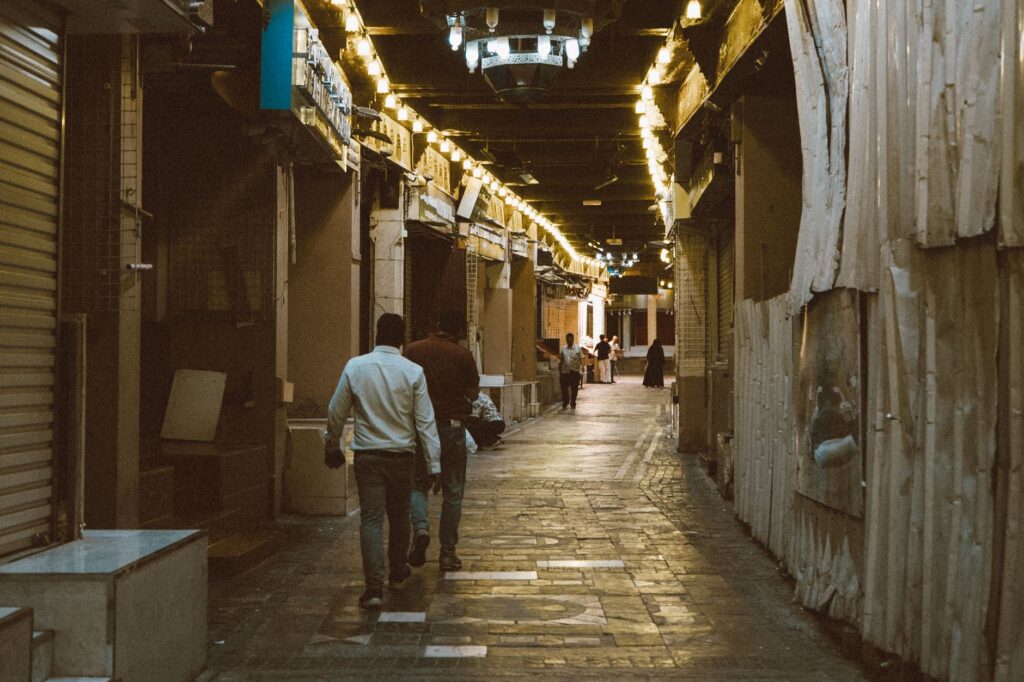
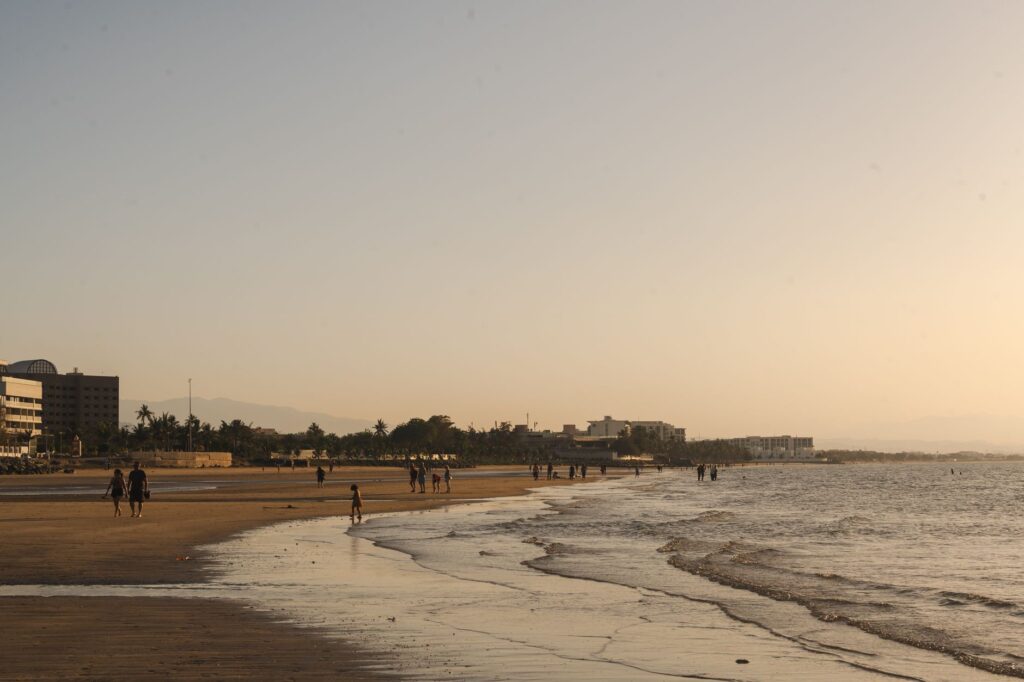
Muttrah’s port was for centuries the gateway to Oman. Today its two-kilometre corniche remains the place where the city faces the gulf. Fishermen unload in the morning; incense and spice sellers occupy the covered souq; residents stroll at sunset, when the temperature drops and the light turns golden. The water is not an ornament: it sets the pace of the day.
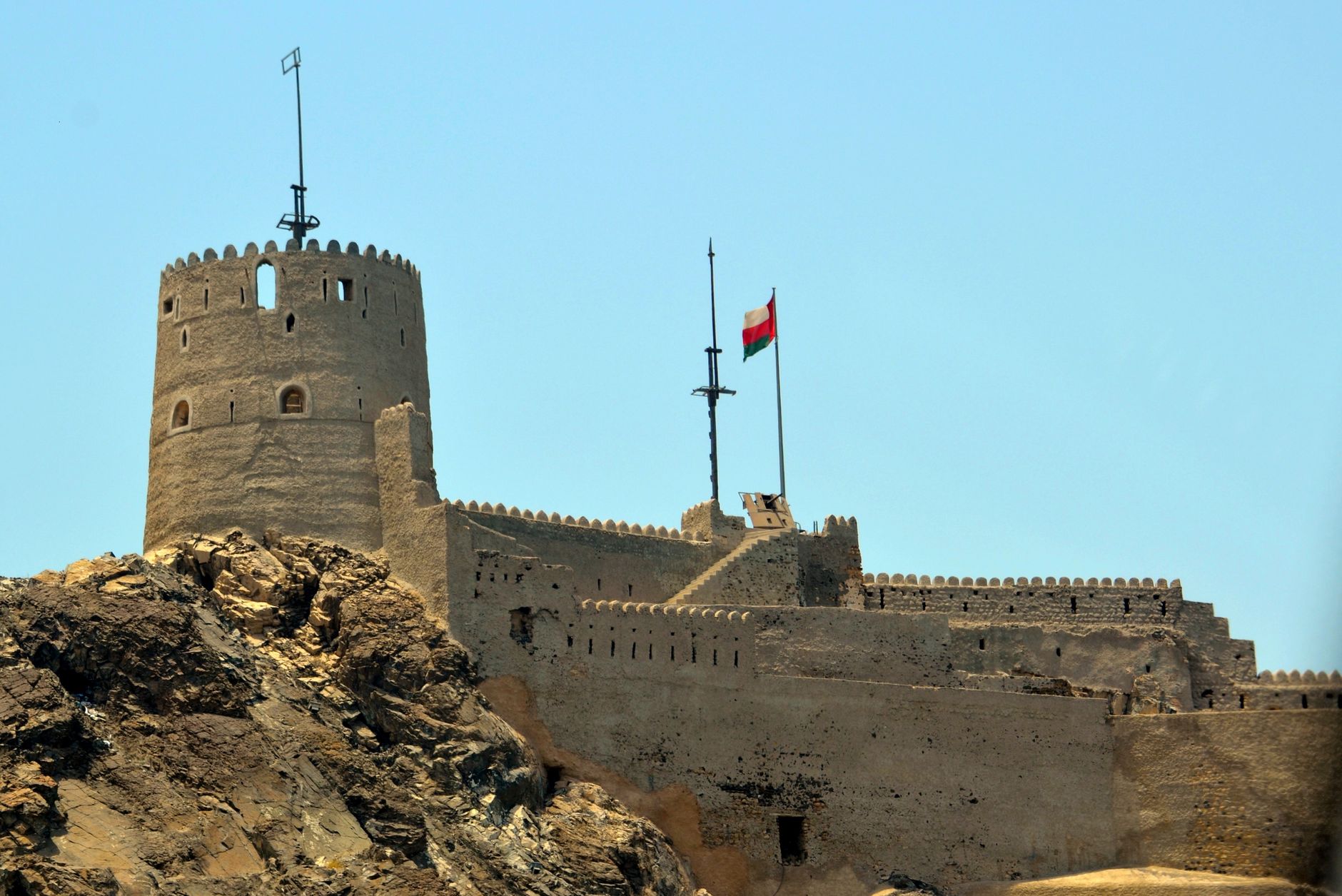
Next to the port, Muttrah Fort watches over the cove from a hill. Built by the Portuguese in the 16th century and reinforced by the Omanis, it is an example of military architecture now viewed from the outside, without needing to enter. Its presence recalls that Muscat was for a long time a contested enclave due to its strategic position on the route to India.
The sea does not only define Muscat’s landscape; it also defines how its inhabitants organise their time.
The mosque that orders the modern city
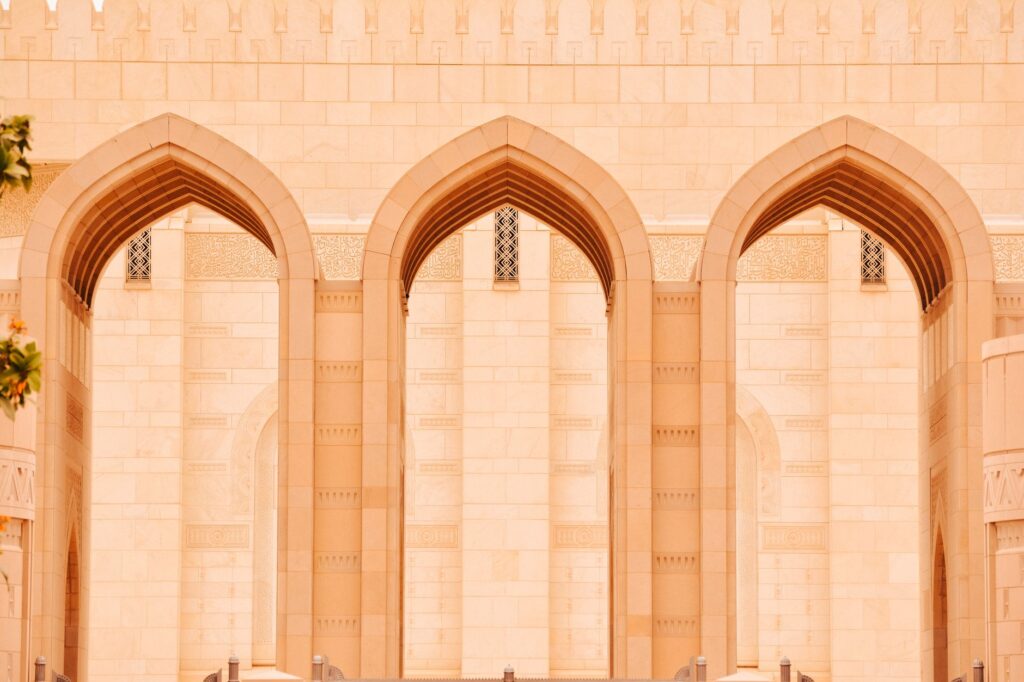
The Sultan Qaboos Grand Mosque, inaugurated in 2001, is the capital’s most recognisable building. Its central dome, main prayer hall and marble courtyard make it an architectural and spiritual landmark. It is not an isolated monument: residential neighbourhoods and avenues have grown around it, structuring life in the western sector of the city.
The mosque can be visited at set times by non-Muslims, always with appropriate dress. It is one of the few spaces where the city clearly shows its communal dimension: thousands of worshippers attend daily prayers, and the building becomes a point of reference for navigating an extensive, low-density city.
Ruwi and everyday Muscat
If Muttrah is the historic face, Ruwi is the commercial and administrative centre. Banks, offices, shops and a mix of Omani and expatriate residents reflect the diversity of the country’s workforce. It is not a monumental neighbourhood, but it is one of the most useful for understanding how the city works from within.
Ruwi lacks major tourist attractions, and precisely for that reason it allows daily life to be observed without filters: cafés where workers gather, small fabric and electronics shops, and a constant flow of vehicles. The architecture is functional, low blocks in neutral colours, adapted to the heat. Walking its streets at midday is a lesson in how the climate conditions movement: activity concentrates at dawn and dusk.
The opera and the new cultural face
The Royal Opera House Muscat, opened in 2011, is one of the sultanate’s main cultural centres. Its building, with Omani inspiration and contemporary lines, hosts seasons of opera, concerts and dance performances. It is located in the Shati Al Qurm district, an area of wide avenues and gardens that has become the capital’s modern showcase.
Around the opera, galleries, cafés and public spaces have emerged that attract an urban, cosmopolitan audience. This is not an isolated phenomenon: it is part of a broader strategy to diversify the economy and project an image of Oman as a cultural destination. For the visitor, it is an opportunity to see how tradition and modernity coexist in the same space.
The National Museum and the country’s memory
The National Museum of Oman, opened in 2016, occupies a building next to the Al Alam Palace, in the old part of Muscat. Its fourteen galleries trace the country’s history from the earliest settlements to the contemporary era, with archaeological pieces, manuscripts and ethnographic objects. It is an essential visit to understand Omani identity before exploring the rest of the city.
The museum is well organised and offers signage in Arabic and English. Its location, near the wall and the palace, allows the visit to be combined with a walk through the historic centre, where traditional houses and narrow alleys are still preserved. It is one of the few places where old and modern Muscat touch.
Bawshar and the expansion inland
Bawshar is one of the most populated wilayats of the capital and an example of how Muscat has grown inland, away from the sea. Here are the Mall of Oman, the largest in the country, and major avenues connecting the city with the airport and the roads to the south. It is an area of services, offices and new housing, where the urban landscape becomes more uniform.
However, Bawshar also preserves archaeological remains, such as the Al Khoud site, recalling that this area was inhabited thousands of years ago. The coexistence of shopping centres and ancient vestiges is a constant in Muscat: the city grows without completely erasing its past.
The role of the mountains in daily life
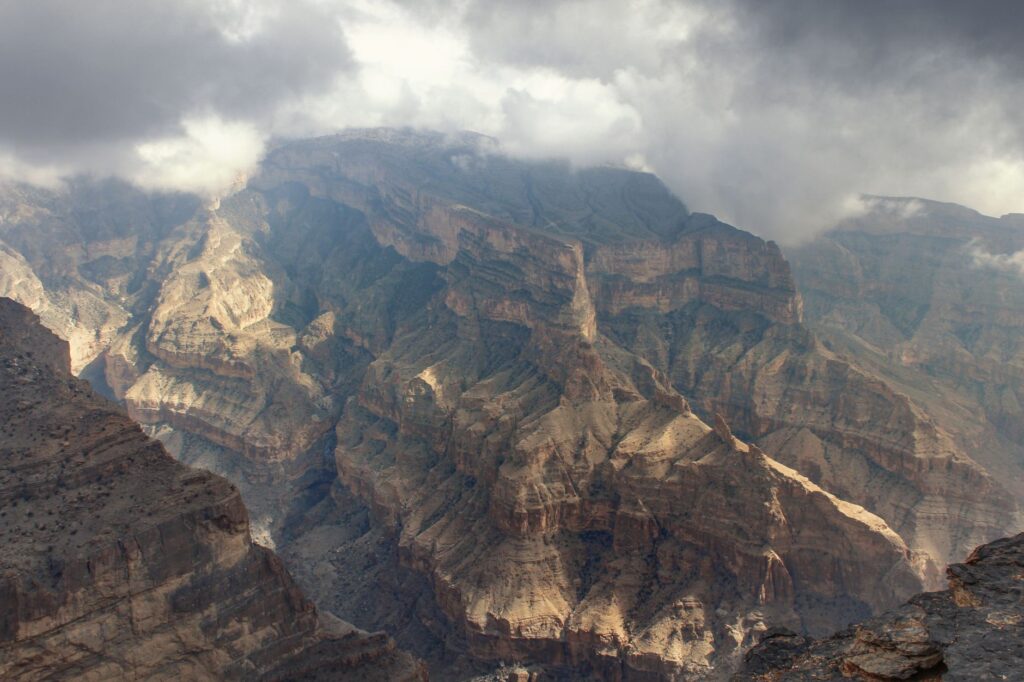
The Al Hajar range surrounds the capital and conditions its development. Neighbourhoods adapt to valleys and slopes, and roads wind between rocks. In summer, temperatures can exceed 40 degrees, and mid-altitude areas offer relief. At weekends, many Omani families head to mountain villages, such as Wakan or the surroundings of Nizwa, to escape the heat.
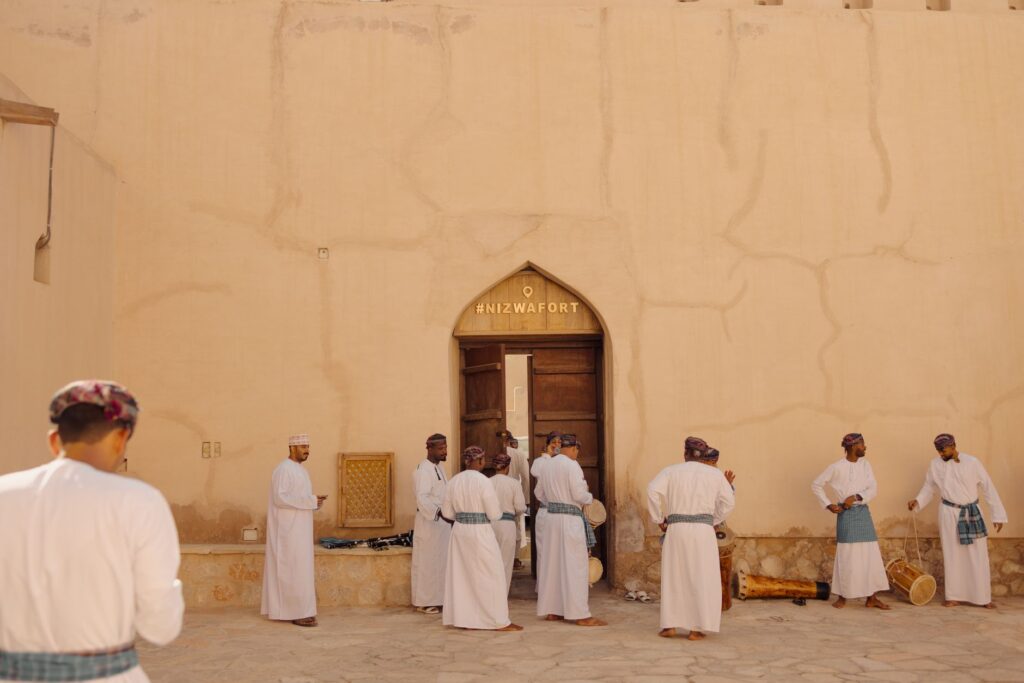
This relationship with the mountains explains why Muscat is not a compact city but a sum of nuclei separated by geographical features. The result is an extensive capital, requiring a car or taxi to get around, yet retaining a human scale in each neighbourhood.
Light as a building material
Muscat’s architecture is designed for light and heat. Facades are light-coloured, buildings low, windows small and inner courtyards frequent. Local materials such as stone and gypsum are combined with modern insulation techniques. The result is a city that, seen from the air, seems to blend into the desert.
This colour palette is not only aesthetic: it responds to a climatic need. Light colours reflect solar radiation and reduce interior temperature. The narrow alleys of Muttrah and the adobe houses of nearby villages follow the same principle. It is a lesson in bioclimatic architecture that has been practised in Oman for centuries.
Gastronomy and social life
Omani cuisine reflects the country’s position as a crossroads of trade routes. Rice with lamb, grilled fish, dates and cardamom coffee are part of daily life. In Muscat, popular restaurants serve dishes such as shuwa, marinated meat cooked slowly, or majboos, spiced rice with chicken or fish.
Hospitality is a core value. Offering coffee and dates to a visitor is a widespread custom, both in private homes and shops. Markets, such as the Muttrah souq, remain meeting spaces where incense, halwa and handicrafts are bought. Food is not just sustenance: it is a way of maintaining social ties.
Practical guide
To visit Muscat, it is advisable to plan movements in advance. The city is extensive and public transport is limited; taxis and rental cars are the most practical options. Muscat International Airport is well connected to Europe, Asia and the Middle East.
- Best time: November to March, when temperatures are milder.
- Dress: modest clothing, especially in mosques and public buildings. Women should cover their hair in the Grand Mosque.
- Hours: many shops close at midday and reopen in the afternoon. Fridays are the weekly day of rest.
- Currency: Omani rial. Cash is recommended for markets and small shops.
- Language: Arabic, though English is spoken in hotels and tourist areas.
- Respect: avoid photographing people without permission, especially women. Alcohol is not permitted in public spaces.
A visit to the Grand Mosque, the National Museum and the Muttrah souq can be done in a day, but time should be reserved to stroll without haste along the corniche and observe how the city adapts to the rhythm of the sun and the sea.
Muscat is not explored with a list of monuments, but with a willingness to understand how the landscape dictates the lives of those who inhabit it.