Helsinki does not keep design behind museum glass. In Finland, the capital has turned architecture and everyday objects into a language you can explore on foot, by tram or by ferry. From stone benches emerging between rocks to the lamps in a public library, every detail responds to an idea of shared wellbeing. This report proposes a reading of the city through its everyday design, with particular attention to accessibility and trip preparation.
The first-time visitor to Helsinki discovers that functionality does not clash with beauty. On the contrary: beauty arises from precision. Here design is inherited, debated in squares and used without ceremony. The question guiding this journey is simple: how do you inhabit a city that has made the everyday its greatest architectural work?
An urban landscape carved by stone and water
Helsinki sits on a granite peninsula, surrounded by an archipelago of more than three hundred islands. That geography has shaped its urban planning: streets adapt to the terrain, parks are integrated into housing blocks and the sea appears unexpectedly at the end of an avenue. The result is a city on a human scale where nature is not a backdrop but another building material.

Visitors can start in the Katajanokka district, a harbour neighbourhood where red brick and copper roofs coexist with renovated warehouses. There you can see one of the hallmarks of Finnish architecture: attention to climate. Buildings are oriented to capture winter light, arcades protect from snow and windows, often generous, seek the low sun. Walking its streets is to understand that Nordic design is not a trend but a response to months of darkness and cold.
Art Nouveau in stone and iron: the legacy of a young capital
In the late 19th and early 20th centuries, Helsinki experienced a construction boom that left one of the most remarkable Art Nouveau ensembles in Northern Europe. Unlike other cities, here the national romantic style blended with local tradition and gave rise to buildings with carved facades, corner towers and nature-inspired motifs. The Kruununhaka and Eiranranta areas preserve excellent examples.
This is not an open-air museum but living architecture: many of these buildings are still lived and worked in. Visitors can wander without haste, observing wooden doorways, bronze handles and marble staircases. It is a lesson in how a city can preserve its heritage without turning it into a theme park.
Finnish design does not seek applause: it seeks to make daily life a little easier, brighter and fairer.
Alvar Aalto and the humanisation of functionalism
The figure of Alvar Aalto hovers over all 20th-century Finnish architecture. In Helsinki you can visit some of his most representative works, such as Finlandia Hall, a congress and concert building where curved wood and natural light create a warm atmosphere. Aalto argued that architecture should serve people, not an abstract ideal, and that maxim translates into details such as door handles designed to fit the hand.

His influence extends to street furniture. The laminated wood benches, the simply lined streetlamps and the covered tram stops are direct heirs of that school. In Helsinki, design is not exhibited: it is used. And that constant use keeps it alive.
The library as the city’s living room
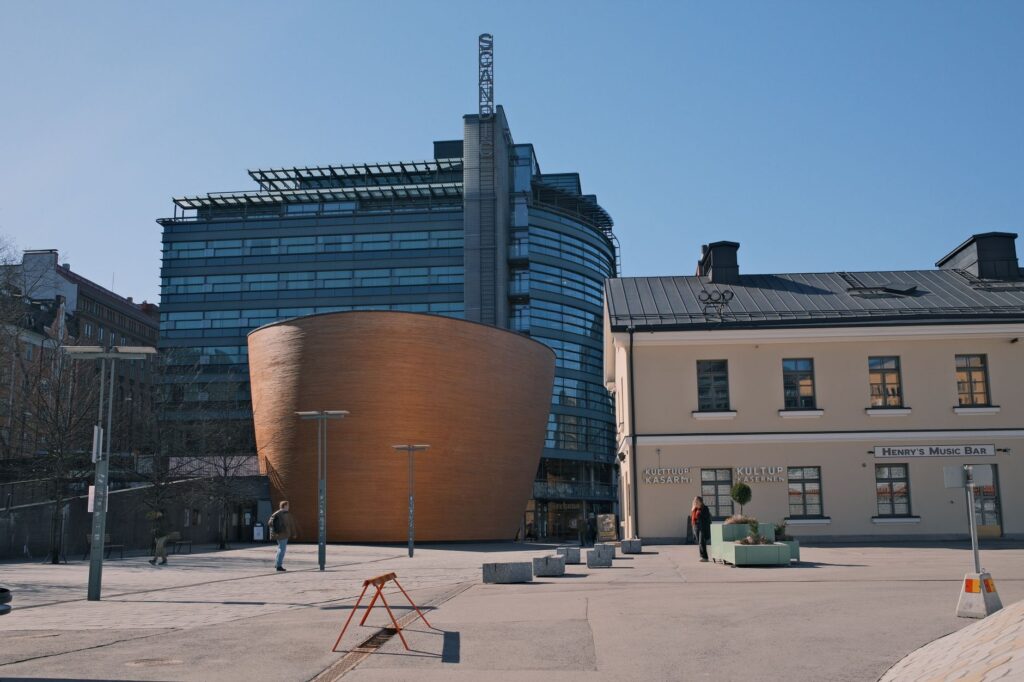
The Central Library Oodi, opened in 2018, is probably the most visited building in the capital. It is not just a book repository: it is a public space where residents can sew, 3D print, study, play or simply rest. Its spruce facade and large windows make it a symbol of the Finnish welfare society.
Visitors understand that accessibility is a priority here. There are ramps, spacious lifts, adapted toilets and clear signage. The library itself is a lesson in inclusive design. And its south-facing terrace offers a privileged view of Parliament and Kansalaistori square.
The tram as a moving gallery
Helsinki’s tram network is one of the oldest in Europe and remains the preferred means of transport for many residents. Its carriages, some of recent design, incorporate low floors, spaces for wheelchairs and prams, and visual and audio information systems. But the tram is also a way to explore the city without missing a detail: lines 2 and 4 cross historic and modern neighbourhoods, allowing you to see the evolution of urban design from the window.
Boarding a tram in Helsinki is also an aesthetic experience. The seats, handrails and even the ticket validators have been carefully designed by local designers. Functionality becomes identity.
Street furniture: benches, lamps and shelters
Helsinki’s street furniture deserves special attention. The stone and wood benches that appear in parks and squares are not isolated elements but parts of a coherent system. The streetlamps, sober in design, avoid light pollution and create a warm glow on winter nights. Bus stop shelters, with glass and wood panels, protect from the wind without obstructing the view.

This attention to detail extends to traffic signs, postboxes and litter bins. Everything seems designed to last and to make life easier. It is a lesson in sustainability: fewer objects, but better ones.
Accessibility and trip preparation
Helsinki is a relatively accessible city for people with reduced mobility. Most trams and buses have low floors, and pavements have curb cuts at crossings. However, the terrain is uneven in some areas, and ice and snow can hinder movement in winter. It is advisable to check the public transport website (HSL) to plan accessible routes and verify the status of lifts in metro stations.
To prepare for the trip, wear comfortable shoes and warm clothing in any season, as the weather can change quickly. Many museums and public buildings offer free entry or discounts, and most cultural spaces are accessible. The Oodi Library, for example, lends wheelchairs and other technical aids.
Practical guide
Before travelling, it is useful to download the Helsinki public transport app, which allows you to buy tickets and check routes in real time. Tickets can also be purchased from vending machines and some shops. To get around the centre, the tram is the most comfortable and scenic option. The network covers the main points of interest, from Kauppatori Market to Esplanadi Park.

- Best time: summer offers long days and mild temperatures, ideal for walking. Winter, though cold, allows you to enjoy the architecture with fewer tourists and the Christmas lighting.
- Accommodation: there are design hotels in the centre and also more affordable options in neighbourhoods such as Kallio, well connected by tram.
- Food: local markets, such as Hakaniemi, offer fresh produce and traditional dishes at reasonable prices.
- Accessibility: check the city’s accessibility maps and verify lift schedules in the metro.
An evening stroll: design and light in the archipelago
To close the route, nothing better than taking a ferry from Kauppatori Market to the island of Suomenlinna, a UNESCO World Heritage Site. The crossing, about fifteen minutes, offers a unique perspective of the city and its archipelago. On the island, historic fortifications coexist with artisan workshops and cafés. It is a place to walk without haste and watch how the northern light turns the sea and stone silver.
On returning, the visitor understands that Helsinki is not a city to be visited with a list of monuments but with an attitude: that of someone who observes the details and appreciates that someone thought of them. That is, perhaps, the greatest legacy of Finnish design.