
In southwest England, the city of Bath rises from a valley surrounded by hills, in the county of Somerset. Its name recalls the Roman baths whose hot water still flows today, and its urban layout preserves the mark of two eras that transformed its appearance entirely: the Roman and the Georgian. To walk through Bath is to travel through a city that made water its reason for being and that, centuries later, turned that reason into architecture, sociability and landscape. UNESCO inscribed it on the World Heritage List in 1987 for its outstanding cultural values, including the Roman remains, the Neoclassical Palladian ensemble and the harmonious integration of city and natural setting.
This feature proposes an experiential, wellbeing-oriented visit, without attributing therapeutic properties to the water or promising health outcomes. The aim is to understand what it means to inhabit a thermal city, how to prepare an accessible route and what can be observed calmly in a place where heritage is not kept behind glass but lives in the streets, the squares and the spring that still rises underground.
A city built around a spring
Bath’s origins are tied to its natural hot springs. The Romans founded a settlement there, Aquae Sulis, in the 1st century AD, and used the warm waters as a thermal complex. That early core grew around the spring and marked the beginning of the city’s history as a bathing destination. Today, the Roman complex and the Temple of Sulis Minerva rank among the most important Roman remains north of the Alps, and their presence still organises the city centre.
In the Middle Ages, Bath became a significant centre of the wool industry. But it was in the 18th century, under the reigns of George I, II and III, that the city acquired the appearance we recognise today: an elegant town of Neoclassical buildings inspired by Palladio, designed for the enjoyment of those who came to take the waters. The Georgian city reflects the ambition of figures such as the architect John Wood the Elder, the entrepreneur and quarry owner Ralph Allen and the Master of Ceremonies Richard ‘Beau’ Nash, who sought to make Bath one of the most beautiful cities in Europe.
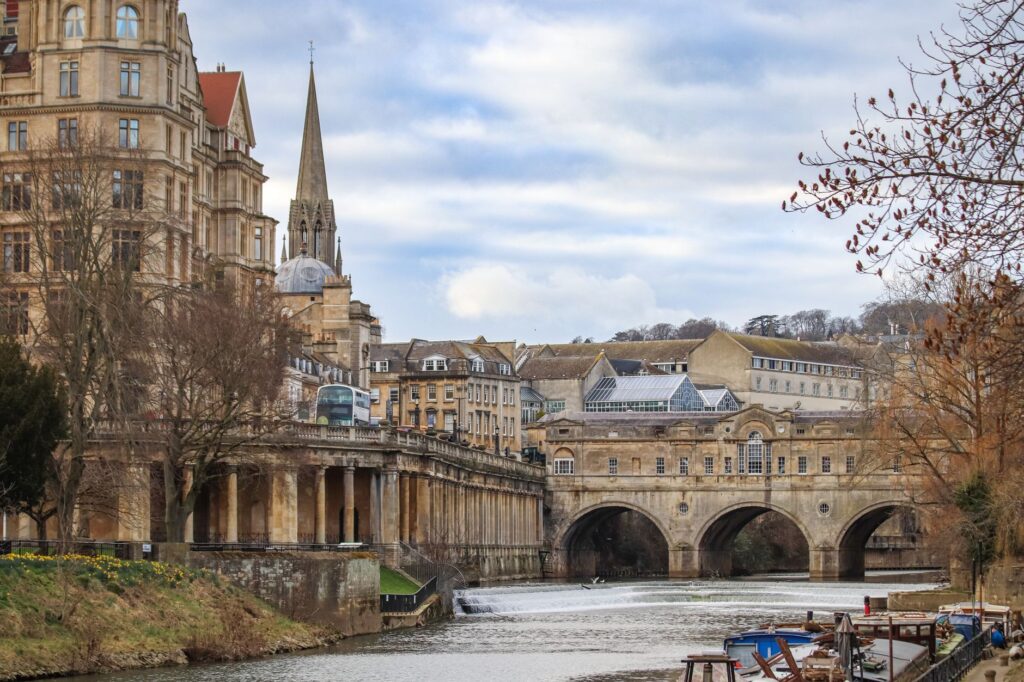
Bath’s heritage is not contemplated from a distance: it is walked, inhabited and crossed daily by the ordinary life of its residents.
The Roman baths: the heart of the visit
The Great Bath, fed by the thermal spring, is the natural starting point of any visit. Around it, remains of the temple, archaeological pieces and spaces that explain how a Roman thermal complex worked are preserved. The visit takes place in a museum environment that protects and displays the finds and allows visitors to appreciate the original use of the waters. This is not a contemporary spa but a visitable archaeological site that explains a social and religious practice from two thousand years ago.
Beside the baths, Bath Abbey rises in the heart of the city, a testimony to the historical continuity of the site over the centuries. The coexistence of the Roman temple, the medieval church and the Georgian city sums up Bath’s stratification and helps explain why its urban ensemble was recognised as world heritage.
The Georgian city: limestone and proportion
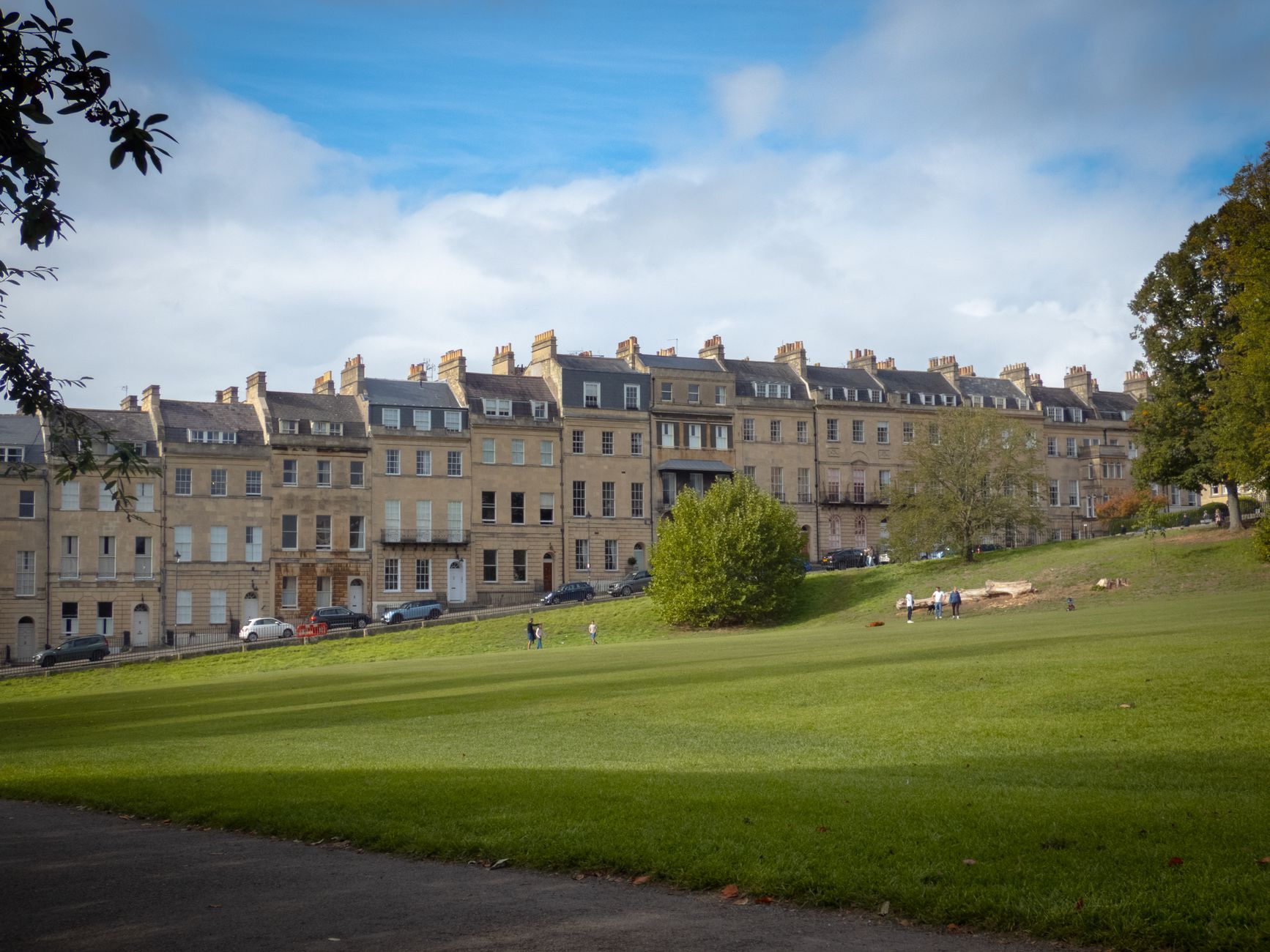
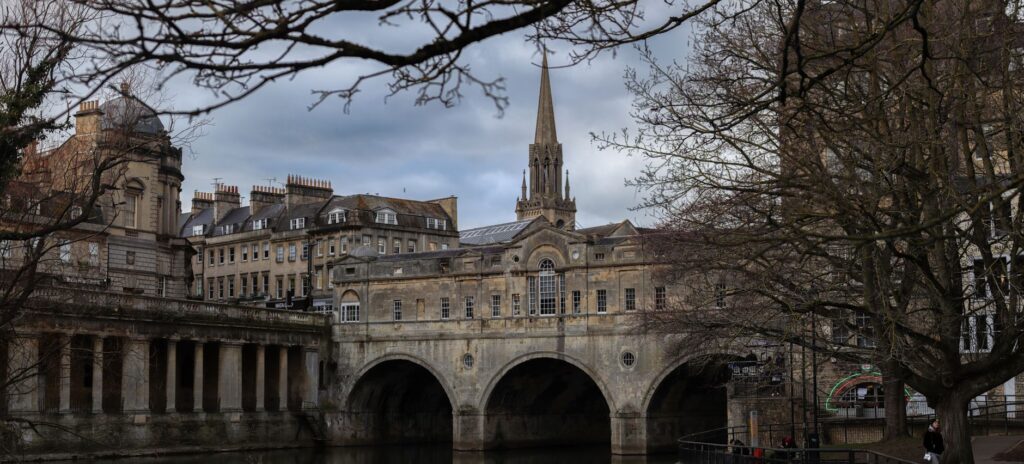
The Neoclassical Palladian style is expressed in public buildings such as the Assembly Rooms and the Pump Room, and in monumental ensembles such as Queen Square, the Circus and the Royal Crescent. These spaces are not isolated pieces: they form part of an urban landscape that developed over a century in a harmonious and logical way, integrating public and private buildings, squares, terraces and views towards the green hills surrounding the city.
The local oolitic limestone, quarried in the area, gives Bath its warm tone and visual homogeneity. That uniformity was not accidental: it responded to a deliberate intention to create a beautiful city, in which architecture, urban design and landscape were conceived together. The Royal Crescent and Lansdown Crescent are perhaps the clearest examples of that idea of planting buildings in the landscape to achieve picturesque views, an approach that anticipates the garden city planning of the 19th century.
Wellbeing without promises: what visiting a thermal city means
Speaking of wellbeing in Bath requires precision. The thermal water is the historical origin of the city and the axis of its heritage, but an editorial feature should not attribute curative properties to it or present it as a treatment. What travellers can experience is a context: the pause, contemplation, a slow walk through pedestrian streets, the chance to understand how a society organised its social life around water.
That approach turns the visit into a cultural and restful experience, not a medical consultation. The Pump Room, the assembly rooms and the Georgian public spaces recall that Bath was, above all, a place of sociability: a setting where bathing, conversation, music and strolling came together. Exploring it with that perspective allows visitors to enjoy the heritage without demanding functions it does not have.
To understand Bath as thermal heritage is to understand a way of inhabiting water that belongs to history, not to commercial promise.
Accessibility and preparing the route
Bath is a relatively compact and very walkable city, but its terrain includes slopes and cobbled streets that should be taken into account. The historic centre, the Roman baths, the abbey and the main Georgian ensembles are short distances apart, which makes it easy to organise the visit by areas and with breaks. For those with reduced mobility, it is advisable to check the specific access arrangements of each space in advance, as some historic buildings have stairs and thresholds.

Planning also matters when it comes to weather: rain is frequent in southwest England, so appropriate footwear and waterproof clothing are recommended. Booking visits to the busiest spaces in advance helps avoid queues and allows time to be distributed calmly. The city has public transport and railway stations connecting it with other British locations, making it easy to organise arrival and departure without depending on a car.
Beyond the centre: hills, gardens and views
Bath’s landscape value is not limited to its urban core. The hills surrounding it are part of the relationship between city and nature that justified its inscription as world heritage. Climbing to one of the nearby viewpoints reveals the layout of the valley, the geometry of the crescents and the way limestone dialogues with the green surroundings. That view helps read the city as a whole, not as a sum of monuments.
The nearby gardens and walks offer quiet alternatives for resting between visits. Bath’s scale invites exploration without haste, alternating indoor and outdoor spaces and reserving time to sit, observe and let the city’s rhythm set the pace. That slowness is, in a way, the best way to approach a city designed for leisurely enjoyment.
Food and everyday life
Bath’s food offering suits a full-day visit well. Cafés, bakeries and pubs in the centre allow breaks without straying far from the points of interest, and local markets provide a view of everyday life that complements the heritage visit. Trying regional products and sitting at a terrace is part of the experience of a city that, since the 18th century, understood the importance of meeting places.
Beyond the tourist circuit, residential neighbourhoods and secondary streets show an inhabited Bath, where heritage coexists with daily life. Walking without a fixed goal, letting the facades and courtyards guide you, reveals details that guided tours often overlook.
Practical guide
When organising the visit, some general criteria help make the most of the time and move comfortably around the city.
- Best time to walk: early morning and late afternoon offer soft light and fewer visitors at the main sites.
- Footwear: comfortable and with good grip, due to the slopes and uneven pavements of the historic centre.
- Clothing: layers and rain protection, as the climate of southwest Britain is changeable.
- Bookings: check opening times and availability of heritage spaces before travelling, especially in high season.
- Accessibility: find out in advance about access and adapted routes in each historic building.
- Getting around: the centre is walkable; for longer distances, public transport and the railway make travel easier.
- Pace: allow time for breaks and observation, as Bath’s scale rewards a leisurely visit.
A closing moment by the water
At the end of the route, returning to the square where the spring is located closes the circle. There where the Romans built their baths and where, centuries later, the Georgian city raised its rooms and promenades, the water still rises. There is no need to attribute powers to it: it is enough to recognise that it has been the thread running through an urban history of two thousand years. Bath cannot be understood without that water, but it is not reduced to it either. It is a city that learned to turn a natural resource into culture, architecture and a serene way of being in the world. To explore it attentively, without haste and with respect for its heritage, is the best way to take something lasting home.