
Beneath the imposing structure of iron, glass, and ceramics crowning Valencia’s Market Square, the morning begins not with a roar, but with the measured rhythm of knives sharpening against whetstones and the rustle of wooden crates holding the day’s harvest. Valencia’s Central Market is far more than an urban provisioning hub; it is the secular cathedral where the uninterrupted marriage between the coastal marshlands, the dry interior, and the depths of the Gulf of Valencia is officiated. Here, every stall operates as a chapel dedicated to a precise ingredient, tended by butchers, fishmongers, and greengrocers who inherited their trade as an act of cultural resistance against the homogenization of supermarket aisles.
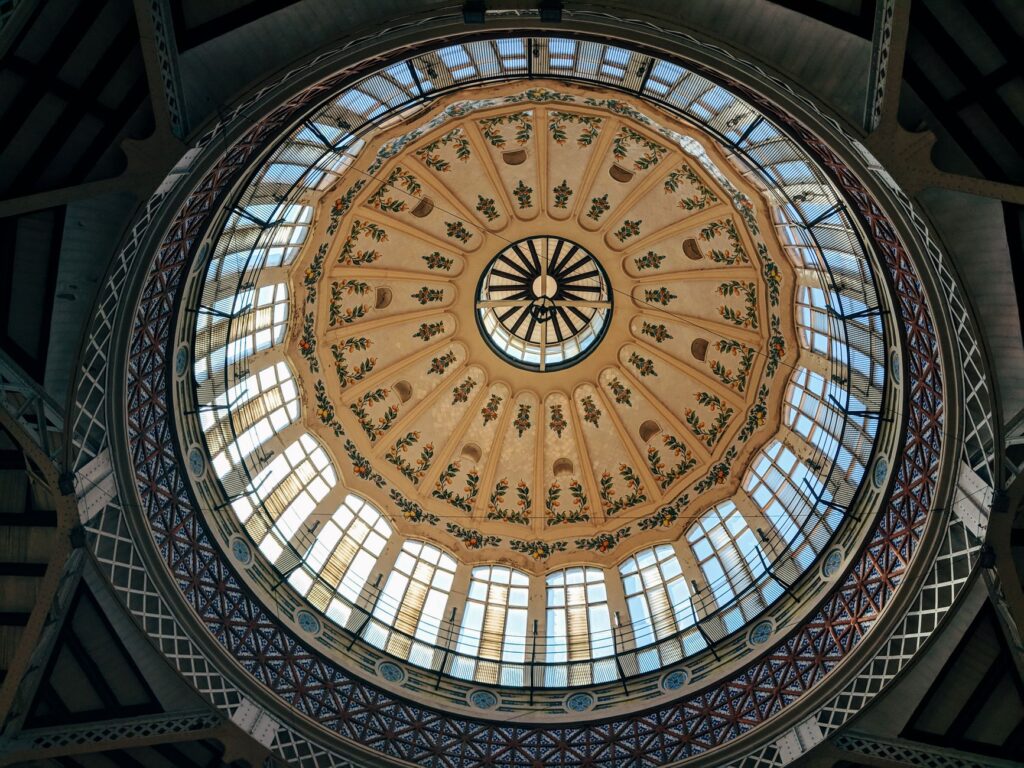
Crossing the modernist threshold, the zenithal light filtered through the stained-glass domes bathes the stalls of the fish market, where freshly auctioned specimens from the ports of El Cabanyal and El Grao display an iridescent sheen that defies time. This report ventures into the bowels of this architectural colossus to trace the ingredient back to its geographical origin, ascending the historic irrigation canals that water the Huerta of Valencia. Through this journey, we will explore how the market’s daily liturgy defines the culinary identity of a city that has made rice, tiger nuts, and market-garden produce its greatest declaration of principles.
The Cathedral of Produce: Architecture and Morning Pulse
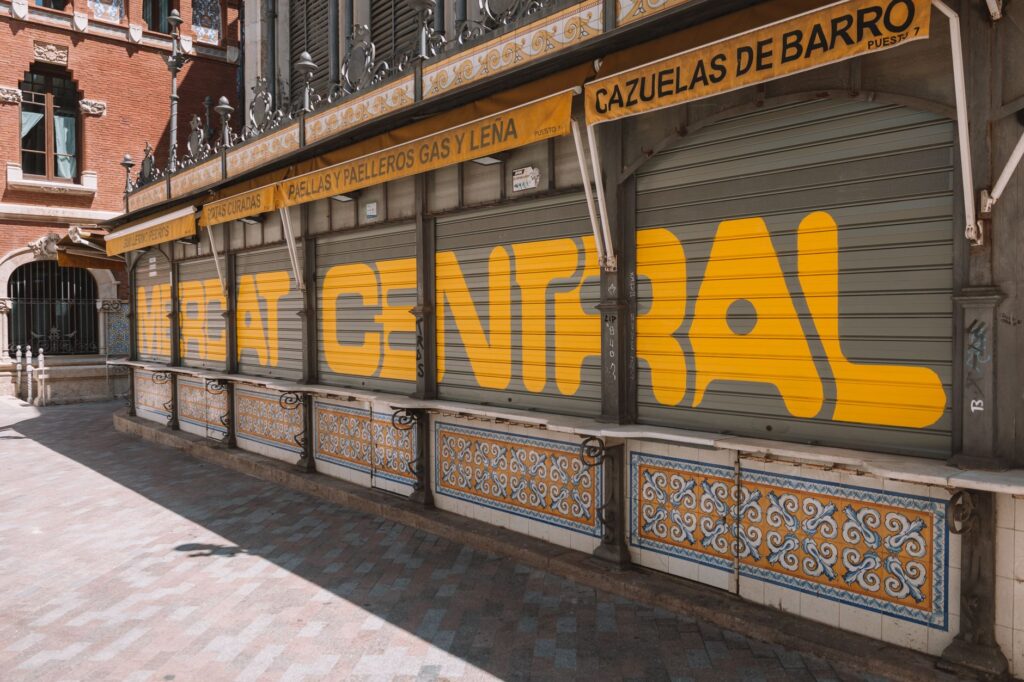
Inaugurated in 1928 after a protracted design and construction process led by architects Alejandro Soler March and Francisco Guardia Vial, the Central Market brought a hygienic and urban revolution to Valencia at the dawn of the 20th century. The building replaced an open-air market and gathered beneath a single monumental roof the needs of thousands of residents hungry for modernity. The structural audacity of the forged iron eliminated intermediate columns, creating an open floor plan where the gaze can roam freely from the main entrance to the colorful tile murals decorating the rear gables.
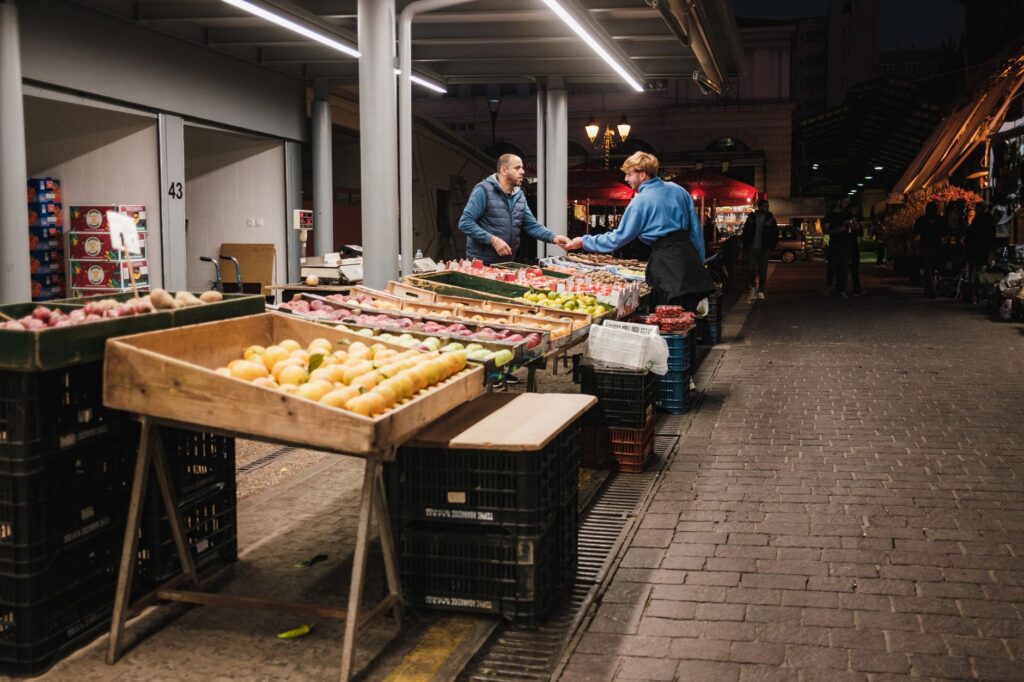
At early dawn, the air is impregnated with the sharp scent of marine iodine and the earthy sweetness of freshly picked oranges. Vendors arrange their goods with an almost choreographic precision. In the fruit and vegetable sector, Benicarló artichokes, Platja tomatoes, and Huerta onions are stacked into still lifes worthy of the Flemish school. «We don’t just sell food here; we sell the landscape of our land concentrated in a kilo of produce,» recounts Vicente Marí, whose family has spent three generations selling vegetables in the building’s central aisle.
The Veins of Water: The Millennial System of the Huerta
To understand what is displayed on the market benches, one must leave the walled enclosure and venture into the Huerta of Valencia, that green belt that struggles and endures in equal measure beneath urban pressure. This agricultural territory, crisscrossed by a network of irrigation canals inherited directly from the Andalusian era, continues to be governed by the Water Tribunal, Europe’s oldest active legal institution, recognized as Intangible Cultural Heritage by UNESCO.
Every Thursday at noon, in front of the Apostles’ Door of the Cathedral, the syndics of the Rovella, Quart, Mislata, and Tormos canals gather to judge irrigation disputes in the Valencian language, without written paper or possibility of appeal. It is this millennial, community-based management of water that allows the alluvial soils of the Valencian plain to produce vegetables of exceptional organoleptic quality. The roots of these plants drink from water regulated with near-sacred justice, explaining the tender texture and concentrated flavor of produce that hours later finds its way into home kitchens and high-end restaurants across the city.

The Kingdom of Rice: Beyond the Tourist Cliché
Although the international collective imagination reduces Valencian cuisine to Sunday paella, the market and its surroundings reveal an ecosystem of rice varieties as complex as the wine regions of Burgundy. In the specialized stalls of the Central Market, signs do not merely distinguish between round and long grain; they specify exact denominations and origins such as Albufera, Senia, and Bomba, cultivated right in the heart of the Albufera Natural Park.
The pearly-grained Senia rice absorbs broths like no other, becoming mellow and melting on the palate, while Bomba—the undisputed king of dry paella—maintains core firmness thanks to its high amylose content. Conversing with the market’s rice vendors is like attending a masterclass in culinary physics. Choosing the right grain determines the absolute success of the dish, and local customers arrive with the demanding eye of those who master a ritual passed down from parents to children. It is not about following a strict recipe, but about reading the state of the grain and adjusting the wood or gas fire with the precision of a goldsmith.
The market is the mirror where the city looks at itself every morning to remember where it comes from and what flavors it deserves to preserve.
The Route of Dryland and Forgotten Fruits
Not everything in the Valencian pantry comes from the abundant water of the marsh; the inland regions supplying the market contribute a rugged, austere, and deeply aromatic larder. In the stalls dedicated to dried fruits, Marcona and Planetaria almonds coexist with the tiger nuts of Alboraya, the tuber used to craft authentic Valencian horchata. Tiger nuts require highly specific sandy soil and relentless sun to develop their sugary and fatty properties, later transformed into a beverage with a silky texture and unique dairy profile.
Similarly, traditional charcuterie stalls offer aniseed-scented sausages, onion blood sausages, and local sobrasada crafted in the mountain villages. These slow-cured products dialogue directly with hearth bread baked from local hard-wheat flours. Gastronomic anthropologist Carmen Albors notes that «traditional Valencian cuisine is, in reality, a brilliant combination of intensive market-garden resources and the survival pantry of the mountainous drylands.»
The Fish Market: Wild Produce from the Gulf
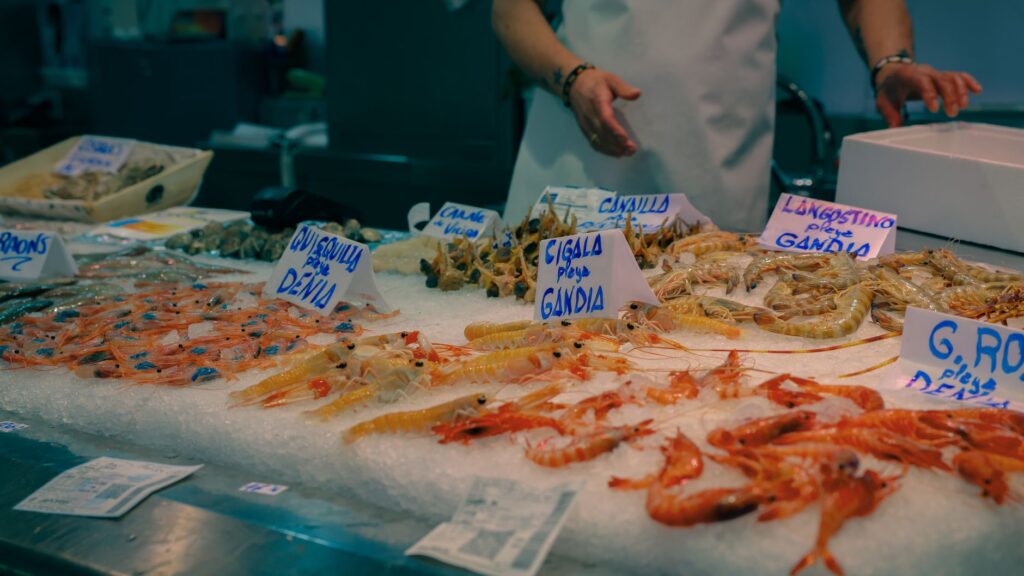
At the back of the modernist building, the fish sector impresses with its cleanliness and the volume of its specimens. Here arrive the catches of the artisanal fleet operating in the Gulf of Valencia, a fishing ground characterized by muddy seabeds and posidonia meadows that grant fish and seafood a singular finesse. Red prawns from Denia, though sourced further north, compete at the counters with mantis shrimp, Vinaròs prawns, and superb specimens of wild sea bass and seabream.
Fishmonger Jesús Martínez, with over thirty years of experience behind the counter, explains that the secret lies in immediacy: «The fish you see here at eight in the morning was swimming in the sea at three in the morning. There are no unnecessary intermediaries mistreating the product.» This hyper-brief supply chain allows Valencian households to prepare fish broths with a clarity and depth unattainable in more centralized markets.
Popular Midday Meals: The ‘Esmorzaret’ as a Social Institution
No approach to the Valencian market would be complete without mentioning the sociological phenomenon of the esmorzaret, the popular mid-morning meal that halts work activity. Surrounding the Central Market and in its adjacent bars, such as the historic Central Bar run by chef Ricard Camarena, hundreds of workers, intellectuals, and locals gather to devour colossal sandwiches accompanied by split olives, lupini beans, cremaet (coffee with burned rum, lemon peel, sugar, and coffee beans), and a cold beer.
This ritual is not a mere snack, but a space for democratic socialization where social hierarchies dissolve. A good sandwich of black-and-white sausage with broad beans, or squid with tender garlic, demands a crusty baguette and top-quality filling, closing the virtuous circle between the food market and local hospitality. The Valencian midday meal is irrefutable proof that popular gastronomy is also haute cuisine when supported by honest ingredients and respect for seasonality.
Practical guide
How to get there: The Central Market is located in the heart of Valencia’s historic center (Plaza del Mercado, s/n). It is accessible on foot from the Estació del Nord in a ten-minute walk or via metro lines 3 and 5 (Xàtiva or Colón stations).
Opening hours: The market is open Monday through Saturday, from 7:30 AM to 3:00 PM. The optimal time to visit and observe the produce in all its splendor is between 8:30 AM and 11:00 AM.
Shopping tips: Bringing reusable insulated bags is recommended if you plan to purchase fresh produce, and consulting vendors on the seasonality of each vegetable ensures the exact point of ripeness.
Recommended dining: Inside the venue itself, Central Bar is ideal for a high-quality quick lunch; in the surrounding area, restaurants in the Carmen and El Cabanyal neighborhoods offer traditional rice dishes prepared with market-fresh catch.
The true wealth of a people does not lie in what it accumulates, but in the fidelity with which it preserves the flavors that gave it origin.
As the morning progresses toward noon, the bustle of the Central Market slowly subsides, giving way to the cleaning of the stalls and the measured pulling down of metal shutters. What lingers in the air is the certainty that this food temple is not a museum fossil, but a living organism beating in unison with the territory that feeds it. Crossing the threshold back out into the bustling square, one understands that Valencia guards within these modernist corridors its best-protected secret: the flat refusal to forget the authentic taste of earth and sea.