
The alpine territory has historically represented one of the most formidable barriers to the development of communications across the European continent. Overcoming steep elevation changes without resorting to impossible gradients demanded pioneering engineering efforts in the mid-nineteenth century. The route connecting the Viennese basin with the Styria region via the Semmering pass constitutes the first high-altitude mountain railway built in Europe, a milestone that radically transformed the conception of land transport and Central European logistics.
Fully inaugurated in 1854 under the direction of visionary architect and engineer Carl Ritter von Ghega, this rail layout demonstrated that steam technology could tame alpine severity. Far from being a mere aesthetic exercise, the project responded to an imperative economic need: guaranteeing the continuous supply of coal, raw materials, and manufactured goods between the main industrial centers of the Austro-Hungarian Empire and the southern ports of the Adriatic Sea. Today, the line remains operational, integrated into the modern network of the Austrian Federal Railways (ÖBB), maintaining a delicate balance between heritage preservation and twenty-first-century logistical demands.
The Genesis of a Masterpiece in the Alps
During the early decades of railway expansion in Central Europe, engineers confronted the dogma that trains could not overcome gradients exceeding ten percent without rack-and-pinion mechanisms. Von Ghega challenged this theoretical premise through a bold design combining tight curve radii with continuous ramps adapted millimetrically to the abrupt topography of the Semmering geological fault. Every kilometer of track required bypassing deep ravines, rocky ridges, and extreme weather conditions that tested both material durability and the health of thousands of workers drawn from diverse corners of the empire.
The pioneering use of locomotives specifically designed for this layout validated a technical model subsequently replicated in mountain ranges worldwide, from the Andes to the Himalayas. The construction not only mobilized vast financial resources but also structured a new paradigm of labor management in high mountains, where coordinating supplies across isolated construction fronts anticipated modern methods of large-scale civil logistics.
Monumental Architecture in Stone and Iron
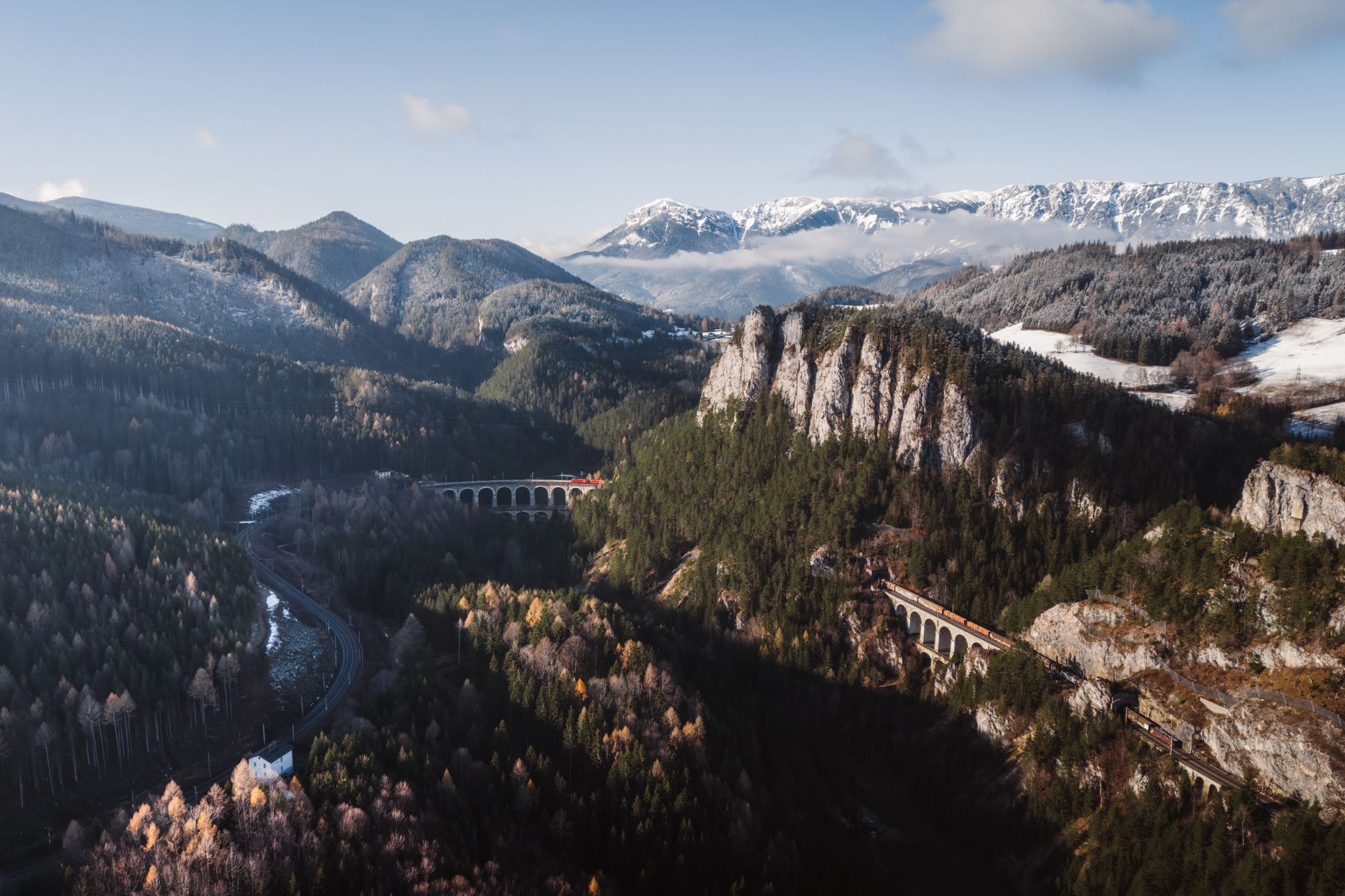
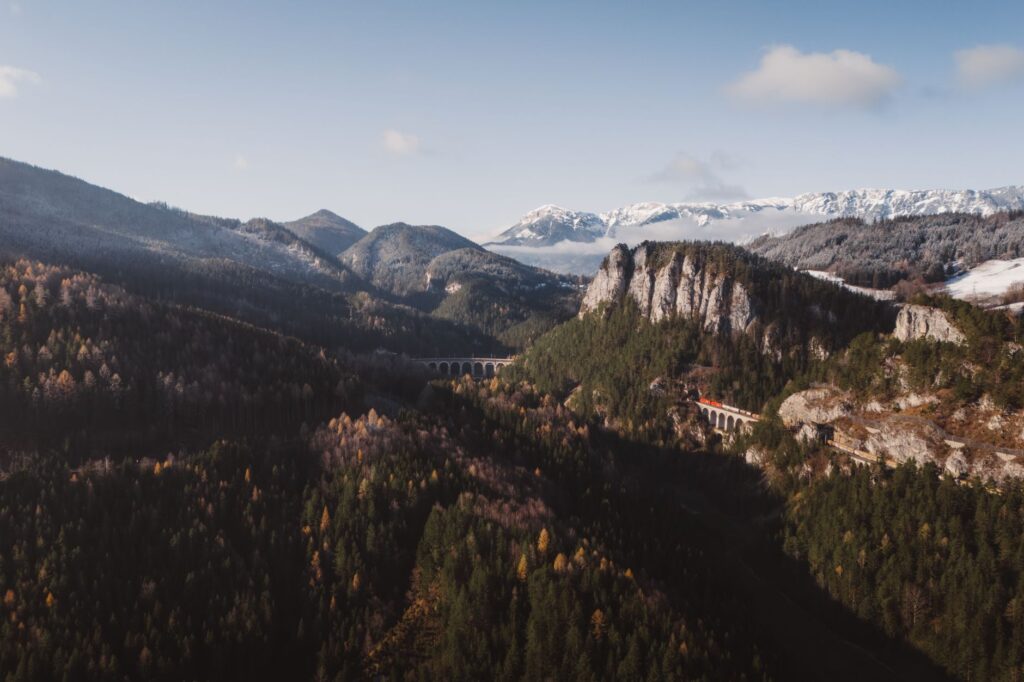
One of the most remarkable aspects of the Semmering Railway lies in its seamless landscape integration and robust monumental architecture. To bridge the gorges, builders erected over twenty multi-arched viaducts and bridges using unrendered local stone, a technical decision ensuring durability against severe frosts while granting the infrastructure a sober aesthetic elegance. The Kalte Rinne viaduct, with its multiple tiers of superimposed arches, stands as one of the undisputed summits of nineteenth-century civil engineering.
Likewise, the network includes fifteen hand-excavated tunnels driven with gunpowder and pickaxes, with the summit tunnel, situated nearly 900 meters above sea level, marking the culmination of the journey. The complexity of these structures required on-site masonry workshops where specialized craftsmen carved each block to withstand the massive dynamic loads generated by the constant passage of heavy freight compositions and passenger convoys.
Alpine Logistics and Central European Connectivity
Beyond its heritage value as a UNESCO-protected monument, the Semmering line continues to play a strategic role in southern Austria’s railway corridor. Connecting key nodes such as Vienna Central Station with Graz and Klagenfurt, it serves as a channel for commuter passenger flows and heavy freight. Nonetheless, the physical limitations of an infrastructure over 170 years old have driven the construction of the Semmering Base Tunnel megaproject, a twenty-seven-kilometer underground bypass designed to absorb high-speed traffic and relieve strain on the historic route.
This coexistence between nineteenth-century legacy and technological modernization reflects the complexity of spatial planning in the Alps. While high-capacity trains transit new low-level galleries to reduce travel times, the historic mountain route preserves its regional corridor function and establishes itself as a prime attraction for cultural and industrial tourism, demonstrating that civil infrastructure can evolve without sacrificing its historical identity.
Socioeconomic Impact in the Valleys of Styria and Lower Austria
The arrival of the railway in the mid-nineteenth century irreversibly altered the socioeconomic fabric of previously isolated rural communities. Agricultural villages such as Semmering, Mürzzuschlag, and Gloggnitz rapidly transformed into centers of bourgeois attraction, where the Viennese aristocracy erected sumptuous hotels and summer villas drawn by the purity of alpine air and the unprecedented accessibility guaranteed by the train. This phenomenon birthed one of the earliest forms of seasonal alpine tourism in Central Europe.
On the industrial front, the drastic reduction in transport costs boosted Styrian steelmaking and facilitated the efficient distribution of timber harvested in the region’s dense forests. Intermediate stations functioned as authentic decentralized logistics hubs, coordinating the transfer of goods between animal-drawn carts and railway convoys, vertebrating a cohesive internal market that strengthened the empire’s economy against external competitors.
World Heritage and Conservation Challenges
In 1998, the Semmering Railway was inscribed on the UNESCO World Heritage list, becoming the first railway line globally to receive such distinction. This international recognition marked a turning point in territorial management, compelling federal, regional, and local authorities to coordinate strict urban planning and environmental regulations to protect the visual and structural surroundings from real estate pressure and natural degradation.

Conserving century-old viaducts requires highly specialized restoration techniques employing traditional mortars and continuous geological analyses to prevent slope landslides. The preservation of this corridor is not an exercise in museum nostalgia, but an active commitment to technical and landscape sustainability. Modern engineers must compile historical records and apply laser technology to monitor the structural health of arches and tunnels subjected to continuous vibrations and severe freeze-thaw cycles.
Energy Transition and the Future of Alpine Transport
Within the framework of European transport decarbonization guidelines, the Semmering corridor is undergoing deep renovation oriented toward energy efficiency. The complete electrification of the line, finalized in the early twentieth century and continuously modernized, allows all convoys to operate using renewable hydroelectric power generated within the alpine valleys themselves. This makes the railway a model of sustainable mobility contrasting sharply with mass road transport.

The true measure of technological progress lies not in the speed with which distances are erased, but in the capacity to integrate human work into the fragile balance of the alpine territory.
Furthermore, tariff integration and schedule synchronization with regional buses ensure capillary connectivity benefiting both local residents and visitors exploring mid-mountain trails, consolidating an efficient and diversified public mobility ecosystem.
Practical guide
- Getting There: Direct Railjet and regional trains depart with daily frequency from Vienna Central Station (Wien Hauptbahnhof) toward Mürzzuschlag, with key stops in Gloggnitz and Semmering. The journey to Semmering station takes approximately one hour and ten minutes.
- When to Go: Spring months (May and June) and autumn (September and October) offer optimal conditions for combining the train journey with hiking routes. Winter transforms the region into a snow sports destination with exceptional landscape integration.
- Infrastructure and Walking Routes: The long-distance Semmering Railway Walking Trail runs parallel to the tracks, providing access to official panoramic viewpoints such as Edlach and the famous 20 Schilling viewpoint, overlooking the Kalte Rinne viaduct.
- Recommended Accommodation: The area features restored historic establishments, such as the historic Grand Hotel Panhans in Semmering, alongside traditional guesthouses (Gasthöfe) in the Gloggnitz and Mürzzuschlag valleys.
- Ticketing Planning: Tickets are best purchased via the official Austrian railways app (ÖBB Tickets) or station ticket machines. Regional passes and the Austrian Klimaticket are fully valid on local route services.
Silence on the Rails: Seasonal Twilight in the Pass
When the final night convoy crosses the threshold of the summit tunnel, a profound and solemn silence reclaims the Semmering valleys. The faint lights of vintage lanterns at century-old stations flicker beneath the alpine mist, reflecting upon the carved stone profiles that have withstood the passage of empires, wars, and technological revolutions. In that instant, the immense mass of stone and iron seems to fuse definitively with the mountain, reminding the traveler that the true value of these tracks lies not solely in transport efficiency, but in the tangible memory of human effort to unite distant worlds.