
At the southern confines of the Emirate of Abu Dhabi, where the terrestrial relief yields to the marble-like and shifting immensity of the Rub al-Jali, human survival and intermodal mobility depend on a logistical discipline as micrometric as it is relentless. The desert internationally known as the Empty Quarter is not a barren space, but rather a historical corridor of linear oasis systems where clay, the deep roots of date palms, and fossil aquifers sustain millennial settlements. Today, the connectivity of these enclaves—grouped under the geographical arc of Liwa—is no longer entrusted solely to traditional dromedary caravans or the intuitive paths of the al-Mazroui or al-Hamli Bedouin. It relies on a technical network of high-friction asphalt roads, grader-leveled sand tracks, and a specialized fleet of tanker trucks that daily challenge the mobile tides of the dunes.
Understanding how people, supplies, and energy resources move within this sandy confine requires examining the complex infrastructure connecting the Emirati capital with the more than twenty settlements comprising the Liwa oasis. From the monumental E65 highway, popularly known as the Liwa Road, to the gravel branches winding between dune cordons over one hundred meters high, transportation in this region constitutes a permanent exercise in applied engineering against wind erosion.
The Asphalt Backbone: The E65 and Heavy Traffic
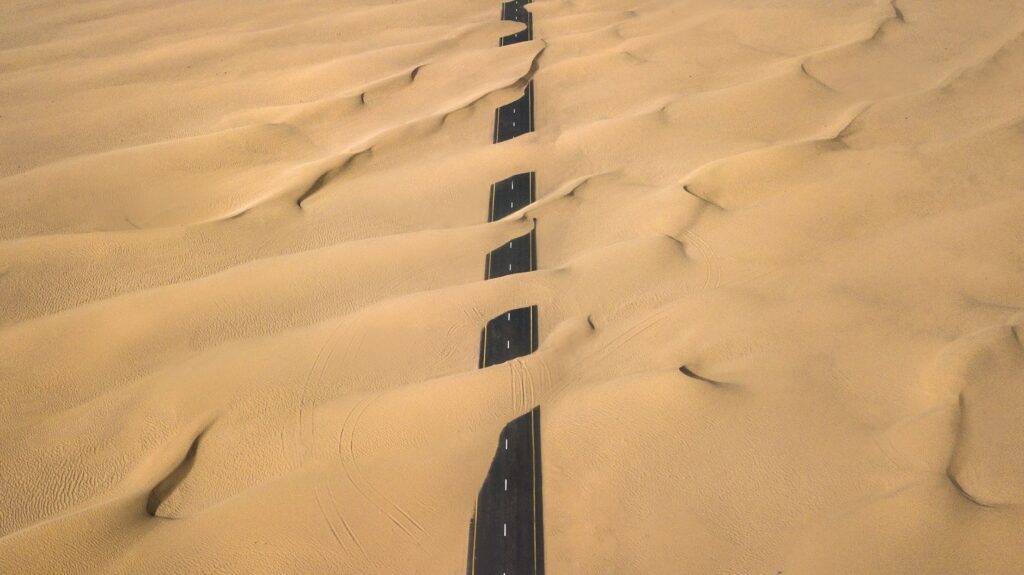
The backbone sustaining Liwa’s accessibility is the E65 highway, a high-capacity route penetrating from the mainland into the heart of the Al Dhafra region. This artery is not merely a tourist transit lane; it forms the umbilical cord through which fuel trucks, refrigerated transports carrying perishable goods from Abu Dhabi’s wholesale markets, and public line buses operated by the emirate’s transit authority circulate. The complexity of this route lies in its constant maintenance: seasonal sandstorms, locally known as shamal, can deposit tons of sediment over the asphalt within a matter of hours, forcing the permanent deployment of heavy clearing machinery.
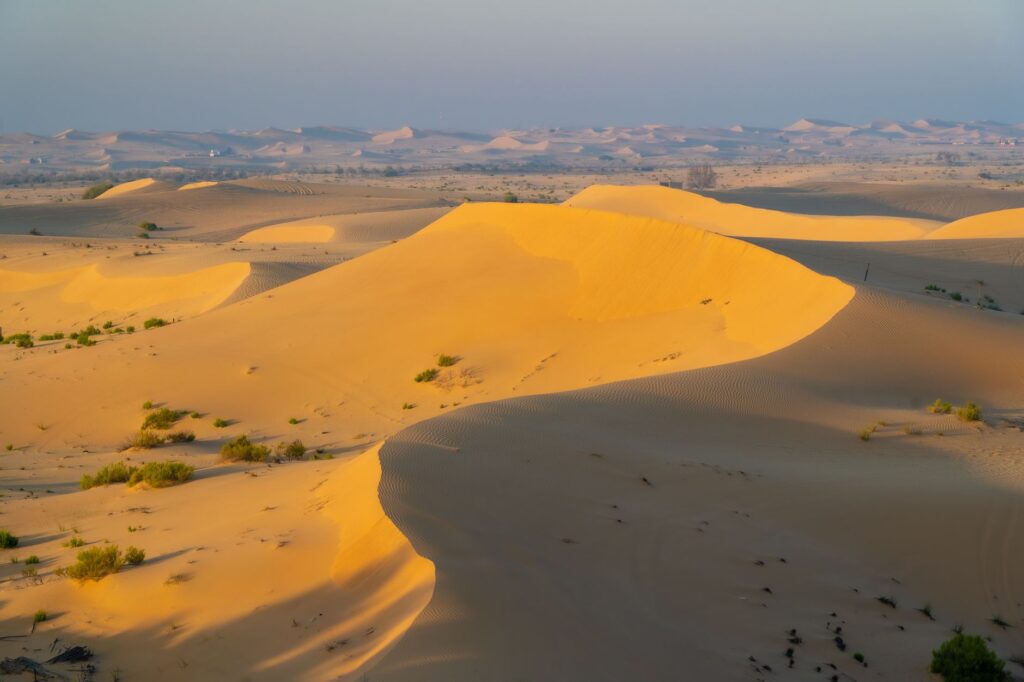
Along this main axis, the secondary network branches into minor paved arteries connecting individual oasis settlements, such as Hameem, Muzairai, and Aradah. However, the true intermodal challenge begins where the asphalt stops and gives way to internal service tracks. In these zones, conventional private vehicles prove useless, ceding prominence to all-terrain vehicles equipped with tire pressure control systems, essential elements for lowering traction and gaining contact surface over soft sand.
The Logistics of Water and Fuel at the Edge of the Dune
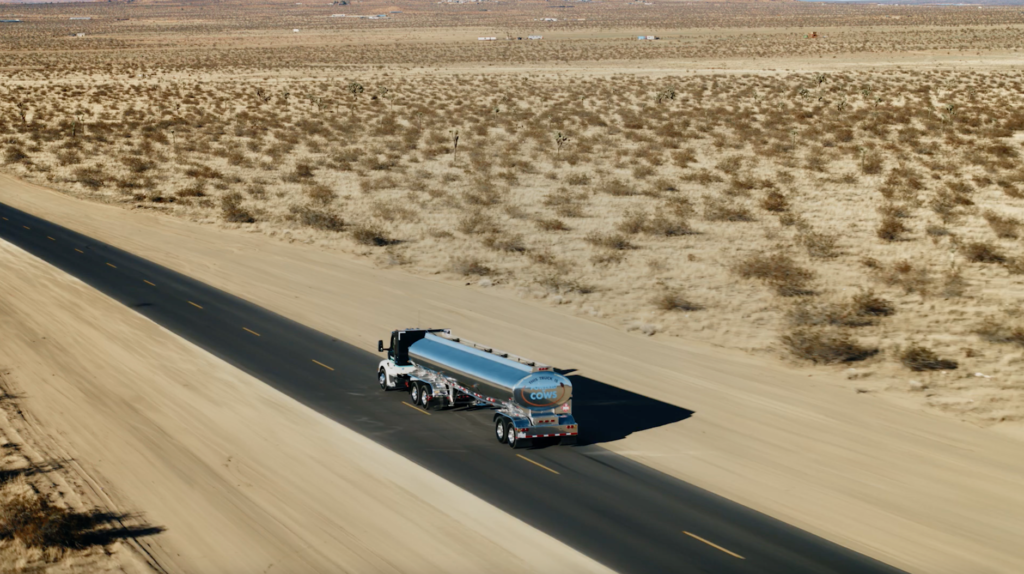
One of the most fascinating and critical aspects of connectivity in the Rub al-Jali is the provisioning of basic resources. Although the oases feature traditional wells and modern subterranean water extraction systems for intensive date agriculture, the supply of treated potable water and fuel for electrical generation and local transport relies on a daily logistical chain. Large-tonnage tanker trucks, operated by public utility companies and private contractors, travel hundreds of kilometers daily from coastal desalination plants to communal storage depots in Liwa.
These vehicles operate under extreme conditions where pavement temperatures frequently exceed sixty degrees Celsius during the summer months. Coordinating these fleets requires high-precision satellite telemetry and GPS tracking, as a mechanical failure or a traffic jam caused by sand accumulation on a secondary track can temporarily isolate entire communities. The resilience of this system lies in route redundancy: if a storm blocks the main transversal pass, secondary bypass routes remain open through the constant leveling of dune fronts.
School Transport and Community Mobility in the Desert
Beyond industrial and commercial logistics, human connectivity in the Liwa oasis presents very particular social dynamics. Settlements are dispersed along a strip stretching over one hundred kilometers, posing significant challenges for schooling, healthcare, and the employment integration of local residents. School transport plays a fundamental role in this fabric: fleets of all-terrain minibuses and adapted buses travel peripheral tracks every dawn to pick up students from the most isolated family farms and transfer them to centralized educational complexes in Muzairai.
This daily mobility reflects the delicate balance between the modernization of public services and the preservation of the traditional lifestyle of farming families. Unlike large cities, where transportation responds to a logic of congestion and mass transit, mobility in Liwa is on a human scale, based on mutual trust between local drivers, fleet managers, and regional authorities supervising road safety in desert zones.
The Impact of Contemporary Ecotourism on Local Routes
Over the past decade, the opening of high-end resort complexes on the crests and valleys of the desert has introduced a new actor into the regional transport equation. The influx of international travelers seeking experiences in the Rub al-Jali has transformed the demand for mobility, prompting the creation of high-end all-terrain transfer services, the setup of emergency helicopter landing pads, and multilingual signage along historical routes.
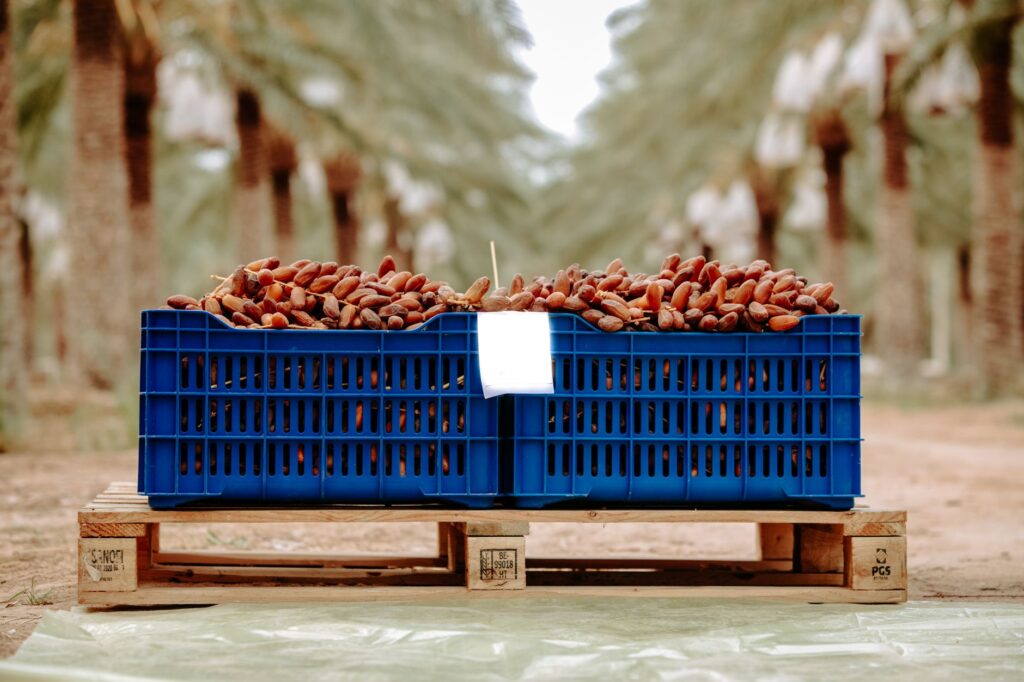
This touristic phenomenon is not without ecological friction. The uncontrolled transit of off-road vehicles outside authorized paths damages fragile endemic flora and alters dune morphology. For this reason, Abu Dhabi environmental authorities have implemented strict regulations limiting recreational driving to specific corridors, compelling local tour operators to coordinate their caravans with desert rangers.
The stability of an oasis in the heart of the Empty Quarter is measured not by the amount of water gushing from its subsoil, but by the reliability of the asphalt and gravel thread keeping it connected to the rest of the world.
The integration of these new tourist flows with tanker truck traffic and school buses demonstrates the maturity of the regional transport system. It is not a matter of displacing the traditional, but of superposing layers of infrastructure that guarantee safety without distorting the mystical isolation defining the Arabian Desert.
Practical guide
Getting there: The main access to the Liwa region is by road from Abu Dhabi via the E11 highway and subsequently the E65 (Liwa Road). The rental car journey from the capital takes approximately two and a half hours. There is no passenger rail transport in this zone.
Vehicle requirements: If you plan to leave the main paved roads to explore the oases or access remote desert accommodations, using a four-wheel-drive (4×4) vehicle with low-range gearing is mandatory. Traveling in a caravan of at least two vehicles and carrying satellite communication devices is strongly recommended.
Fuel and supplies: Service stations are scarce outside the main hubs of Muzairai and Hameem. It is a mandatory safety rule to fill your tank completely before leaving the main highways and to carry extra reserves of drinking water.
Climate and seasonality: The best time to tour the northern Rub al-Jali spans from November to March, when daytime temperatures are moderate. During summer, extreme heat can deform tires and overload vehicle cooling systems.
Environmental regulations: Driving vehicles off marked tracks in protected environmental areas is strictly prohibited to prevent the destruction of the fragile desert ecosystem and the disruption of local wildlife.
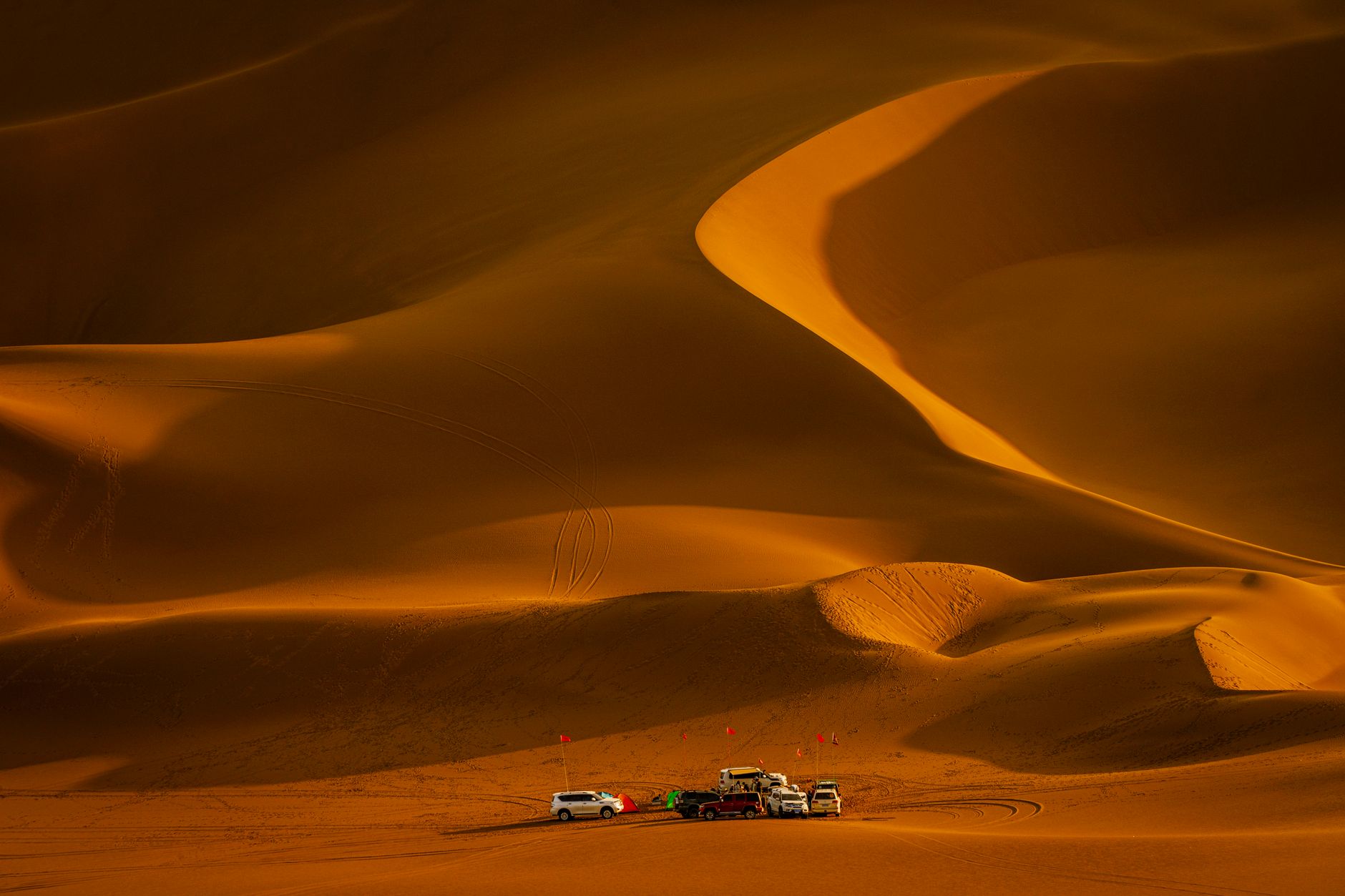
The definitive silence of the Rub al-Jali is not a physical void, but a monumental presence enveloping the traveler from the moment they cross the threshold of the first stable dunes. In this confessional of sand and lime, the sunset light dyes the crests a deep ochre shade contrasting with the cobalt blue of the evening sky. There, contemplating the distant silhouette of a tanker truck raising a golden wake of dust on the horizon is not merely witnessing a logistical operation; it is observing the tenacious pulse of human life which, supported by technical precision and ancestral respect for the territory, manages to persist and communicate in one of the most rigorous environments on the planet.