A coastline sculpted by history and wind
Italy’s coastline is far more than a succession of idyllic sandy shores; it constitutes a borderland where geography and history embrace under the intense Mediterranean light. From the limestone cliffs plunging into the southern sea to the hidden coves of Liguria, each stretch of coast tells a different version of the national character. Far from the homogeneous postcard, Italian beaches demand a measured gaze, one capable of distinguishing between the summer bustle of mass tourism developments and the almost secret quiet of corners where time seems to have stood still.
Approaching this marine territory requires understanding that the sea here is the true protagonist of daily life. Fishermen, artisans, and local inhabitants have shaped their routines around the rhythm of tides and prevailing winds such as the sirocco and the mistral. This feature offers a rigorous immersion in the country’s most notable shores, examining not only their scenic beauty but also the cultural contexts, environmental challenges, and practical keys to exploring them with respect and depth.
Sicily: The sovereignty of stone and deep azur
At the southernmost tip of Europe, Sicily displays a coastline where nature expresses itself with almost dramatic force. The island’s beaches are not mere resting places, but geological stages marked by volcanic activity and millennial erosion. In the Zingaro Nature Reserve, for instance, the dense green of dwarf palms contrasts violently with the pristine white of pebbles and the electric blue of transparent water that seems barely able to support the weight of boats.
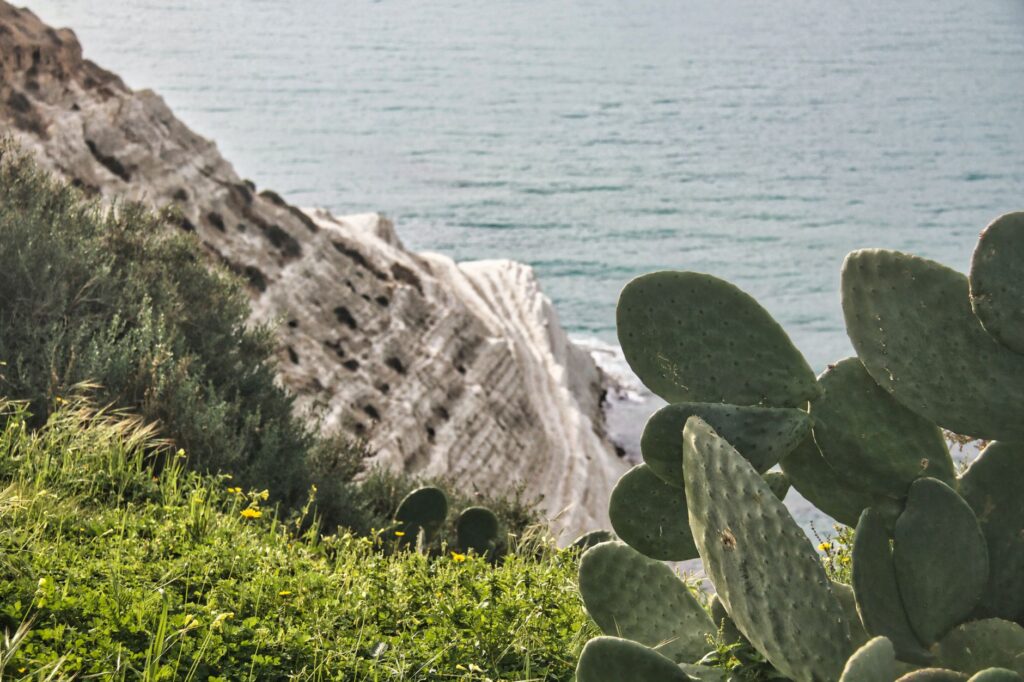
The chromatic scale of the Zingaro Reserve
Walking the trails descending toward Zingaro’s coves requires sturdy footwear and a generous supply of water. Here there are no noisy beach bars or invasive infrastructures; the ban on motor vehicles has preserved an ecosystem where gulls reign over limestone cliffs. Each cove—from Capreria to Tonnarella dell’Uzzo—offers a different visual composition, where the remains of ancient tuna fisheries recall man’s historical dependence on marine resources.
The Sicilian coast is not merely visited; it is inhabited through the senses, enduring the heavy midday heat and surrendering to the cool relief of its deep waters.
Further south, the Scala dei Turchi in Realmonte redefines the sandy beach through a staircase of white marl polished by wind and water into a natural sculpture. Although access to the monument has been strictly regulated in recent years to prevent erosion caused by overcrowding, viewing the sunset from surrounding viewpoints remains a first-rate aesthetic experience, where the white rock turns golden and pink as the sun dips below the horizon.
Puglia: The Adriatic and Ionian as mirrors of Magna Graecia
If Sicily is drama and fire, Puglia—the heel of the peninsula—represents the elegance of pale stone and cultivated plains descending gently toward two different seas. In the Salento region, the Adriatic coast breaks into low cliffs and sea caves, while the Ionian coast unfolds fine, almost Caribbean-like sandy shores bordered by dunes covered in junipers and Mediterranean scrub.
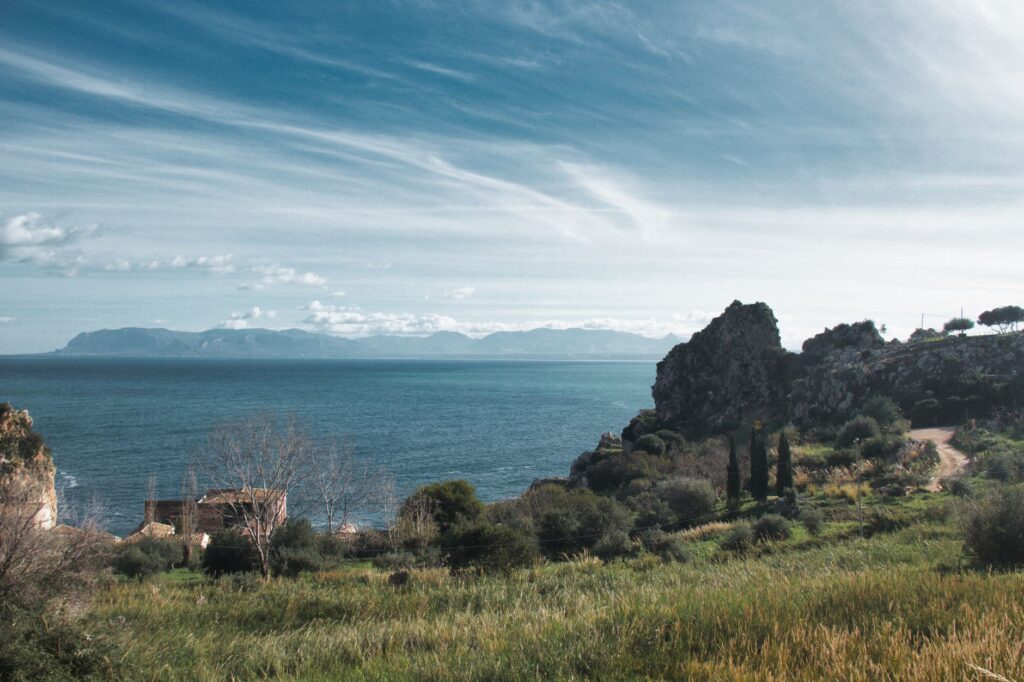
Torre Guaceto and ecological resistance
The Torre Guaceto Marine Protected Area stands as an exemplary conservation model in southern Italy. Here, access is rigorously controlled to protect seabeds rich in Posidonia oceanica and the avifauna inhabiting inland wetlands. Visitors can explore the trails by bike or on foot, reaching beaches where human footprint is reduced to the absolute minimum. This commitment to the environment proves that quality tourism in the Mediterranean depends inexorably on the active protection of its most fragile resources.
At the southern tip, where the Adriatic and Ionian seas officially meet off Santa Maria di Leuca, the landscape changes scale. Nineteenth-century villas built by the local bourgeoisie dot the cliffs, recalling an era when this geographical frontier was viewed as the end of the known world and the threshold to the East.
Tuscany and Liguria: The refinement of the northern coast
Moving north, the Italian coastal landscape adopts more stylized and shadowed forms. In Tuscany, Versilia combines the expanse of its fine sandy beaches with the imposing backdrop of the Apuan Alps, whose quarries provided the marble sculpted by Michelangelo. Here, historic bathing establishments—known as *stabilimenti*—maintain a retro aesthetic evoking the golden decades of mid-20th-century European tourism.
The Cinque Terre and vertical architecture
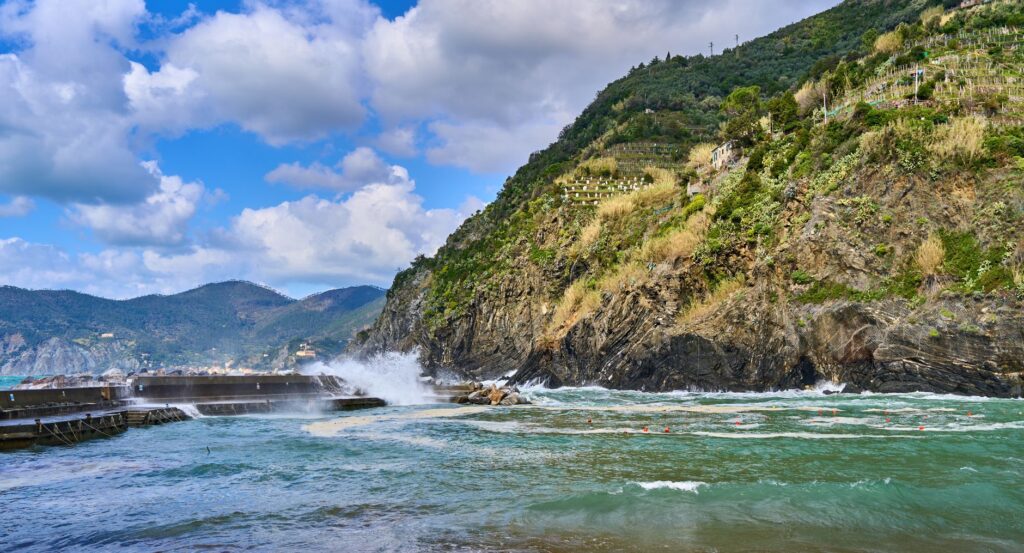
Further north, in the Liguria region, the Cinque Terre National Park offers one of the most singular geographies on the planet. In Monterosso al Mare, the largest beach in this cluster of cliff-hanging villages, the shore opens between rocks carved by the surf. The relationship between man and sea in this coastal stretch is a marvel of agricultural and urban engineering: stepped terraces cultivated with vines are supported by dry-stone walls descending directly to the waterline.
- Monterosso al Mare: the only significant sandy beach in Cinque Terre, ideal for swimming and accessing local services.
- Vernazza: a historic fishing port where the small urban beach is protected by a natural stone breakwater.
- Corniglia: perched on a rocky promontory, it lacks a direct beach but offers dizzying viewpoints over the gulf.
Material culture and seafaring traditions
The Italian coastline cannot be understood solely through its landscape dimension; it is also an open-air museum of material culture. Traditional boatbuilding techniques, such as the Ligurian *gozzo* or the Sicilian *luntra*, survive thanks to the work of rib carpenters passing their knowledge down through generations. Likewise, coastal gastronomy reflects a philosophy of radical utilization: from fish couscous in Trapani to seafood soups on the Tuscan coast, each dish is a synthesis of salt, extra virgin olive oil, and wild herbs.
The seaside table in Italy fulfills a ritual function: it halts time and obliges the traveler to participate in an ephemeral yet intense community based on shared pleasure.
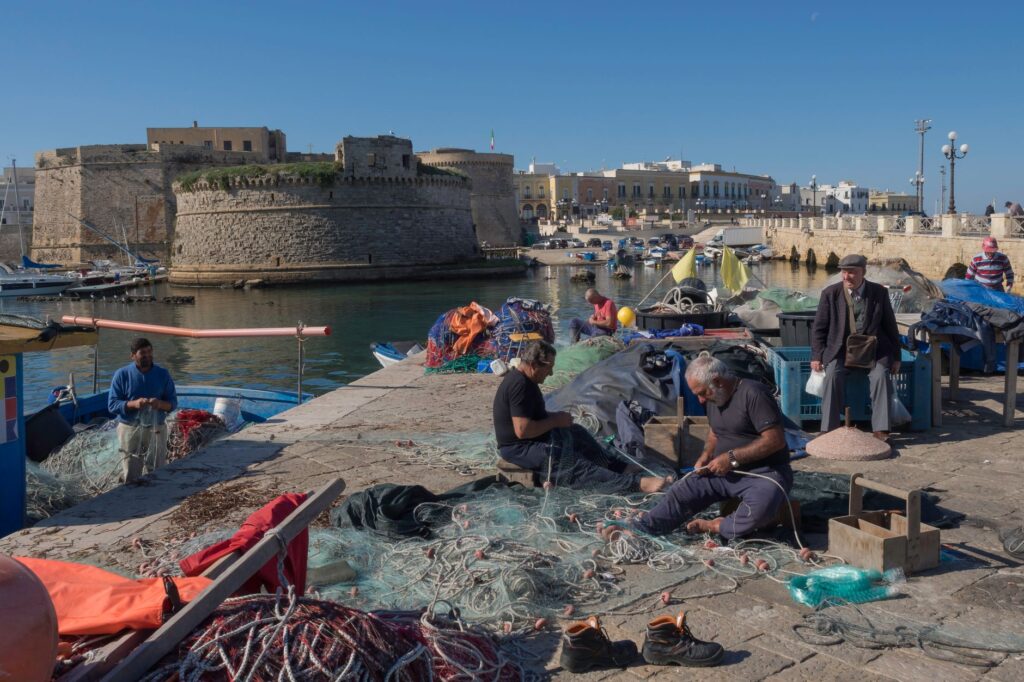
Morning fish markets, located in historic ports such as Catania or Gallipoli, remain the beating heart of these communities. There, the daily catch is negotiated using gestural codes that have barely changed in centuries, offering the curious visitor a direct anthropological perspective on the economy of the sea.
Contemporary challenges of the Italian coast
Today, Italy’s coasts face monumental challenges driven by climate change, coastal erosion, and excessive urban development. The privatization of vast stretches of beach through commercial concessions—the *stabilimenti balneari* occupying up to eighty percent of some shores—generates constant political and social debate over public rights of free access to the sea, a principle enshrined in legislation but eroded by commercial practice.
Faced with this reality, local administrations and environmental movements promote dune restoration initiatives and capacity limits in sensitive enclaves such as the island of Lampedusa or the Sardinian coast. The future of sun-and-sand tourism in Italy depends on collective capacity to transition toward management models that prioritize the health of marine ecosystems over immediate economic gain.

Practical guide
Planning a trip along the Italian coast requires attention to detail and respect for seasonality. The best time to tour the south (Sicily and Puglia) spans May, June, and September, when temperatures allow swimming without enduring the scorching heat or August crowds. In the north (Liguria and Tuscany), late spring offers optimal conditions for combining coastal hiking with beach relaxation.
For transport, renting a vehicle is virtually essential in rural regions like Salento or the Sicilian interior, while in Cinque Terre the regional train is the most efficient and sustainable option, avoiding chronic parking issues in cliffside villages. Booking accommodations months in advance in protected areas and checking local regulations regarding access to nature reserves and capacity-limited beaches is essential.
The last flash over the sea
When day fades on the coast of Maratea, along the Tyrrhenian stretch of Basilicata, the light acquires an almost melancholic consistency. The shadows of surrounding mountains lengthen over the dark water, and the murmur of waves against the breakwater becomes the only sound dissolving the travel’s urgencies. In that twilight instant, stripped of any touristic artifice, the Italian coastline reveals its true nature: an ancient refuge where human beings, for a fleeting moment, feel once again an undisputed part of the landscape.
Source in EN: Condé Nast Traveler (https://www.cntraveler.com/gallery/best-beaches-in-italy)