The Island of Silent Ovens
There is a morning heartbeat in the cobbled streets of Palma that responds not to the rhythm of seasonal tourism, but to the rigorous discipline of slow fire and strong flour. While the Mediterranean laps lazily against the bay’s breakwaters, hidden behind the stone walls of local bakeries, microscopic gestures defy the passage of centuries. The Mallorcan ensaïmada is far more than a simple pastry product; it constitutes a living historical document, a protected gastronomic fossil guarded by a Protected Geographical Indication that certifies its lineage back to the 17th century, when local recipe books began documenting this spiral-shaped marvel.
Delving into the culinary reality of the island requires stripping away commercial storefronts to descend into the bowels of the urban fabric. In the heart of the Balearic capital, the iron-and-stone architecture of the traditional food market acts as an exact thermometer for this devotion. Here, amid stalls of dry-farmed vegetables and freshly landed fish, the pulse of the community is measured by the sheer finesse with which dough is stretched into a nearly translucent membrane—an exercise in physical balance and patience.

Market Architecture and Local Larder
Palma’s Central Market, widely known as the Mercat de l’Olivar, stands as the contemporary agora where farmers from the rural interior and master artisans converge. Its aisles exude the unmistakable aroma of autochthonous nuts, sweet pepper powder, and extra virgin olive oil with a Binissalem designation of origin. Each morning, fresh produce stalls reveal the deep reliance that Mallorcan pastry maintains with its immediate agricultural environment.
The texture of the iconic spiral cannot be grasped without analyzing the ingredients that sustain it. Far from industrial standardization, the traditional recipe demands soft wheat flour, water, sugar, sourdough, and above all, the distinctive fat that grants both its name and its unmistakable texture: saïm, or Mallorcan pork lard. This fatty element, purified through traditional methods, not only provides unctuousness but acts as an insulating agent during the delicate prolonged fermentation process, allowing the internal structure to retain its natural moisture for days.
The artisanal bakery is not an industrial kitchen, but a laboratory of applied physics where family memory replaces digital timers.
The Liturgy of Stretching: Geometry and Patience
The climax of ensaïmada-making occurs in the small hours of the morning, when the bakery plunges into an almost monastic silence. Bakers, their hands lightly greased with oil to prevent the dough from sticking, begin the rolling process over large wooden tables. The physical objective is clear and unforgiving: the dough, initially a compact and rested ball, must be stretched evenly and concentrically until it covers the surface of the table without tearing, achieving the thickness of silk.
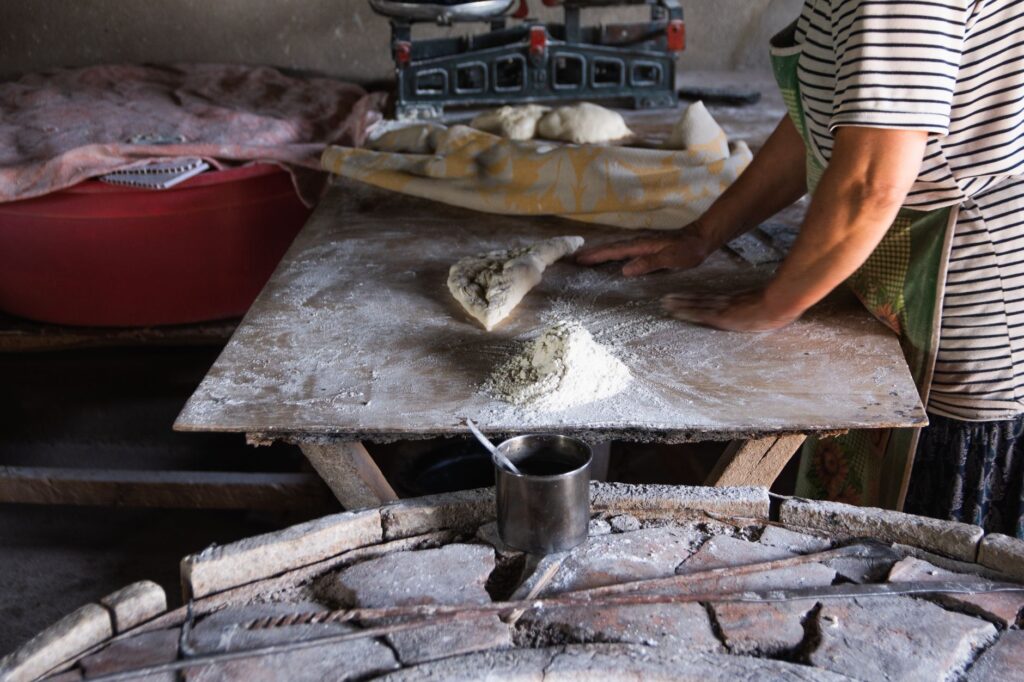
This technical mastery requires years of silent apprenticeship. If the dough rips, the air accumulated during fermentation escapes, ruining the characteristic internal flakiness generated by rolling the stretched sheet upon itself. Once the dough sheet is achieved, it is generously anointed with pork lard, a crucial step that will determine the product’s future layers. The resulting cylinder is then gently rolled into the classic open spiral shape that mimics a mollusk shell or the ancient folds of Eastern turbans.
Fermentation and the Miracle of the Oven
Patience constitutes the invisible yet most decisive ingredient in this production cycle. The raw ensaïmadas, arranged on circular aluminum trays separated by ample space, are transferred to proofing chambers where temperature and humidity are controlled with millimeter precision. Unlike conventional breads that pursue speed, the ensaïmada dough requires between twelve and eighteen hours of rest for natural yeasts to complete their metabolic cycle, generating the air pockets that guarantee final lightness.

The oven stage represents the ultimate trial by fire. Stone ovens, traditionally fueled by holm oak or almond wood though now adapted to controlled convection systems, bake the pastry at moderate temperatures for periods ranging from fifteen to twenty-five minutes, depending on size. The visual result is a golden surface, crisp at first touch yet yielding inside, crowned always by a generous snowfall of fine powdered sugar that adheres to the superficial fat.
Historical Variants: From Plain to Angel Hair
While the purest and most respected version among purists is the *ensaïmada llisa*—devoid of any filling to fully appreciate the quality of the dough and lard—Mallorcan tradition has enriched this repertory with variants that converse directly with the island’s agricultural seasonality. Among them, the variant filled with cabello de ángel stands out, crafted from the candied fibers of winter squash cultivated in local orchards during autumn.

Likewise, during winter months and coinciding with the slaughter season, bakeries incorporate versions featuring Mallorcan sobrasada and candied pumpkin, a bold and deeply rooted contrast that fuses cured pork fat with sweet pastry. This sweet-and-salty duality reflects the adaptability of island cuisine, a territory historically forced to optimize its own food resources through long-term preservation techniques.
True territorial cooking does not seek ephemeral surprise, but the permanence of a flavor that explains where we come from.
Impact on Local Economy and Mindful Travel
In the current socio-economic landscape, the survival of these traditional bakeries faces complex challenges stemming from real estate speculation in historic quarters and the pressure of mass tourism. However, a parallel movement of cultural resistance is emerging, driven by young bakers and pastry chefs who reclaim the value of zero-kilometer produce. Artisanal ensaïmada routes have become an attraction for contemporary travelers seeking authentic experiences, far removed from the standardized circuits of coastal mega-resorts.
This rigorous gastronomic tourism not only sustains the family economies of farmers producing lard and flour, but also guarantees the generational transmission of a craft declared a Asset of Cultural Interest. Purchasing an ensaïmada directly from a traditional neighborhood bakery in Palma, transporting it with characteristic care in its octagonal cardboard box, and consuming it outdoors facing the sea represents an act of communion with the most genuine identity of the Balearics.

Practical guide
- Getting There: Palma de Mallorca Airport (PMI) connects with major European capitals. From the terminal, city bus line A1 takes you to the city center in under thirty minutes.
- When to Go: Spring (April to June) and autumn (September to November) offer ideal temperatures for exploring markets without crowds and enjoying bakeries at full morning operation.
- Where to Buy: Avoid airport souvenir shops and head directly to the Olivart Market or centuries-old bakeries in the old town such as Forn Fondo or Forn de la Glòria.
- Product Identification: Always look for the official Protected Geographical Indication (PGI Ensaimada de Mallorca) seal on the packaging, guaranteeing it was made with local pork lard via traditional methods.
- Transporting the Pastry: If you plan to carry an ensaïmada as a gift, request the traditional octagonal rigid box; it is specifically designed to protect the fragile structure from pressure and air during flight.
- Storage: Artisanal ensaïmada contains no artificial preservatives. It is best consumed within the first 48 hours of baking, kept in a cool, dry place without refrigeration.
- Local Pairing: Enjoy a morning portion accompanied by a glass of cold milk or, failing that, an infusion of traditional Mallorcan herbs following a light meal.
The Memory of Shared Flavor
At the end of the day, when the metal shutters of markets and bakeries begin to lower, Palma recovers the calm of its ancient stone. At a small wooden table in Plaza de Cort, a traveler unties the cord of a cardboard box worn by use. The immediate aroma of toasted lard and powdered sugar evokes an invisible cartography that transcends conventional travel guides. In that everyday gesture, the grand history of the island—that of its farmers, anonymous bakers, and dry-farmed lands—is concentrated in an ephemeral bite that defies oblivion with the simple force of well-baked memory.