More than two hundred kilometers north of the Arctic Circle, geography offers no quarter to improvisation. Between the underground mines of Kiruna in Swedish Lapland and the ice-free port of Narvik in Norway’s western fjords lies one of the most audacious feats of railway engineering from the late nineteenth and early twentieth centuries: the Malmbanan line (and its Norwegian section, the Ofotbanen). This 500-kilometer corridor carries Europe’s heaviest freight trains, engineered to move tons of magnetite through severe freezing conditions, blizzards, and unstable permafrost.
Beyond its strategic and industrial significance, the line represents a vital artery for human connectivity in the High North. Boarding the passenger trains that share these standard-gauge, electrified tracks reveals a landscape of bare plateaus, tunnels carved through primordial granite, and mountain passes where the tundra plunges sharply into the dark waters of the Rombak fjord. This report examines the logistics, technical history, and daily life orbiting Europe’s northernmost and most resilient rail network.
The Origins of the Magnetite Route at Parallel 68
The creation of the Malmbanan line at the close of the nineteenth century answered a global geographic dilemma. The Kiruna mine held the world’s highest-density iron ore deposit, but the Baltic Sea—the natural export route southward via Luleå—remained choked by thick ice for over five months each year. The only viable solution for an uninterrupted supply to European steel mills was to push infrastructure westward across the Scandinavian mountains to the Atlantic waters of Norway, warmed by the Gulf Stream.

Construction proved to be an unprecedented technical challenge for the era. Thousands of itinerant laborers, known as navvies or rallarfe, cut through hard rock using dynamite and hand tools, constructing embankments in temperatures that frequently dropped below minus forty degrees Celsius. The line officially opened in 1902, and its subsequent electrification in 1915 established it as a pioneering model for high-power electric traction adapted to subarctic environments.
High-Voltage Engineering Against Extreme Winter
The operation of the Malmbanan relies on a tight synthesis between mechanical design and continuous thermal monitoring. The IORE locomotives, custom-built for this corridor, rank among the most powerful in the world, capable of producing a continuous tractive effort of 1,200 kilonewtons. These massive double units haul trains of up to 68 loaded hoppers, reaching a total weight of approximately 8,600 tons per convoy.
The arctic climate demands keeping the overhead catenary free of frost and preventing rail fracture caused by thermal stress. During peak winter months, heating systems integrated into the track switches prevent freezing caused by compacted snow and ice. Furthermore, acoustic and infrared sensors along the route continuously monitor wheelset and axle wear to detect microscopic flaws before they cause a derailment in remote terrain inaccessible by road.

The early electrification of the Malmbanan in 1915 transformed Lapland’s frozen expanse into a railway innovation laboratory, proving the viability of heavy-haul transport in polar conditions.
Crossing the Watershed: From Tundra to Fjord
The most dramatic segment from both a scenic and technical perspective lies between the border station of Riksgränsen and the approach to the port of Narvik. Within this forty-kilometer stretch, the line leaves the Swedish high plateau at 500 meters above sea level and descends sharply along Norwegian mountain slopes down to sea level at the coast.
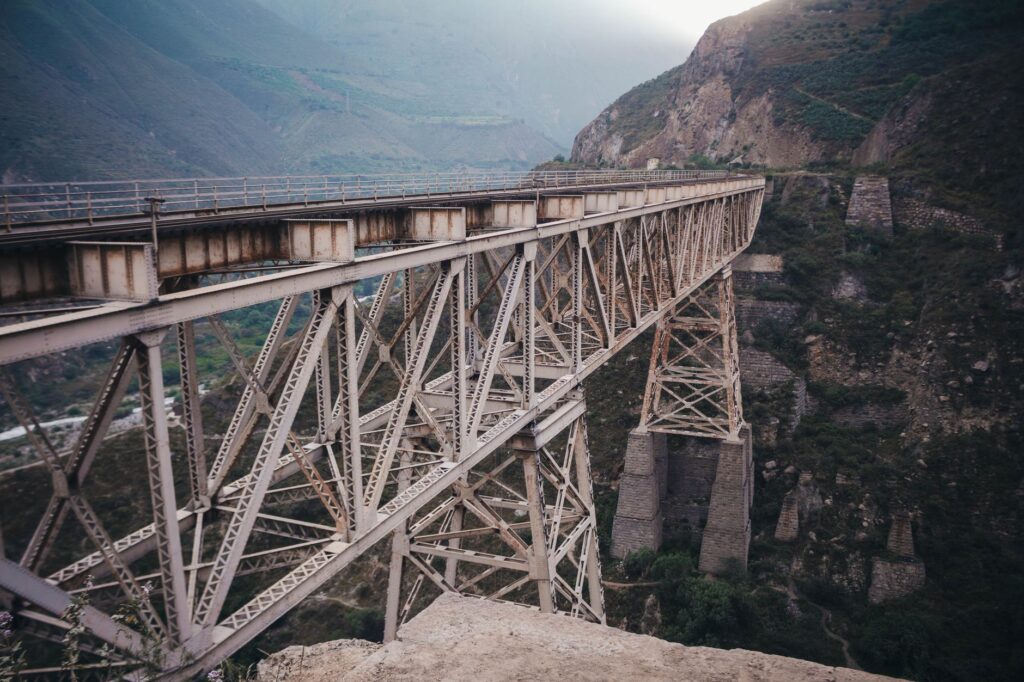
Trains travel suspended over deep chasms via steel lattice viaducts, alternating with a continuous sequence of rock tunnels and wooden or concrete snow sheds. At the Norddalen pass, the historic viaduct opened in 1902—originally built with a mechanism for swift demolition in the event of military conflict—stands as a monument to border engineering where geology governs movement.
Riksgränsen and Björkliden: Lifeline Stations in the Wild
Far from being mere technical waypoints, the intermediate stations along the ore corridor structure daily life for isolated inland communities. Towns like Björkliden and Riksgränsen originated as track maintenance camps and now serve as crucial transit hubs for scientists, skiers, and the indigenous Sami people managing traditional reindeer herds across the surrounding wilderness.
Here, passenger trains are not a secondary travel option but the sole reliable overland connection when severe blizzards force the closure of European route E10. Small station buildings feature heated, round-the-clock waiting rooms, offering critical shelter in a vast white landscape where distances between settlements span tens of kilometers of uninhabited tundra.

Ofoten Bay and Narvik’s Port Logistics
The terminal at Narvik reveals an industrial port seamlessly integrated into the fjord landscape. Deep-water loading facilities operated by the state-owned mining company LKAB allow bulk cargo ships to dock directly beneath automated loading booms, ensuring the dispatch of high-grade iron ore to global markets twelve months a year.
The arrival of the railway transformed Narvik from a quiet fishing village into a key international node. This logistical importance turned the city and the railway line into a major battleground during World War II, as Allied and German forces fought fiercely for control over the export route of Swedish iron ore.
Coexisting with Arctic Wildlife and Tundra Pastures
Operating a heavy rail line through a sensitive subarctic ecosystem presents ongoing wildlife conservation challenges. During winter, herds of reindeer and moose frequently use the cleared track bed for travel, drawn by the lower snow accumulation compared to the surrounding terrain.
To mitigate collisions, Swedish and Norwegian rail authorities have installed intelligent fencing, dedicated wildlife overpasses, and acoustic warning systems. Direct, real-time communication with Sami herders ensures that herd migrations are coordinated with freight schedules, limiting the infrastructure’s impact on traditional land use.
The iron moving from the depths of Kiruna to the Atlantic does not merely supply global industry; it sustains the only uninterrupted link between the interior high plateau and the Norwegian coast.
The Challenge of Urban Relocation in Kiruna
The contemporary narrative of the Malmbanan is inextricably bound to the transformation of Kiruna. Decades of continuous underground mining caused ground subsidences that threatened the structural integrity of the town center and the original railway alignment. This necessitated one of the world’s most complex urban relocation projects: moving an entire city three kilometers eastward.
The railway line was re-routed along a new bypass loop to avoid the sinking ground. The construction of a new central station and its integration with relocated residential and commercial districts demonstrate how century-old infrastructure can adapt to a mine that now reaches more than 1,300 meters beneath the earth’s surface.
Practical Guide
Planning a Journey on the Arctic Rail Line
The rail journey between Kiruna and Narvik operates daily via Swedish National Railways (SJ) and regional transport providers. Travelers can embark on the trip from Stockholm aboard the Arctic Night Train or board day trains directly in Kiruna.
Ticketing and Practical Advice
- Reservations: Book tickets at least four weeks in advance on the official SJ site or via Eurail. Panorama carriage seats and sleeper berths sell out quickly during Northern Lights season and the peak summer months.
- Intermodal Connections: From Narvik station, direct long-distance bus routes link onward to the Lofoten Archipelago and the city of Tromsø.
- Gear and Clothing: Layered thermal clothing and sturdy footwear with anti-slip soles are essential for waiting on exposed outdoor platforms along the subarctic route.
Optimal Seasons for Travel
From December through March, the journey provides snow-covered wilderness vistas and opportunities to view the Aurora Borealis, despite limited daylight hours. From June through August, the Midnight Sun provides twenty-four hours of continuous daylight to view the tundra and fjords.
The Iron’s Echo Over the Fjord
As darkness settles over the calm waters of the Rombaksfjord, the distant rumble of a descending ore train echoes off the cliff walls. It is a heavy, rhythmic pulse that underscores the resilience of human engineering set against the immense scale of the northern wilderness. The Malmbanan is more than an engineering record; it remains a living testament to human determination to keep channels of communication open across a landscape defined by winter, ice, and stone.