The Iron Scar Across the Canyon
The whistle of the locomotive cutting through the morning mist in the Duero gorges is not merely a tourist attraction, but the echo of an engineering feat conceived in an era when steam and dynamite tamed the most hostile reliefs of the Iberian Peninsula. The railway line running parallel to the international course of the river—where it acts as a deep natural border between Spain and Portugal—represents one of the most daring achievements of nineteenth-century transportation cartography. Far from high-speed networks that prioritize blind tunnels and aseptic viaducts, this route forces the traveler to comprehend the territory through its geological resistance. Every tight curve and manual rock cut reveals a railway architecture designed to negotiate the abyss, where human ingenuity subordinated its layout to the capricious contour lines of a gorge sculpted over millennia.
The tracks penetrate a territory where slate and granite impose their mineral law, forcing nineteenth-century engineers to project titanic solutions with very limited technical resources. Unlike the cereal plains preceding this section, the border Duero is boxed into gorges with drops of up to three hundred meters, creating a unique microclimate and historical isolation that the railway briefly broke and now rescues as a slow-travel experience. The track not only unites forgotten stations, but structures an ecosystem where water-sculpted stone engages in direct dialogue with iron bridges suspended over the void. This corridor does not seek contemporary commercial efficiency; its value lies precisely in its temporal stagnation, in its ability to keep intact the construction memory of a Europe that believed in progress through metal and coal.
The Geography of Isolation and Hillside Alignment
Advancing along this railway corridor is akin to deciphering a map where topography conditions every meter of progress. Embankments of consolidated rock secured by dry-stone masonry walls support the ballast on impossible slopes, demonstrating absolute mastery of material physics by early constructors. In many sections, the train seems to float over the river abyss, supported by lattice metal structures that challenge the vertiginous slope of the canyon. The choice of this hillside alignment responded to the urgent need to connect mining and agricultural basins with Atlantic ports, linking economies on both sides of the border through international bridges that today symbolize European technical cooperation in cross-border communications.
The maintenance of these infrastructures has historically required almost artisanal vigilance. Gangs of workers walked along sections affected by winter freezes or summer storms, securing unstable blocks with containment nets and wooden wedges. The fragility of the roadbed is, paradoxically, the guarantee of its landscape authenticity. From the window, the passenger notices how the ballast rests on narrow platforms excavated with pick and shovel, where a millimeter miscalculation would have plunged the convoy directly to the riverbed. This communion between civil engineering and terrain roughness turns the journey into a masterclass in applied geography.
Fluvial Engineering and the Challenge of Historic Bridges
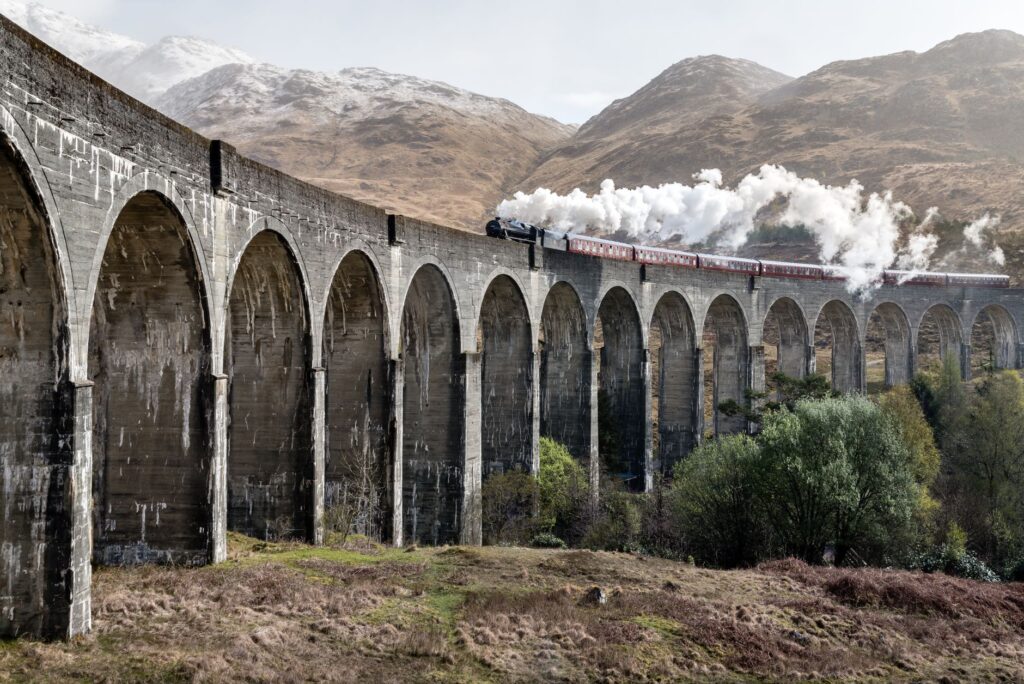
One of the undisputed milestones of this route is bridging the tributaries that pour their waters into the Duero through equally impenetrable ravines. To span these natural chasms, railway companies turned to the school of metallic engineering inspired by Gustave Eiffel’s principles, erecting puddling-iron viaducts that integrate with surprising harmony into the siliceous landscape. These structures, subjected to intense thermal oscillation between Castilian winter rigors and the extreme heat of the gorges, continue to operate with millimeter precision, bearing witness to the durability of nineteenth-century alloys over modern prefabricated materials.
The construction of these bridges constituted a true logistical nightmare. Without prior access roads, all material—from iron beams to steam boilers for rivets—had to be transported on mule back or towed upstream on river barges. The human effort behind each masonry pier submerged in the riverbed remains invisible in official engineering manuals. Today, crossing these viaducts suspended dozens of meters above dark waters, the metallic clatter acquires a solemn resonance, reminding the traveler that they are traversing living monuments of Europe’s industrial heritage.

The Mediterranean Microclimate and Viticultural Terraces
As the train delves deeper into the canyon, Atlantic and continental vegetation yields to a surprising Mediterranean oasis. The shelter of rock faces, acting as natural thermal screens retaining heat during the day and releasing it slowly at night, generates a microclimate where centuries-old olive trees, wild almond trees, and above all, vineyards planted on vertiginous terraces thrive. This heroic viticulture, hand-sculpted onto bedrock, shares visual space with the passing railway, generating a postal where human handiwork manifests in two of its most persistent works: the railway groove and the vine step.
Local winemakers depended for decades on this mode of transport to evacuate their harvests to consumer markets, turning the small local station into the bustling nerve center of the region during the grape harvest months. The train not only transported goods, but introduced the pulse of the outside world into traditionally isolated valleys. Although freight traffic has almost completely disappeared today, the visual coexistence between vines leaning over slate and the sporadic passage of the light railcar keeps alive a territorial narrative where subsistence agriculture and industrial technique evolved in parallel.
The railway in the Duero canyons is not a means to shorten distances, but an instrument to widen time and face the peninsula’s most demanding geography.
The Architecture of Phantom Stations
The stations marking this border section constitute an architectural catalog of the nineteenth-century industrial periphery. Built with local granite ashlar, ceramic tile gabled roofs, and spacious freight warehouses, these stops reflect the hierarchy and ambition of the original railway project. Today, most of these buildings are uninhabited, converted into solitary landmarks dotting the railway line with their melancholic print of noble stone and boarded-up windows, recalling a time when each flag stop was a vital node of human and commercial exchange.

The institutional abandonment of the facilities has not managed to erase their formal dignity. Stone platforms, progressively invaded by rupicolous vegetation and lichens, retain original elements such as old freight scales, wrought-iron telegraph poles, and station clocks stopped forever at an uncertain hour. Visiting these railway vestiges is equivalent to conducting an archaeological excavation into the recent memory of European communications. The attentive traveler will discover in the construction details—exposed brick chimneys, pilaster capitals, original lettering typography—the footprint of a modernity that reached the confines of the territory with a vocation for eternity.
Conservation, Slow Travel, and the Future of Secondary Lines
In the current mobility landscape, where the obsession with speed relegates secondary lines to oblivion or dismantling, the Duero corridor asserts the validity of slow travel as an alternative for heritage preservation. Various local associations and institutions on both sides of the border promote initiatives to consolidate tourist and cultural railway services that help finance the costly maintenance of cuttings, bridges, and stations. The recovery of these routes proves that the value of a train is not measured exclusively by its contribution to logistical GDP, but by its capacity to generate immersive territorial experiences respectful of the environment.

The main challenge lies in balancing environmental conservation demands with the controlled opening of these itineraries to the general public. The Duero gorges are also protected spaces of high ecological value, serving as a refuge for threatened species such as the black stork, Eurasian griffon vulture, and Bonelli’s eagle. Any tourism valorization strategy must be subordinated to rigorous respect for the biological cycles of local fauna. The train, due to its inherent guided nature and low noise footprint compared to road transport, stands out as the ideal instrument to traverse this fragile natural sanctuary without altering its delicate ecological balance.
Practical guide
How to get there: The main rail access is from connecting stations in Zamora or Valladolid, linked to the national high-speed network. To travel the specific international section, checking seasonal schedules of tourist runs operated with historic rolling stock is recommended.
When to go: Spring (from April to June) and autumn (from September to November) offer optimal climatic conditions and an exceptional chromatic palette in the canyons and vineyards, avoiding the extreme temperatures of the Castilian summer.

Logistics and planning: Verifying schedules and seat availability in advance is essential, as frequencies are very limited and special journeys usually require prior booking. Bringing comfortable footwear to explore station surroundings and clothing suitable for the gorge’s thermal shifts is advised.
Accommodation and gastronomy: Surrounding villages feature small rural houses and charming hotels located in former oil mills or traditional wineries. Local gastronomy highlights roast lamb, artisanal sheep cheeses, and designation-of-origin wines from the Duero basin.
The Last Gasp of Steam in the Gorge
As the sun begins to decline behind the granite crests, golden light bathes the slate slopes and the waters of the Duero acquire a specular, almost metallic tone reflecting the grandeur of the surrounding landscape. It is in this crepuscular moment that the train journey recovers its most intimate and emotional dimension. Seated by the window, the traveler perceives that the constant rattling of wheels over rail joints is not merely a mechanical mechanism, but the paced heartbeat of an infrastructure that defied time and oblivion. In the twilight of the carriage, flanked by the mute immensity of the canyons and the indelible wake of human effort, the journey transforms into an experience of deep reconnection with the territory, reminding us that the best journeys are those forcing us to halt our pace and listen to the earth’s mineral voice.