Origins and the Topographic Conquest of Graubünden
The construction of high-mountain railway lines in Switzerland responds to a historical necessity for territorial cohesion in terrains where geography seemed to veto any attempt at human intervention. At the end of the nineteenth century, the Graubünden region suffered from chronic isolation during the long winter months, when mountain passes lay buried beneath meters of snow. The arrival of the railway did not merely represent an improvement in transport times, but an absolute redefinition of alpine habitability. The Rhätische Bahn company undertook the titanic challenge of charting rail tracks capable of defying impossible gradients without systematically resorting to rack-and-pinion systems along its entire route, relying instead on pure mechanical adhesion for many stretches.
The design of these infrastructures demanded a perfect symbiosis between topography and structural calculation. Engineers of the era had to carve helical tunnels deep within the rock to gain elevation gradually, avoiding steep grades that would have caused primitive steam locomotives to slip. Every kilometer of track built in this environment represented a victory of technique over the abyss. The shale and granite slopes required colossal retaining walls, many of which still stand after over a century of uninterrupted service, withstanding the cyclical pressure of spring thaws and winter avalanches.
The financing and routing of these paths were not without political and financial tensions. Entire local communities debated whether the arrival of the train would destroy the subsistence economy based on high-mountain livestock or whether, conversely, it would open the door to vital commercial exchange. History proved that the railway became the economic backbone of eastern Swiss valleys. Today, keeping this infrastructure operational requires constant investment in preventive maintenance, sleeper replacement, and geological monitoring of the unstable slopes flanking the route.
The Architecture of Historic Bridges and Viaducts
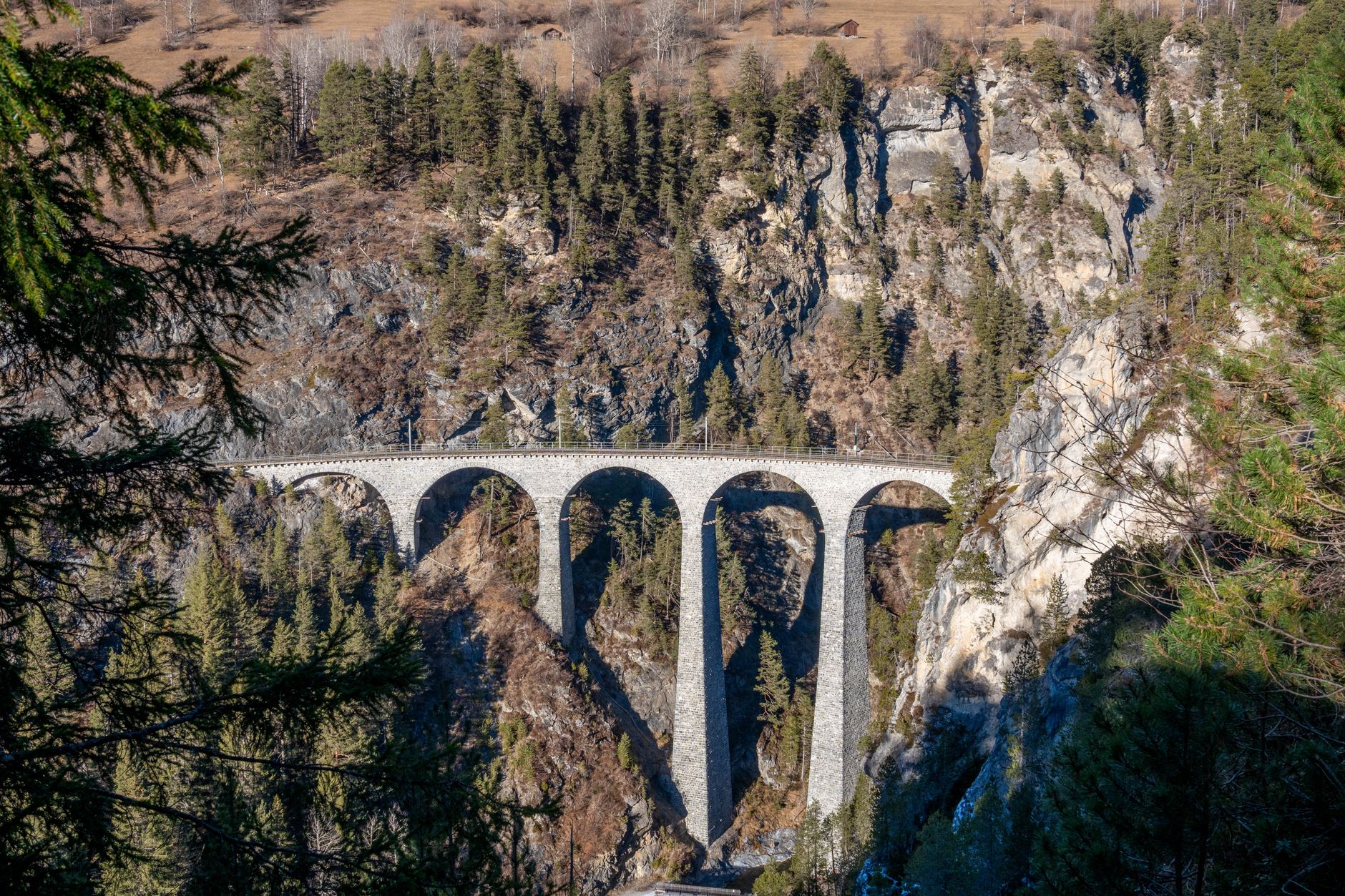
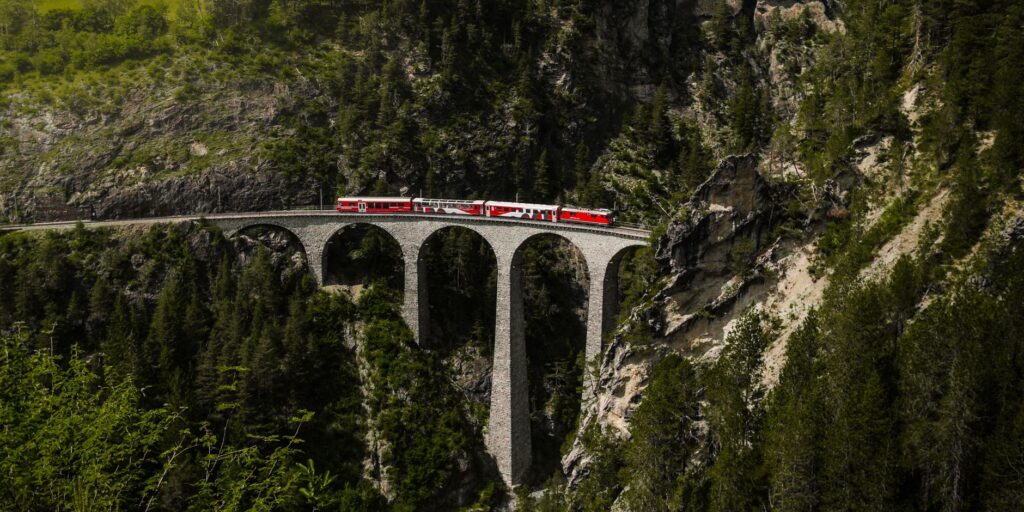
One of the most fascinating aspects of the route toward Alp Grüm is the integration of civil engineering works into a landscape of extreme visual and environmental fragility. The sandstone viaducts and metal lattice bridges do not compete with nature; rather, they appear to emerge organically from the rock. The use of local stone in constructing the arches ensured not only durability against harsh weather conditions but also an aesthetic integration that today commands the admiration of architects and engineers worldwide. Each pillar was anchored onto living rock, often excavating dozens of meters below the bed of rushing alpine torrents.
The construction techniques employed at the turn of the twentieth century lacked modern heavy machinery, leaving human muscle and controlled explosives as the only available resources. Monumental wooden centering supported the stone arches while masons manually adjusted each voussoir. This level of structural craftsmanship explains the longevity of the viaducts, some of which now support train compositions with axle loads far exceeding what their creators imagined. Inspection of these structures is performed meticulously using drones and fiber-optic sensors installed in expansion joints.
Blockquote: The alpine railway is not a scar upon the landscape, but a precision suture binding communities separated by fathomless geological chasms.
Along the journey, travelers cross dizzying gorges where the roar of furious water mingles with the metallic clatter of wheels upon riels. These elevated crossings act as privileged vantage points over glacial valleys that have receded alarmingly over recent decades. Observing these shifts from the train window offers a unique perspective on the climate transformation of the Alps, turning the trip into a moving visual document on the health of the high-mountain ecosystem.
Climate Transition and the Ascent Toward the Tree Line
As the train leaves the valley floor and winds its way up the slope, the vegetation undergoes a radical metamorphosis evidencing different bioclimatic belts. Lush beech and fir forests progressively yield to larches, whose golden needles offer an unmatched chromatic spectacle during autumn. Beyond the tree line, the landscape opens to high-alpine pastures and, ultimately, to high mountain terrain dominated by bare rock, perennial ice, and glacial moraines. This drastic scenery shift occurs in barely an hour of travel, compressing half a continent’s biodiversity into a few linear kilometers.
Thermal comfort and the natural pressurization of the carriages contrast sharply with the exterior wilderness. While passengers enjoy a stable interior temperature, the outside displays the harshness of alpine weather, where katabatic winds can abruptly drop the temperature within minutes. Onboard heating systems, historically powered by local hydroelectric electricity, ensure that the traveler’s experience remains exceptionally comfortable, even when the convoy forces its way through snowdrifts several meters deep.
Local fauna has also had to adapt to the constant yet silent presence of electric trains. Unlike older steam locomotives, modern multiple units generate significantly lower acoustic levels, allowing passengers to occasionally spot chamois, deer, and even ibex grazing on slopes close to the track. Train drivers receive specific training on wildlife observation and apply speed reduction protocols in critical seasonal migration zones, demonstrating a firm commitment to preserving the fragile natural environment they traverse.
Alp Grüm: The Balcony Suspended Between Valleys and Glaciers
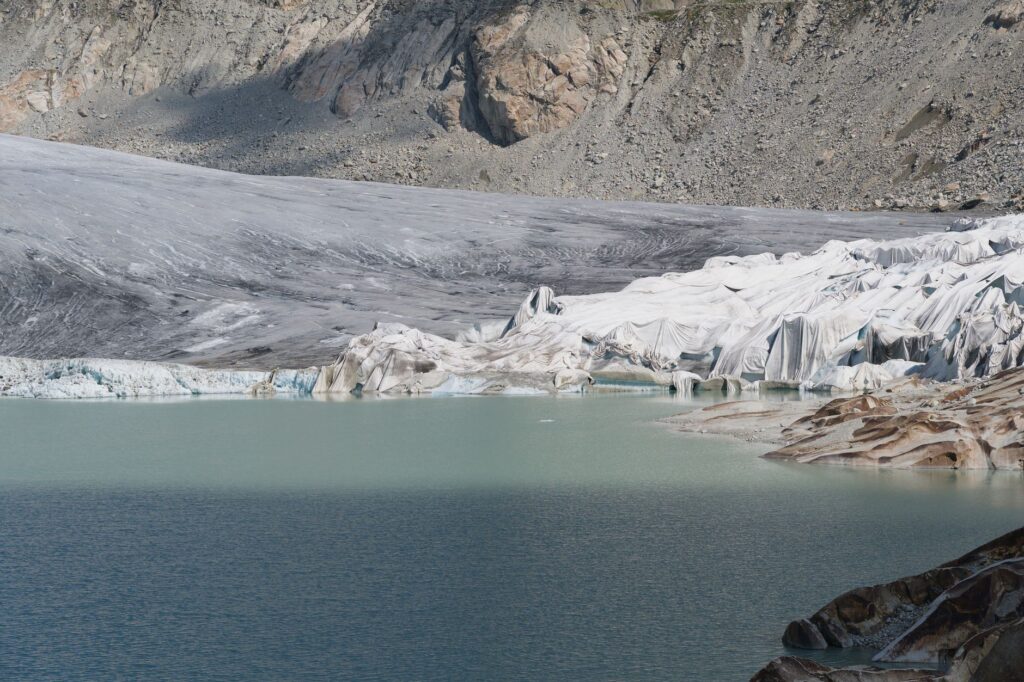
The nerve and emotional center of this stretch is the Alp Grüm station, situated at over two thousand meters of altitude and accessible solely by railway or via high-mountain walking trails. This enclave lacks road access, preserving an atmosphere of isolation and peace difficult to find in other alpine tourist destinations. From its terrace, the view unfolds imposingly over the Palü glacier and its characteristic deep turquoise meltwater lake, creating a snapshot that encapsulates the majesty of the Swiss high mountains.
The station itself operates as a self-sufficient microcosm. Its historic restaurant, opened in the early twentieth century to serve early hikers and railway staff, maintains a culinary offering based on local Graubünden products, such as high-mountain cheeses, air-dried cured meats, and traditional barley soups. Station workers live there on weekly rotations, managing train crossings on single-track sections and attending to the operational needs of an infrastructure that runs with Swiss precision three hundred and sixty-five days a year.
Blockquote: Stopping at Alp Grüm is tuning into the silence of the summits, where the sole clock governing time is the punctually announced passage of alpine convoys.
The wind constantly blowing from the glacier provides exceptional atmospheric clarity, allowing clear days to reveal the distant profiles of Italian valleys toward which the track begins descending shortly after. This invisible border crossing marks the cultural transition from German- and Romansh-speaking Switzerland to the Italian slope of Lombardy, a syncretism perceived both in station architecture and in the shifting accents of conductors and railway operatives.
Logistics, Planning, and Keys for the Rigorous Traveler
Planning a journey aboard the Rhätische Bahn network requires understanding the operational complexity of a system integrated into Swiss public transport. Unlike conventional tourist trains, these routes form part of regular regional networks, allowing residents and travelers to use national transport passes valid across the country. Nevertheless, during peak summer months and the winter ski season, seat reservations are highly recommended, especially for panoramic carriages featuring large glass panes curving upward into the roof.
Connections at nodal stations like Pontresina or Poschiavo are perfectly synchronized with postal buses and other regional trains, guaranteeing punctuality that rarely exceeds a margin of a few seconds. Travelers are advised to consult the official Swiss railways app to monitor real-time track status, as extreme weather conditions can prompt temporary closures due to avalanche risks or emergency catenary maintenance work.
Regarding luggage, regulations permit the free transport of standard-sized bags, though dedicated spaces in regional carriages are limited. For those wishing to combine hiking routes with railway segments, an official station-to-station luggage shipping service is available, allowing travelers to walk light from one village to another while bags are transported securely in the same convoy or associated logistical vans.

Sustainability and the Future of Alpine Mobility
The environmental commitment of the Rhätische Bahn is not a recent commercial strategy, but a foundational pillar derived from its own reliance on natural resources. One hundred percent of the electrical energy consumed by its locomotives and signaling systems originates from local public or mixed-ownership hydroelectric plants, placing the line’s carbon footprint near zero. This model of one-hundred-percent green electric traction serves today as an international benchmark for decarbonizing heavy transport in geographically complex mountainous zones.
Future challenges focus on infrastructure resilience against climate change impacts, particularly clay slope erosion and permafrost thawing at higher elevations. Engineering geologists continuously monitor slopes using laser sensor networks and seismographs detecting micro-displacements before they can compromise track safety. Furthermore, rolling stock fleet renewal prioritizes energy efficiency through regenerative braking systems, returning electricity to the general grid during prolonged descents from mountain passes.
This balance between technological innovation and scrupulous respect for historical heritage ensures that the railway line to Alp Grüm remains a model of sustainable mobility. Far from turning the high mountains into an artificial theme park, the train acts as an integrative element allowing landscape enjoyment with minimal environmental impact, proving that technological development and ecological conservation can march hand in hand in the planet’s most fragile natural environments.