

Introduction to a Centennial Legacy in the Gothic Heart
Few urban settings on the Iberian Peninsula manage to merge the architectural solemnity of the Gothic style with the ephemeral pulse of popular tradition quite like the Plaça de la Seu in Barcelona. Every December, in the shadow of the imposing cathedral facade, the Fira de Santa Llúcia unfolds, holding the title of Spain’s oldest Christmas market. Far from being a mere seasonal theme park or a contemporary commercial showcase, this space represents a three-dimensional historical document, a living archive where 18th-century customs continue to converse with urban modernity.
The celebration of this event is neither accidental nor a response to recent tourist trends. Driving roots into the urban fabric of a Mediterranean metropolis implies understanding how the city has guarded its rites of passage against successive urban, industrial, and demographic transformations. While many European enclaves have completely commercialized their seasonal fairs, Barcelona maintains in this corner a unique balance between artisan devotion, family memory, and the survival of ancestral trades that risk extinction in other contexts.
Documented Origins and the Pulse of the 18th Century
To comprehend the magnitude of the Fira de Santa Llúcia, one must look back to 1786, the date of its first official documented mention, although oral and historiographical tradition suggests commercial practices tied to the feast of Saint Lucy—celebrated on December 13th—from much earlier. In that late 18th-century era, coinciding with the Bourbon period and an incipient commercial awakening in Catalonia, the cathedral surroundings already functioned as a natural meeting point for local artisans and peasants from neighboring regions.
The market was born closely linked to the liturgical feast of the Christian martyr, patron saint of the blind and dressmakers, but its evolution quickly overflowed the strictly religious sphere to become the epicenter of domestic winter provisioning. In those early years, the stalls offered primarily modest liturgical elements, pure beeswax candles, devotional images, and the earliest sketches of what we now know as the popular Catalan Nativity scene, a miniaturist universe with a unique personality within peninsular hagiography.
The Cathedral as a Backdrop: Architecture and Memory
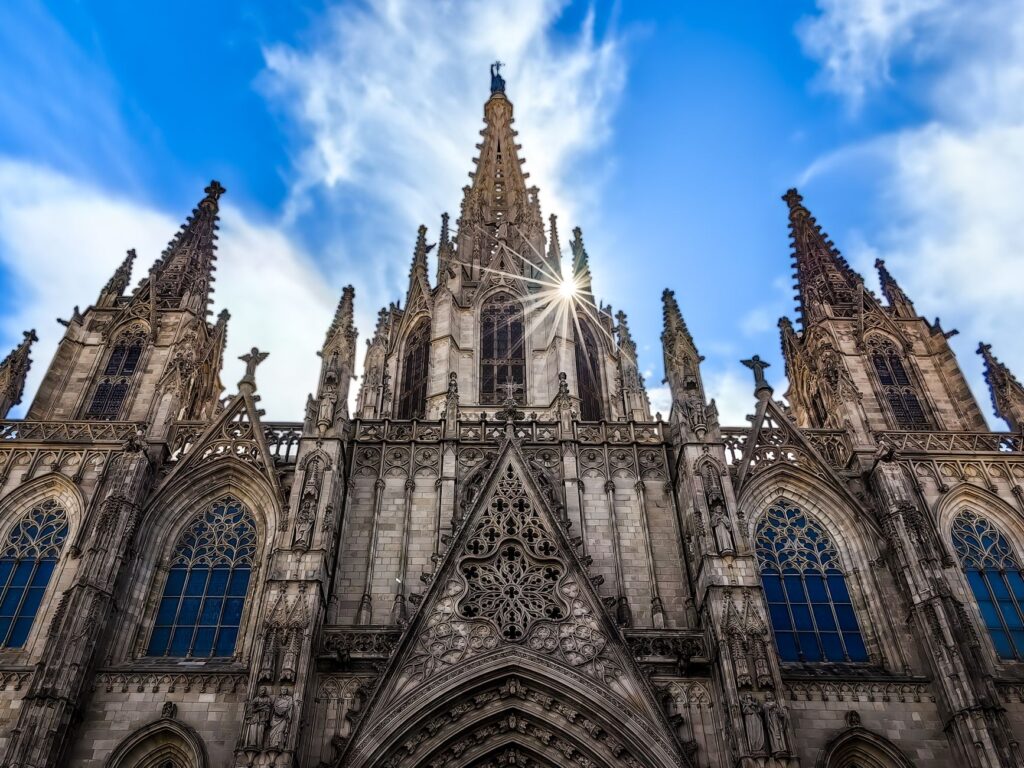
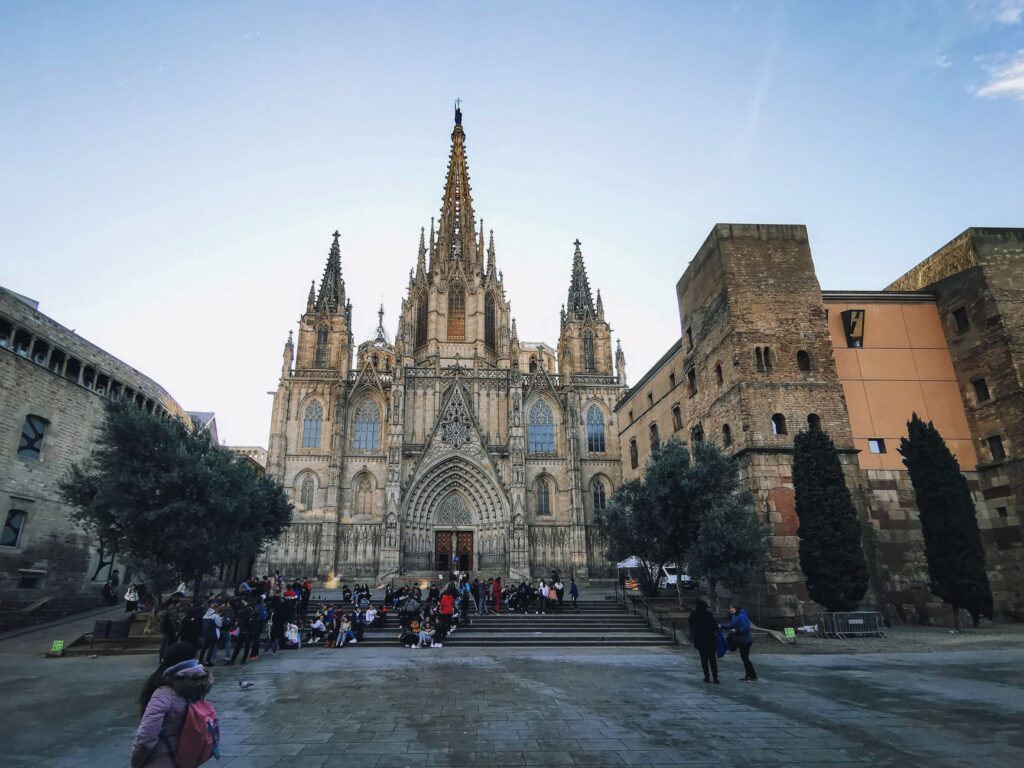
The location of the fair is no minor detail; it constitutes a determining element of its identity. Standing in front of the Cathedral of the Holy Cross and Saint Eulalia means traversing a space where the millennial stones of the cloister and the Gothic buttresses act as silent witnesses to human passage. The monumental scale of the temple deliberately contrasts with the ephemeral fragility of the wooden stalls, generating a visual and emotional tension that captivates both the casual visitor and the historian.
During the weeks the setup lasts, the plaza transforms into a sort of ephemeral agora where echoes of the city’s guild past converge with the cosmopolitan bustle of the present. The porticoes of Plaça Nova and the surrounding streets recover a pedestrian and commercial vocation that dates directly back medieval Barcelona, reminding the passerby that this territory has historically been a crossroads of merchant paths.

The Fira de Santa Llúcia is not merely a seasonal market; it is Barcelona’s most enduring ethnographic archive, where every wooden stall preserves a fragment of Catalan collective memory against the advance of global homogenization.
The Universe of the Catalan Crib and Artisan Trades
If this historic market stands out for anything, it is its unwavering fidelity to the Catalan nativity tradition, whose particularities differ markedly from Castilian or Neapolitan representations. Here, the Nativity scene is not just the classic depiction of the birth, but a complex rural diorama where daily peasant life takes absolute center stage through handcrafted, hand-painted figures.
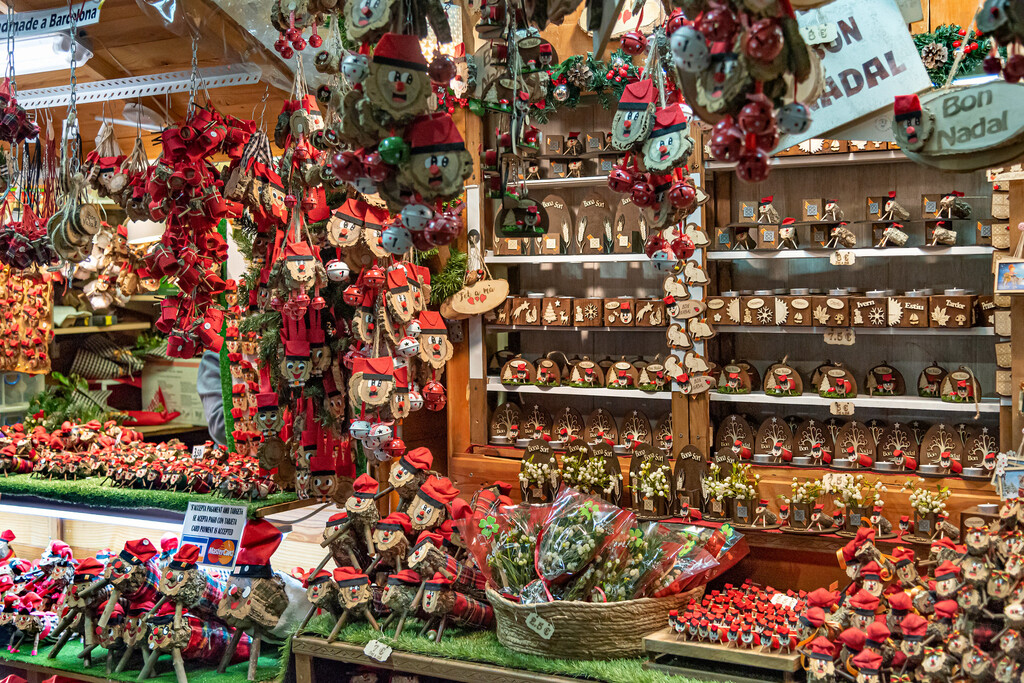
Among the most unique elements popounding the counters are traditional zambombas, fir branches, natural moss, cork extracted from the cork oak forests of Girona, and the characteristic Tió de Nadal, a magical log with a red barretina hat that children care for and feed for weeks before making it ‘poop’ gifts on Christmas Eve. The presence of artisans who have spent generations molding these pieces guarantees the transmission of know-how that survives outside of mass industrial production.
The Green Section: Trees, Moss, and Nature in the City
One of the most aromatic and busiest areas of the fair is the traditional section dedicated to Christmas vegetation. Unlike the imported plastic Christmas trees that dominate large commercial areas, the Fira de Santa Llúcia maintains an offer linked to live nature, sourced from controlled and regulated forestry operations in the Catalan Pyrenees and Pre-Pyrenees.
The smell of fresh pine, resin, and damp wood permeates the air of the plaza, instantly transporting the visitor to mountain forests. Alongside fir trees of various varieties and sizes, vendors offer bunches of mistletoe—traditionally considered a symbol of good luck and protection for the home—holly, and raw cork, essential elements for the artisan construction of miniature landscapes decorating Catalan homes during the holidays.

Living Traditions: The Caganer and Other Iconic Figures
No analysis of the fair would be complete without mentioning the undisputed protagonist of popular Christmas culture in Catalonia: the Caganer. This traditional figure, discreetly hidden in a corner of the nativity scene, depicts a peasant crouching in a physiological posture and has evolved over the years into a global sociological phenomenon, incorporating humorous replicas of famous figures from politics, sports, and culture.
Far from being interpreted as disrespectful, local anthropologists and historians point out that the Caganer symbolizes the fertility of the earth, good luck, and the democratization of sacred space, reminding us that all human beings, regardless of status, share the same earthly needs. Acquiring one at the fair’s stalls is an inescapable ritual for thousands of families seeking the latest addition to their private collection every year.
Cultural and Social Impact in Contemporary Barcelona
In a globalized metropolis subjected to intense tourist pressures, the survival of the Fira de Santa Llúcia for over two centuries constitutes a true exercise in cultural resistance. The market not only survives, but acts as an element of intergenerational cohesion where grandparents, parents, and grandchildren share a common cultural code rooted in the territory.
Local institutions and fairground associations have successfully managed the delicate balance between the massive influx of visitors and the preservation of artisan authenticity. Through strict regulations governing the typologies of permitted products—prioritizing local craftsmanship over cheap imported goods—the fair has managed to keep its patrimonial dignity intact against the temptation of commercial trivialization.
Practical Information for the Visitor
Visiting the Fira de Santa Llúcia requires some planning to fully enjoy its atmosphere without the extreme crowds of weekends or the eves of holidays. The market typically opens its doors in late November and runs continuously until December 23, occupying the entirety of Plaça de la Seu.
Typical Hours: On weekdays, opening hours generally run from 10:30 AM to 8:30 PM or 9:00 PM. On weekends and holidays, the schedule expands slightly in the morning, usually opening at 10:00 AM. It is highly recommended to visit early in the morning or during the early afternoon from Monday to Thursday to explore the more than two hundred stalls with peace of mind.

How to Get There: Its location right in the Gothic Quarter makes private vehicles inadvisable due to traffic and parking restrictions. The most efficient option is public transit: the nearest metro station is Jaume I (Line 4), located a mere five-minute walk away, or Liceu (Line 3), crossing Via Laietana or the historic Call jueu area. Numerous urban bus lines (such as V15, V17, or 47) stop nearby.
Visual Closure and the Persistence of the Christmas Spirit
Walking among the centennial stalls of Santa Llúcia as evening falls and lights turn on over the cathedral stone is to experience the certainty that certain traditions do not age, but rather transform into sanctuaries of humanity.
More than 230 years after its first official mention, the Fira de Santa Llúcia continues to fulfill its foundational purpose: to pause time for a moment and remind citizens that Christmas is, above all, an exercise in encounter, memory, and attachment to simple things. Facing the vertigo of digital society, this corner in front of the Barcelona cathedral stands as a tangible reminder that history can also be touched, smelled, and celebrated in community.
Source: Diario del Viajero

