There are places in the world where nature does not merely demand to be contemplated, but rather insists on being breathed with an almost physical intensity. The island of Taha’a, suspended in the turquoise vastness of French Polynesia, is one of those privileged enclaves. Historically renowned for the sweet, intoxicating aroma of its vanilla plantations, this island has revealed an entirely different facet to one of the most brilliant minds in contemporary perfumery. Christine Nagel, the bold and poetic creative director of perfumery at Hermès, has decided to literally submerge herself beneath the surface of this paradise to capture an essence that challenges the conventions of traditional marine fragrances. Her journey was not a simple search for raw materials, but a deep dive into the texture of water, the color of reefs, and, above all, the subtle and evocative caress of salt on human skin exposed to the South Pacific sun.
A Sensory Journey to the Heart of French Polynesia
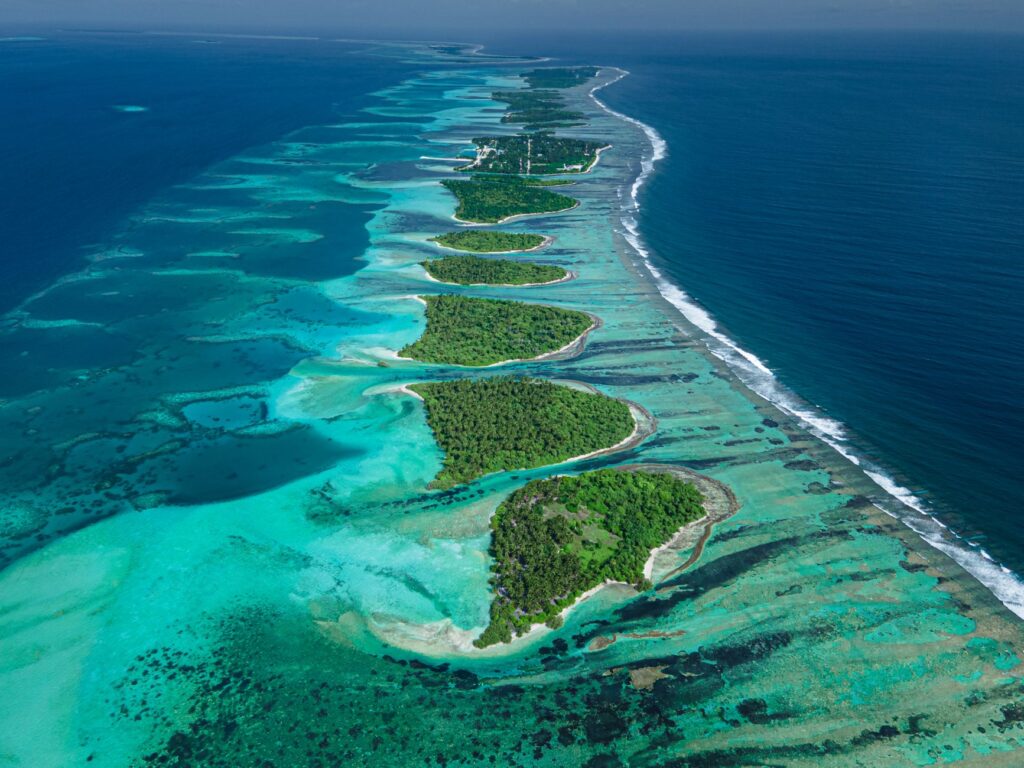
Arriving in Taha’a requires accepting a rhythm of life governed by tides and trade winds. Surrounded by the same lagoon it shares with its sister island, Raiatea, Taha’a presents itself to the traveler as a floating garden of untamed vegetation and waters of an almost unreal transparency. For Christine Nagel, this setting was not just a destination for rest, but a blank canvas to explore new olfactory frontiers. The creator, known for her ability to translate visual and tactile textures into aromatic accords, was fascinated by the constant transition between the open ocean and the stillness of the coral lagoon.
The island’s air is thick with dense humidity, heavy with the evaporation of seawater and the transpiration of the tropical rainforest covering its hills. Walking along its fine sand beaches or sailing in a traditional outrigger canoe, one senses a constant oscillation between the freshness of the easterly wind and the heat radiating from the volcanic earth. It was in this contrast that Nagel found the spark of inspiration for her new work: the need to capture not just seawater, but the physical memory of water on the body.

«Perfume is not merely a scent; it is an emotional map that reconstructs the physical memory of a distant shore.»
The Vision of a Master Perfumer
Since her arrival at the legendary Parisian maison, Christine Nagel has stood out for her intuitive and deeply human approach to perfumery. Far from mathematical formulas and fleeting market trends, Nagel works like a sculptor of the intangible. At Hermès, a house where respect for craftsmanship and raw materials is a secular religion, the perfumer enjoys absolute creative freedom. This freedom allowed her to travel to French Polynesia without a predetermined brief, with the sole purpose of allowing herself to be moved by the environment.
Nagel does not seek to recreate the common scents that the industry associates with the tropics: synthetic coconut, overly sweet solar flowers, or artificial ozone. Her quest is far more intimate and complex. Diving into the waters of Taha’a, Nagel experienced the tactile sensation of saltwater—a mineral density that clings to the skin and, upon drying under the sun, transforms into a crystalline, aromatic veil. This physical transformation of salt on the epidermis is the conceptual core of her new proposal for Hermès.
The Mystery of Salt and Skin
Salt, by definition, is odorless in its dry, pure state. However, when it comes into contact with water, human skin, and solar heat, it becomes one of the most potent sensory catalysts in the natural world. Nagel set herself the technical and artistic challenge of giving scent to the invisible: the saline trail left after a swim in the sea. To achieve this, the perfumer explored the interaction between mineral notes and organic accords that mimic the warmth of sun-warmed skin.
This salty aroma is neither cold nor purely marine; it possesses a carnal, almost animal warmth, yet of extreme elegance. By avoiding the clichés of traditional aquatic notes from the nineties, which often relied on synthetic molecules like calone, Nagel turned to a palette of ingredients that evoke the rough texture of sea salt, the warmth of ambergris, and the subtle roughness of driftwood washed ashore by the tide. The result is a fragrance that does not smell like a postcard ocean, but like the lived experience of having inhabited that ocean.
Taha’a: Beyond the Myth of Vanilla
It is impossible to talk about Taha’a without mentioning its famous Vanilla tahitensis, considered by chefs and perfumers worldwide as the black gold of gastronomy. Its plantations, tended with almost mystical care by local families who pollinate each flower by hand, scent the island’s interior with notes of licorice, prune, and damp wood. However, Christine Nagel’s journey deliberately sought to distance itself from this olfactory monoculture to focus on the marine ecosystem that surrounds and protects the island.
The coral reef of Taha’a is one of the most vibrant living structures on the planet. Beneath the water’s surface, life erupts in a symphony of colors that Nagel describes as an overwhelming visual experience. Coral formations, anemone gardens, and the white sand of the seabed create a microclimate where water takes on different densities and temperatures. It is this underwater dynamism, rather than the static sweetness of vanilla, that defines Taha’a’s true character for the Hermès creator.
«In Taha’a, the water does not simply surround the land; it penetrates the soul of those who dare to look beneath its turquoise surface.»
Translating the Color Blue into Olfactory Notes
How does one translate the blue of the Polynesian sea into a scent? For Nagel, the creative process involves constant synesthesia. The different shades of blue in Taha’a’s lagoon—from the pale turquoise of the sandy shores to the deep ultramarine of the open ocean—correspond to different olfactory intensities in the fragrance. The top notes, light and sparkling, evoke sunlight reflecting off the shallowest waves, using subtle citrus and fresh water notes.

As the fragrance settles on the skin, the heart of the composition is revealed, corresponding to the depths of the lagoon. This is where the salinity becomes present, combined with a subtle floral quality that recalls not a terrestrial garden, but marine vegetation and driftwood that has drifted for months. It is a scent with volume, expanding with body heat and recreating the sensation of being surrounded by a liquid, protective immensity.
The Art of Subtlety in Hermès Perfumery
The philosophy of Hermès has always been linked to discretion and non-ostentatious luxury. In perfumery, this translates into fragrances that do not invade another’s space, but rather invite them to draw closer. Christine Nagel’s creation inspired by Taha’a faithfully follows this premise. It is not a perfume that screams its presence, but a second skin that accompanies the wearer like an intimate memory.
The choice of raw materials reflects this commitment to excellence. Each ingredient has been selected for its purity and its ability to interact uniquely with the chemistry of each individual’s skin. This causes the salty touch of the perfume to vary significantly from person to person, turning the fragrance into a deeply personalized experience. It is Nagel’s mastery in balancing mineral freshness with human warmth that elevates this creation to the status of an olfactory work of art.

A Dialogue Between Fresh Water and Marine Salinity
On a technical level, the fragrance is structured as a constant dialogue between attracting opposites. On one hand, we find the purity of fresh water, represented by clean, almost crystalline notes that evoke the hidden waterfalls in the interior of the Polynesian islands. On the other hand, the salinity of the ocean provides a vibrant tension, an almost physical texture that prevents the perfume from becoming excessively ethereal or fleeting.
This balance is achieved through the use of precious woods that act as an anchor on the skin. Woods that suggest the structure of traditional Polynesian vessels, the sandalwood sometimes used in local rituals, and the warmth of cedar exposed to the elements. These base notes ensure that the salty touch remains on the skin for hours, slowly transforming throughout the day like an imperceptibly rising and falling tide.
Practical Guide for the Traveler Seeking the Essence of Taha’a
For those wishing to personally experience the environment that inspired Christine Nagel, traveling to Taha’a requires careful planning that respects the island’s fragile ecosystem. Access is usually by boat from the neighboring island of Raiatea, which has a local airport connected to Papeete, the capital of Tahiti.
- How to get there: International flights to Faa’a International Airport (PPT) in Tahiti, followed by a 45-minute Air Tahiti domestic flight to Raiatea. From there, a 20-minute speedboat transfer will take you to Taha’a.
- Best time to travel: From May to October, during the dry season, when temperatures are cooler and trade winds keep the air clear and the sea calm, ideal for sailing and diving.
- Essential experiences: Visit a black pearl farm in the lagoon, explore an organic vanilla plantation in the Faaha Valley, and snorkel in the Coral Garden, located between two motus (islets) north of the island.
- Environmental respect: It is essential to use biodegradable sunscreens that do not harm coral reefs and to follow the instructions of local guides when interacting with marine life.
The Legacy of a Suspended Moment in the Pacific
Ultimately, what Christine Nagel has achieved with this creation for Hermès is to bottle a moment of absolute communion with nature. In an accelerated world, where travel is often consumed through screens, this perfume proposes a return to the physical, the sensory, and the ephemeral. It is an invitation to feel the salt on your skin, to remember the freshness of the ocean, and to let yourself be carried away by the current of one of the most beautiful islands on the planet.
The beauty of Taha’a lies not only in its postcard landscapes, but in the subtlety of its details: the rustle of palm fronds, the warmth of black sand under bare feet, and that unmistakable scent of sea and sun that now, thanks to Nagel’s sensitivity, we can carry with us to any corner of the world.
Source: Condé Nast Traveler España