

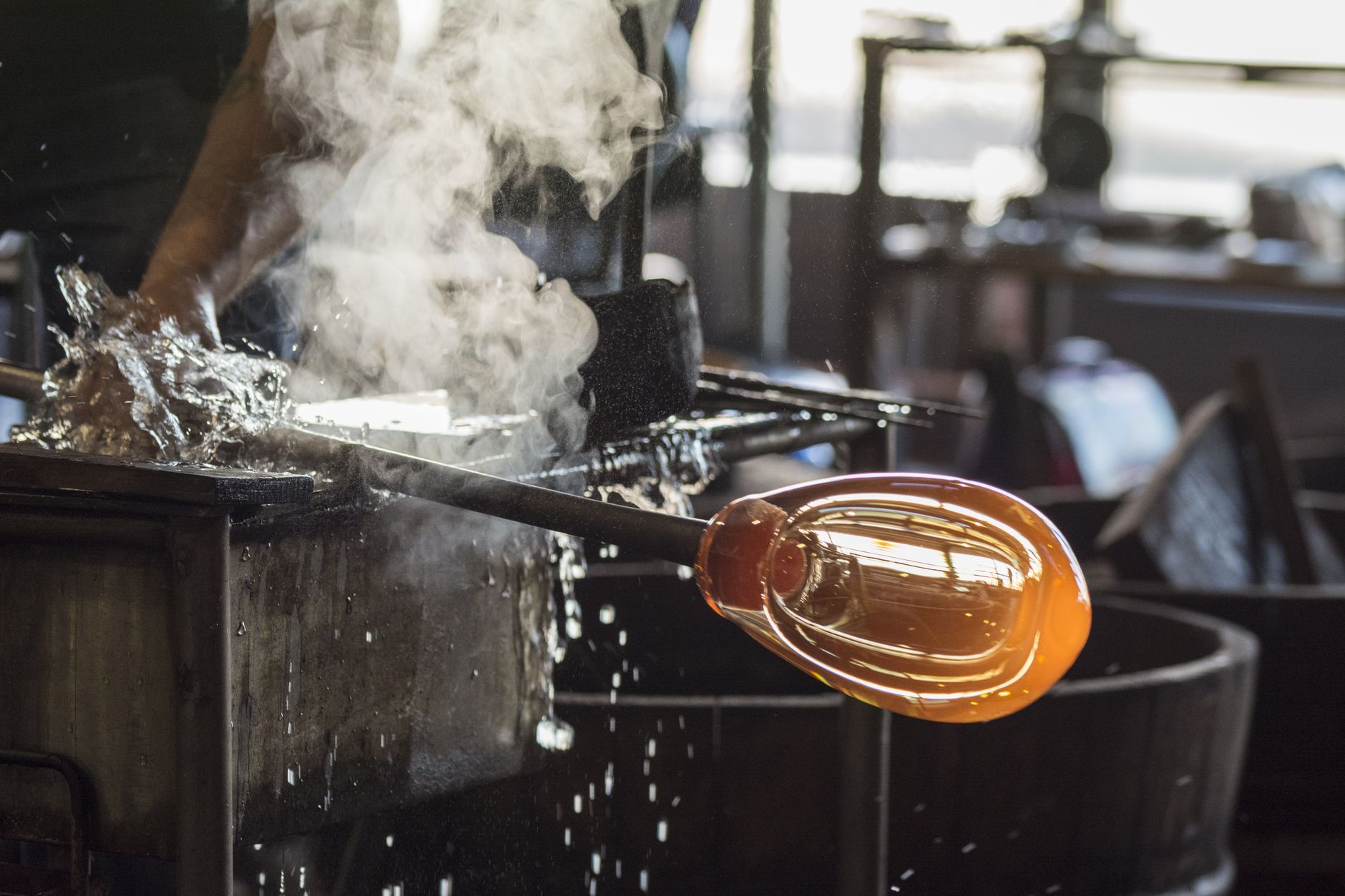
The Island of Fire and Silence in the Northern Lagoon
Just a few kilometres away from the tourist bustle of St. Mark’s Square, the island of Murano maintains its own temporal pulse, marked by the constant flicker of furnaces and the muffled murmur of water against stone docks. For centuries, this Venetian archipelago has guarded with hermetic secrecy the secrets of an ancient alchemy: the transformation of silica into living matter through extreme heat. Today, this artisanal ecosystem not only resists the onslaught of globalization, but faces a structural metamorphosis driven by environmental urgency and aesthetic renewal. Traditional workshops, direct heirs of the ordinances issued by the Serenissima Republic in the thirteenth century, find themselves torn between the strict preservation of their roots and the adoption of clean technologies to ensure their survival into the twenty-first century.
The contemporary challenge for master glassmakers transcends mere technical skill. In an era dominated by mass production and industrial standardization, Murano glass stands as a bastion of slowness and singularity. Each handmade piece embodies a millimetric choreography where exposure time to fire, the density of metallic oxides, and the lung capacity of the blower determine an unrepeatable result. However, the historical dependence on natural gas and the demands for carbon emission reduction have forced the artisanal community to rethink its production methods from the ground up, seeking a delicate balance between millennial tradition and ecological responsibility.
The Energy Transition in Centuries-Old Furnaces
The beating heart of any Murano workshop is its furnace, a refractory structure that remains lit twenty-four hours a day, three hundred and sixty days a year. Extinguishing the crucible means risking the structural integrity of the brick and losing weeks of thermal calibration. For generations, this incessant fire has been fueled exclusively by fossil fuels, generating a significant ecological footprint. Currently, local artisan associations and industrial research consortia collaborate to modernize these systems without altering the quality of the molten material. The integration of high-efficiency burners, waste heat recovery, and the study of alternative gas mixtures aim to mitigate the environmental impact of an intrinsically energy-intensive practice.
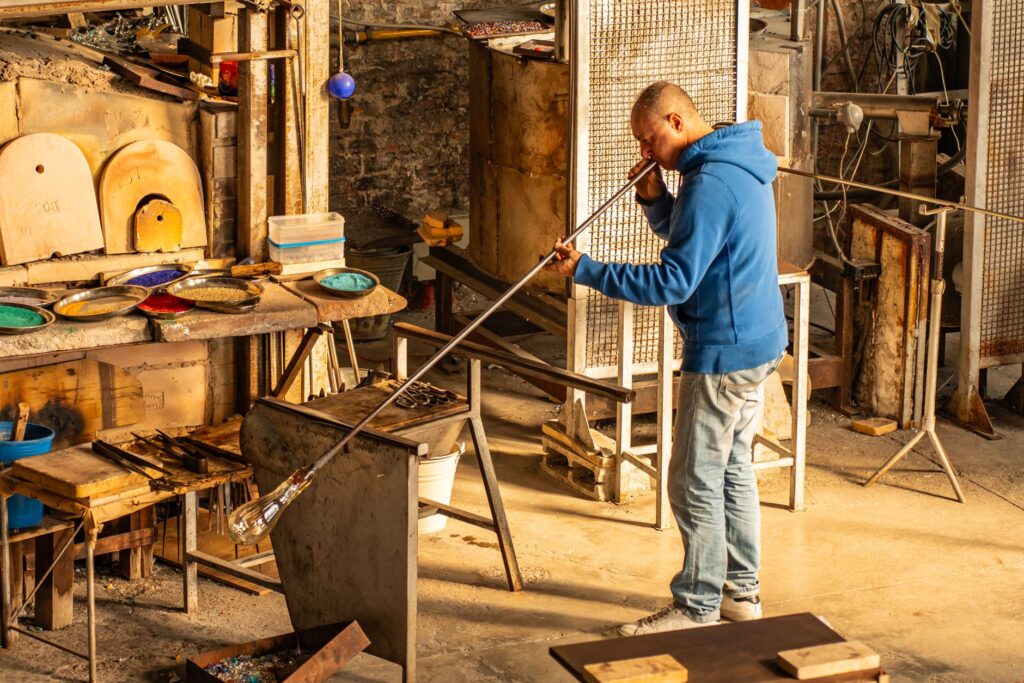
This transition is not without skepticism among veteran masters, who argue that the chemical atmosphere of the traditional furnace is irreplaceable. For them, any alteration in temperature or air composition inside the melting chamber can subtly modify the color and malleability of the glass, altering the nuances that distinguish an authentic Murano piece from any other industrial imitation. Despite these reluctances, European regulatory pressure and rising energy costs have acted as inevitable catalysts, forcing workshops to innovate in silence, experimenting with induction electric furnaces and state-of-the-art thermal insulation systems that promise to keep the flame alive with a fraction of historical consumption.
Glass is not a passive material; it possesses memory, demands respect, and punishes any hint of impatience with immediate deformation.
The Chemistry of Color and the Heritage of Formula Books
One of Murano’s best-kept secrets lies in its formula books, handwritten manuscripts kept away from public light that record the exact proportions of minerals and oxides required to achieve impossible hues. Cobalt blue, ruby red obtained through the addition of colloidal gold, or the milky white of opaline glass depend on millimetric precision passed down from generation to generation, frequently within the family sphere. This oral and practical transmission of knowledge constitutes the core of the island’s intangible heritage, internationally recognized yet precariously protected against commercial piracy and global counterfeiting.
In contemporary artisan laboratories, this alchemical tradition dialogues with modern scientific research. Young chemists and industrial designers work hand-in-hand with master blowers to purify raw materials, eliminating impurities without losing the chromatic richness characteristic of the medium. Likewise, research is underway into the incorporation of post-consumer recycled glass into the melting mixtures, a complex process due to the disparity in melting points of the various recovered objects. This effort to close the material’s life cycle responds not only to sustainability criteria, but to an ethical demand that international buyers increasingly demand when acquiring art glass.
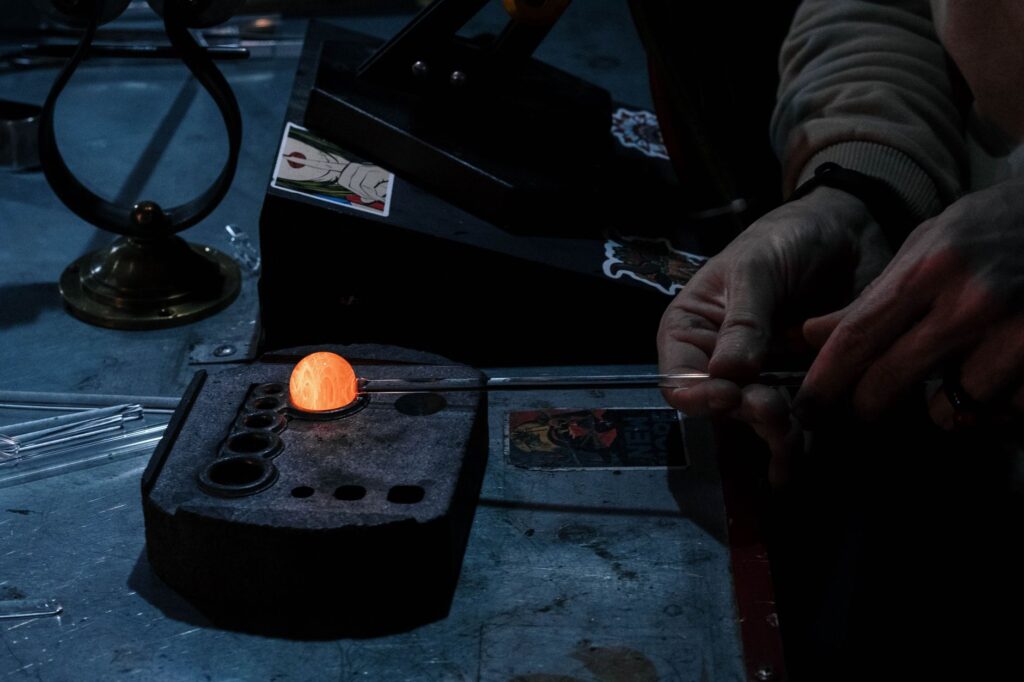
The Dialogue Between the Master and the Contemporary Designer
For decades, the Murano glass sector entrenched itself in the production of traditional decorative objects—ornate chandeliers, animal figures, and floral vases—that satisfied mass tourism demand. However, the true vanguard of the island today manifests itself in the close collaboration between historical workshops and international figures of contemporary design and architecture. Creators from all over the world flock to the lagoon to test the physical limits of the material, challenging local masters with complex geometric projects, monumental installations, and minimalist sculptures that redefine the aesthetic perception of Venetian glass.
These synergies require a profound exercise of cultural translation. The designer brings an abstract conceptual vision devoid of traditional ties, while the master glassmaker possesses visceral knowledge of gravity, viscosity, and cooling time. From this creative clash emerge pieces that disorient the habitual observer, proving that Murano is not an open-air museum frozen in its glorious past, but a living laboratory of material experimentation. Exhibitions in design biennials and global contemporary art galleries reflect this renaissance, once again positioning Venetian glass at the pinnacle of international artistic creation.
Geography of Workshops: A Journey Through the Insular Fabric
Exploring Murano requires moving away from the main canals and venturing into less-traveled alleys, where the sound of circular saws cutting defective pieces or the rhythmic blowtorch hiss betrays the presence of active studios. The island’s urban fabric is crisscrossed by small private docks and old exposed-brick warehouses that now function as production centers and independent exhibition spaces. Venues such as the Glass Museum (Museo del Vetro), located in the historic Palazzo Giustinian, offer the indispensable historical context to understand the technical magnitude achieved in the Republic’s golden centuries, serving in turn as a reference point for researchers and students flocking to the island.
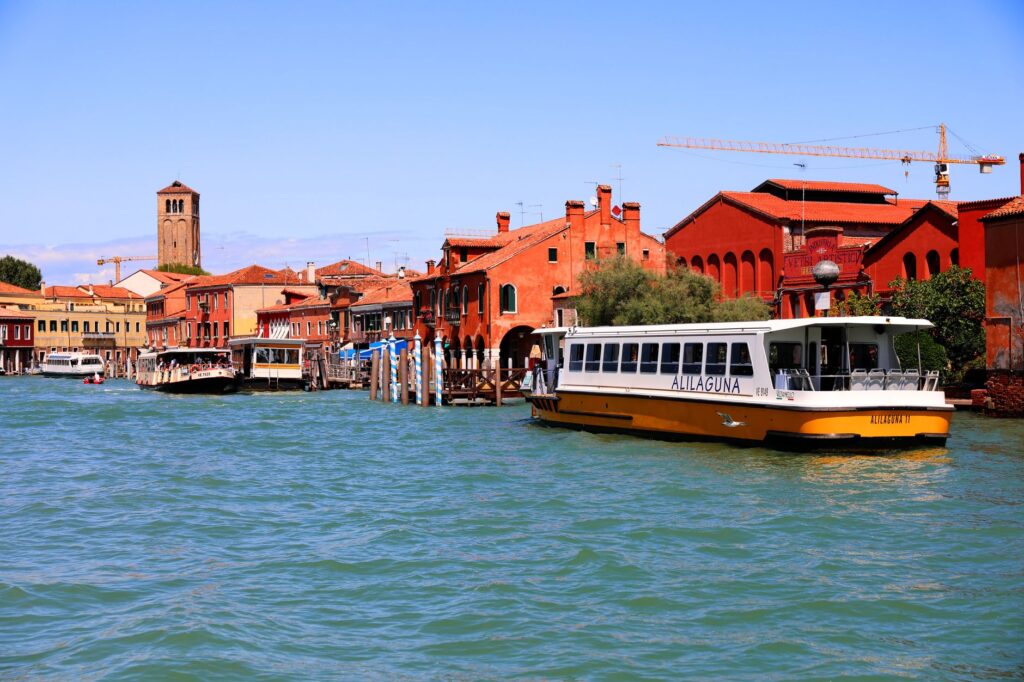
Unlike other areas of Venice, where retail trade has completely displaced local productive activity, Murano retains a vibrant community of workers who live and breathe to the rhythm of the island. Founders, grinders polishing surfaces with water wheels, acid etchers, and bead stringers form an irreplaceable human value chain. Each link in this specialized ecosystem is indispensable; the collapse of even a single craft breaks the ability to finish a complex work, evidencing the structural fragility of an economic model based on hyper-specialized knowledge that is difficult to replace.
Generational Turnover and the Abate Zanetti Glass School
One of the greatest challenges facing the glassmaking community is ensuring generational turnover in a physically demanding trade, exposed to high temperatures and requiring years of intensive practice before achieving mastery. To counter the disinterest of local youth in traditional manual jobs, institutions like the Scuola Abate Zanetti play a fundamental role. This center combines advanced technical training with artistic experimentation, offering specific programs to train new talents in blowing, engraving, and design applied to glass.

Workshops have also begun opening their doors to international artistic residency programs, attracting young creators from Europe, Asia, and America seeking to learn directly alongside old masters. This cultural openness not only revitalizes the local panorama, but injects new aesthetic perspectives and ensures the financial survival of independent furnaces. Nevertheless, experts agree that the true test will be ensuring that younger generations find in the trade not just a means of subsistence, but a vocation of cultural pride comparable to that of their ancestors.
True mastery does not lie in mastering fire, but in learning to negotiate with it every second before the material decides its own form.
Conservation of Intangible Heritage Against Counterfeiting
The international prestige of Murano glass has made its products a constant target of mass counterfeiting, frequently manufactured in Asian countries and imported into Italy to be sold to uninformed tourists as authentic Venetian craftsmanship. This unfair competition not only erodes the economy of local workshops, but devalues the global perception of the product, confusing the consumer regarding the real standards of quality and effort implied by a genuine work. In response, local institutions and the Veneto region have promoted certification marks of origin and legal protection denominations intended to shield the authenticity of the product against commercial fraud.
Quality control and raw material traceability have become strategic priorities for the sector. Legitimate workshops include cold-point engraved seals on the pieces and certificates of authenticity signed by the executing master. However, consumer education remains the most effective tool for heritage defense. Guided tours of the furnaces, promoted by cultural associations and the artisans themselves, seek to reveal to the public the true effort behind each object, transforming the passive tourist into a conscious consumer respectful of the value of handmade work.

Practical Information for the Traveler and Cultural Researcher
Visiting Murano with a cultural and respectful perspective requires planning and sensitivity toward the artisans’ schedules. The island is easily accessible via the public vaporetto service from Venice (lines 3, 4.1, and 4.2), with departures regularly from key stations such as Fondamenta Nuove or Ferrovia. It is recommended to schedule the visit during morning hours, when furnace activity reaches its peak intensity and masters are most receptive to receiving visitors interested in the production process, always by prior appointment or through guided visits arranged via authorized workshops.
When acquiring glass pieces, it is essential to request the official certificate of origin and verify that the shop features the Veneto region’s quality guarantee seal (Trademark of Origin Law 70/94). For those interested in delving deeper into technical history, the Glass Museum opens daily and offers an exceptional collection of archaeological and Renaissance pieces. It is advisable to avoid impulsive purchases in street souvenir stalls and prioritize direct dealings with the master craftsmen’s studios located in secondary streets, thereby directly contributing to the economic sustainability of the local community.
Visual Close: The Persistence of Art in the Lagoon
When dusk falls over the lagoon and the sunset reflects to set Venetian palaces ablaze, Murano recovers a reflective calm that contrasts with the furious heat of its innards. The furnaces continue to roar in the dimness, keeping alive a tradition that has survived pandemics, wars, economic crises, and the most radical technological transformations in human history. In every bubble trapped inside a vase, in every perfectly aligned color cane, and in every flash of light refracted on blown crystal, the incorruptible memory of a people who decided to entrust their destiny to the transformative power of fire endures.

