The Iron Scar That Defies the Abyss
There are geographies where human progress has not consisted of subduing nature, but rather of engaging in a quiet negotiation with it. In the south of Lugo province and northern Ourense, where the Miño and Sil rivers carve out granite rock gorges exceeding five hundred meters in vertical drop, the railway ceased to be a mere means of transport in the late 19th century and became a bold declaration of architectural intent. The rail line connecting Monforte de Lemos to Ourense, winding through the heart of the Ribeira Sacra, represents one of the most complex civil engineering feats in the Iberian Peninsula—a route where every single kilometer demanded the titanic effort of blasting through solid rock with dynamite and pickaxes.
Traveling along this track, largely bypassed by high-speed corridors, is an exercise in industrial archaeology and slow contemplation. Far from contemporary haste, the regional trains plying this gorge move at a measured pace, allowing the traveler to gaze upon a landscape where human hands have sculpted the earth for two millennia. The Romans already understood the strategic and microclimatic value of this sheltered valley; centuries later, hermit monks raised Romanesque monasteries in the most inaccessible river bends. Yet it was the arrival of steam power, culminating definitively in the mid-20th century with the completion of its roughest stretches, that integrated this isolated region into economic modernity.
The Architecture of Dry Stone and Impossible Terraces
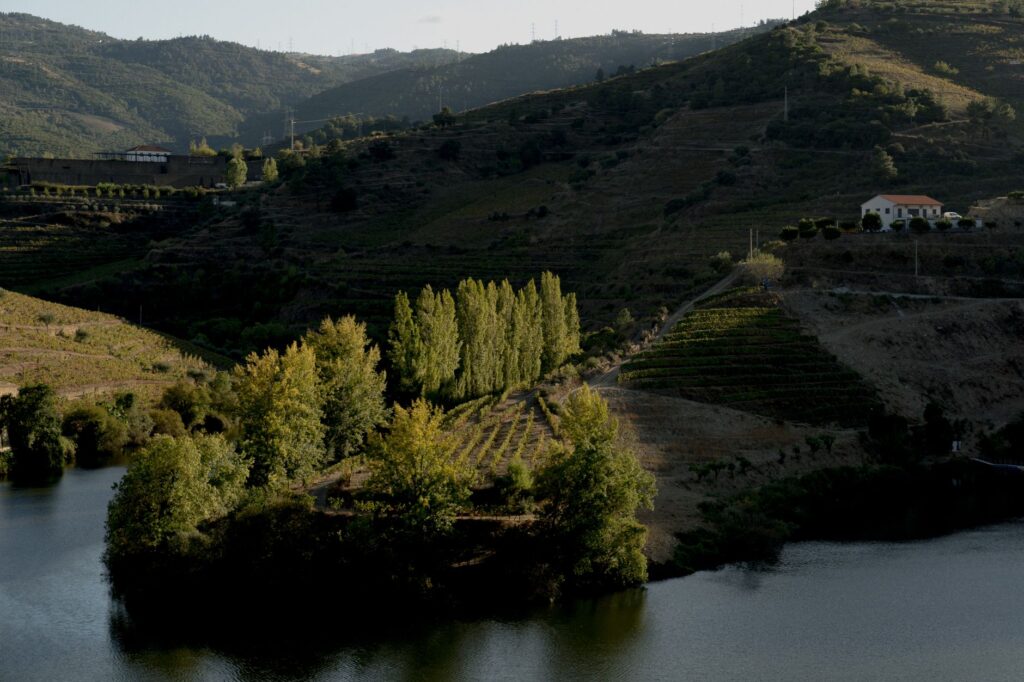
The visual argument dominating the railway journey is, unquestionably, heroic viticulture. From the train window, the traveler witnesses the dizzying spectacle of slopes with gradients of up to seventy percent, where arable land does not exist by nature, but has been constructed meter by meter. Local winemakers piled up slabs of slate and granite to erect millimeter-precise retaining walls, generating small stepped terraces known locally as socalcos. This agricultural system, unique in Europe for its extreme difficulty of mechanized farming, endows the landscape with an almost pre-Hispanic geometry.

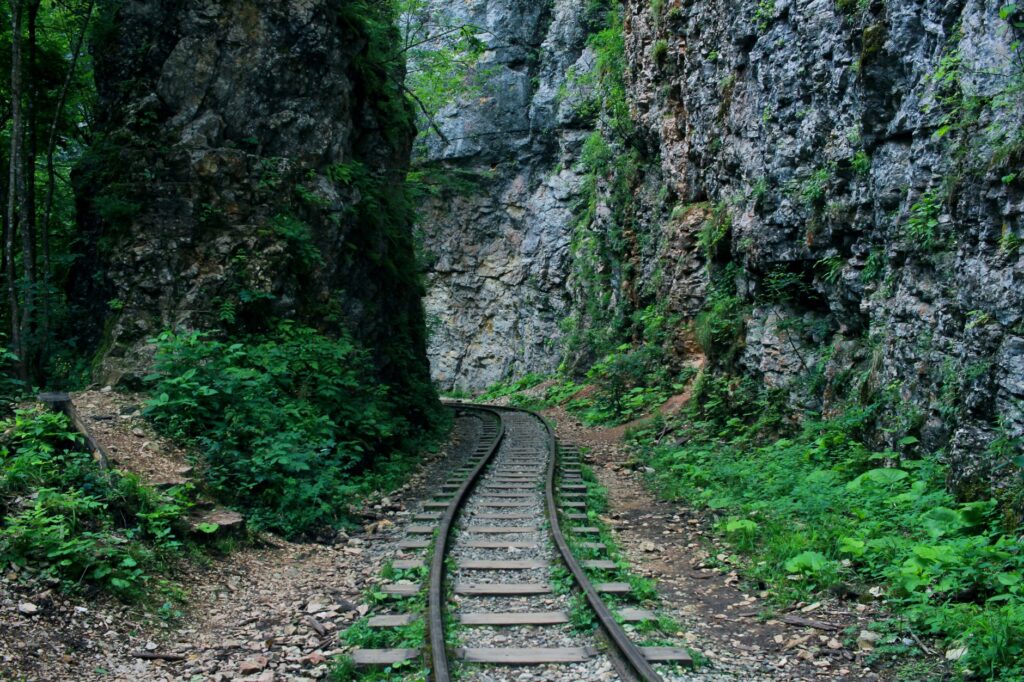
The train acts here as a privileged mobile viewpoint. While the convoys traverse successive tunnels bored directly into living rock—some featuring curves of such tight radii that the tail of the train is visible from the front cab—the landscape abruptly opens up to canyons where the dark green Sil River resembles a mirror. The coexistence of nineteenth-century railway infrastructure and medieval terraces creates a cultural ecosystem where geology sets the pace of life. Stops at tiny request halts like San Clodio-Quiroga or Santo Estevo do Sil evoke an era when the station was the sole umbilical cord to the outside world for entire villages hanging over the abyss.
The railway track of the Ribeira Sacra is not merely a communication infrastructure; it is the testament to a perfect collision between the industrial audacity of steel and the millenary patience of dry stone.
Engineering Below Zero: Tunnels, Bridges, and Metal Fatigue
Constructing and maintaining a rail line at the bottom of a river canyon involves colossal technical challenges. The works, formally initiated in the Galician section in the late 19th century but prolonged for decades due to orographic complexity, required the design of daring metal viaducts and dozens of tunnels piercing the mountain. The constant humidity from the riverbed and scarce sunlight in shaded zones historically tested the durability of materials, forcing Adif’s maintenance teams to conduct meticulous inspections on bridges and unstable slopes.
The late electrification of these sections and the preservation of historic overpasses lend an aura of authenticity that fascinates both railway enthusiasts and modern engineers. There are no hyper-technological signaling systems or LED screens at most of these rural halts; instead, classical track-crossing infrastructure, mechanical interlockings, and direct communication based on the expertise of drivers who know every meter of the route survive intact. This technical vulnerability, far from being a flaw, constitutes its greatest heritage appeal today, serving as a tangible reminder of how mobility was solved before global standardization.
Monasteries in the Mist and Monastic Silence
The train’s passage through the Ribeira Sacra also sheds light on why this territory was given such a name. The term derives from *Rivo Sacra*, first documented in the 12th century, referencing the high concentration of cenobies and monasteries that proliferated along its banks. From the perspective of the tracks, situated almost always at mid-level or on the canyon floor, monumental complexes like Santa Cristina de Ribas de Sil or San Pedro de Rocas—the latter carved directly into the mountain rock—can be glimpsed in the distance.
The morning atmosphere, marked by dense mists rising from the river and trapped between the canyon walls, endows the rail journey with an almost mystical dimension. Passengers opting for this mode of transport experience the same relative isolation sought by medieval anchorites. The metallic rattling over rail joints breaks the absolute silence of the valley, reverberating against the stone walls in a dry echo that temporarily startles the raptors inhabiting the cliffs.

The Traveler’s Logistics: How to Navigate the Line Today
Planning a train journey through the Ribeira Sacra requires rigor and patience, as conventional railway networks in inland Galicia do not operate with the frequency of major suburban hubs. The nerve center to begin the route is the station of Monforte de Lemos, a historic rail junction preserving workshops and significant working-class memory tied to coal and steam. From there, Regional trains operated by Renfe connect with Ourense, descending the course of the Sil.
It is essential to consult weekly updated schedules, as frequencies are usually tailored to local and student commuting patterns, limited to a couple of daily runs in each direction along certain sections. Securing tickets in advance and combining train journeys with strategic stops at stations like San Clodio—from where road transport leads to the canyon docks or marked hiking trails ascending to spectacular viewpoints—is strongly advised.
The Renaissance of Slow Rail Tourism
In a global context dominated by airport urgency and the blind velocity of high-speed rail, the Sil line stands as a bastion of slow travel. Local and regional institutions have begun valuing this corridor not only as an essential public service to anchor rural populations, but as a premier tourism asset. Special historical tourist train initiatives, promoted by heritage bodies, have demonstrated existing appetites for travel experiences where the journey matters as much as, or more than, the destination.
Yet the true value of this infrastructure lies in its everyday, sustainable use. Seeing local residents share a carriage with hikers equipped with hiking boots and winemakers interested in local Mencía and Godello varieties brings an irreplaceable human dimension. The train continues to fulfill its original social function: connecting isolated geographical areas without disrupting the fragile ecological balance of a protected river canyon.
Gastronomy and Territory: The Flavor of the Galician Platform
No journey through the Ribeira Sacra would be complete without understanding its inseparable link to inland gastronomy. In traditional taverns near the railway stations, the cuisine responds to the winter rigors of the Galician mountains and the generosity of its river gardens. Hearty dishes like *caldo gallego*, scallop empanada, or *carne ó caldeiro* are invariably paired with wines from the Ribeira Sacra Denomination of Origin, whose mineral acidity and freshness directly reflect the slate composition of the soil where the vines take root.
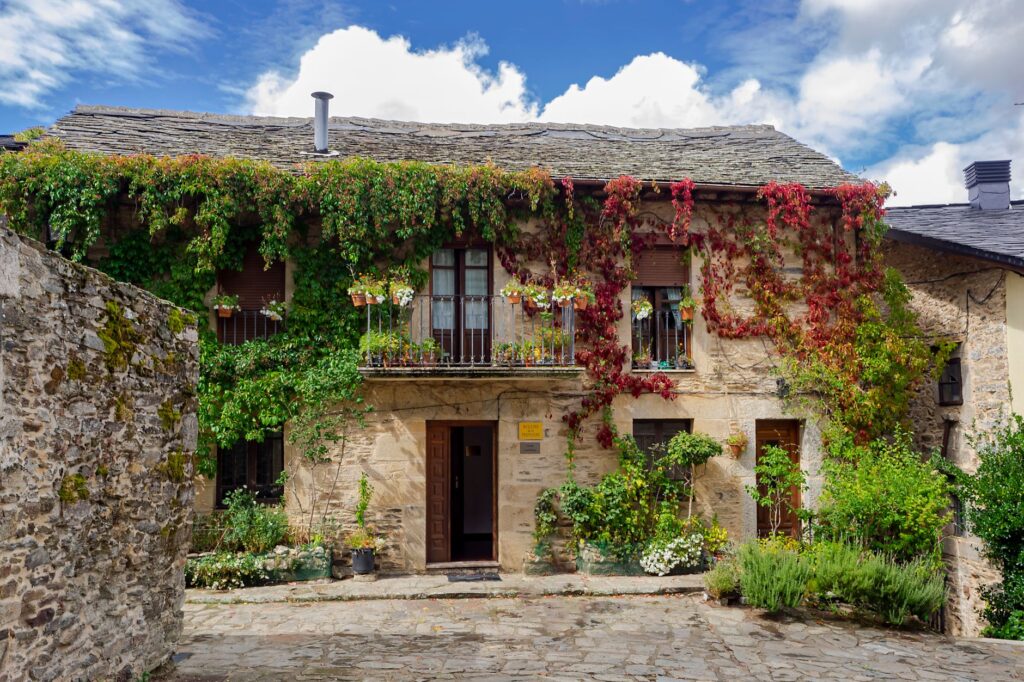
Small station canteens, many of them now converted into information points or simply closed to the public while retaining their original exposed stone and slate-roof architecture, preserve the memory of a time when the stationmaster was the undisputed authority of the village. Sitting on the wooden benches of a halt while awaiting the regional convoy connects travelers with a slowed-down temporality, where unhurried conversation replaces instant digital connectivity.
Towards the Preservation of Heritage on Rails
The future of the railway line crossing the Sil canyons raises complex debates between the modernization necessary to guarantee operational safety and the strict conservation of historical heritage. Replacing wooden sleepers with concrete or automating level crossings are inevitable processes from a technical standpoint, but they demand extreme sensitivity to avoid distorting the scenic character of a route running through protected natural spaces such as Natura 2000 networks and biosphere reserves.
The preservation of this rail corridor is, ultimately, a matter of cultural responsibility. It demonstrates that public transport can simultaneously serve as an engine for sustainable development, a tool for territorial cohesion, and an aesthetic vehicle capable of revealing the hidden beauty of Europe’s most inaccessible corners. The distant whistle of a train approaching a dark tunnel remains the firmest reminder that the adventure of inland travel is still possible.
Practical Guide for the Rail Traveler in the Ribeira Sacra
- How to get there: Monforte de Lemos and Ourense serve as the main gateways to the conventional Galician rail network, directly connected to Madrid and northern Spain via medium and long-distance services.
- Route line: The most scenic stretch runs between Monforte de Lemos and Ourense following the fluvial course of the Sil River, crossing canyons and rocky gorges.
- Frequencies and tickets: Renfe’s Medium Distance services operate with daily limitations. Checking official schedules and purchasing tickets in advance via authorized digital channels is essential.
- Best time to travel: Autumn, with the chromatic explosion of vineyards in ochre and reddish tones, and spring, with river flows at their peak, offer the most striking visual conditions.
- Recommended luggage: Comfortable clothing, footwear suitable for light hiking, and binoculars to observe the rocky cornices and canyon avifauna from the train.