Overcoming Insularity: A Landmark in European History
For centuries, the English Channel served as the ultimate natural barrier, defining British identity in contrast to the European mainland. It was not until the late 20th century that modern engineering achieved what Napoleon Bonaparte could only dream of: a permanent physical link beneath the seabed. The Channel Tunnel, opened in 1994, is not merely a masterpiece of civil engineering; it is the backbone of a transportation network that transformed travel logistics in Western Europe. Through this conduit, the Eurostar service has redefined the concept of distance, turning international journeys into simple metropolitan commutes.
The significance of this infrastructure transcends technical prowess. It represents the integration of historically incompatible railway systems and the creation of an economic corridor that moves millions of passengers and tons of freight annually. In this report, we analyze the complexity of its operations, the logistical challenges it faces today, and why it remains the absolute benchmark for cross-border connectivity.
Engineering the Abyss: The Challenge of the Seabed
The tunnel is not, in fact, a single structure, but a complex system comprising three parallel tubes: two single-way rail tunnels and a central service tunnel. With a total length of 50.45 kilometers—37.9 of which run beneath the sea—it holds the record for the world’s longest undersea section. The choice of the route was far from random; engineers had to identify a specific geological layer known as Chalk Marl, an impermeable rock formation that facilitated excavation and minimized water ingress.
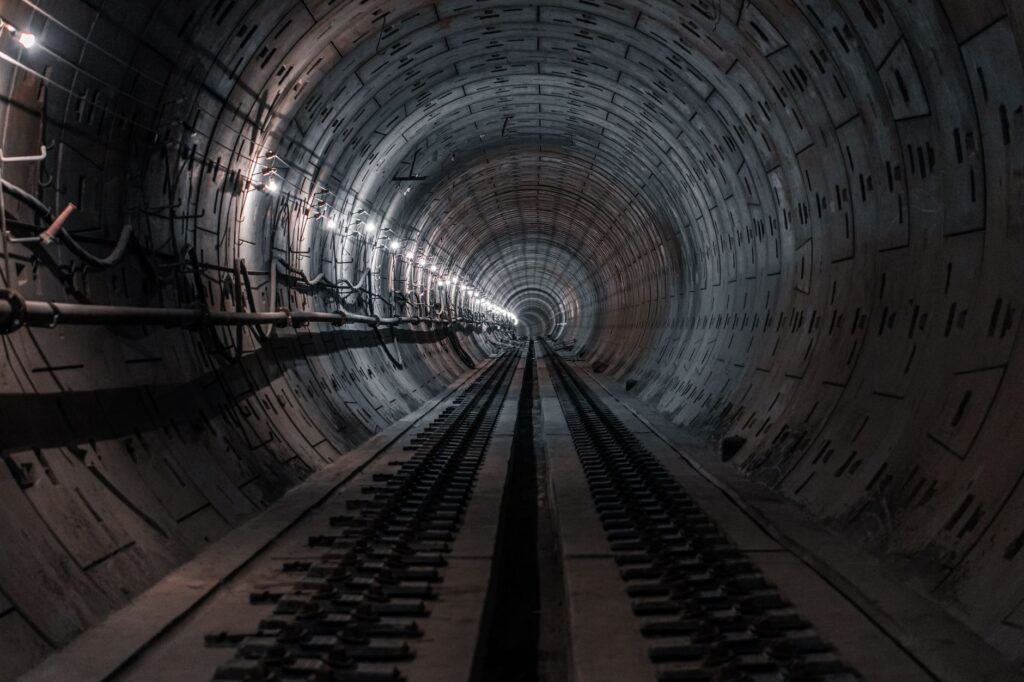
Construction involved eleven Tunnel Boring Machines (TBMs) of colossal proportions, working simultaneously from both the British and French sides. The moment the teams from both countries met under the sea in 1990 remains one of the most potent symbols of European cooperation. However, engineering did not end with the excavation. The system requires constant air pressure management; as trains travel at 160 km/h within the tunnel, they displace massive volumes of air that must be channeled through pressure relief ducts to prevent structural damage and ensure passenger comfort.
«The Channel Tunnel did more than join two coasts; it forever altered the perception of space and time in Northwest Europe, turning a geological obstacle into an invisible bridge of steel and concrete.»
Eurostar: The Evolution of High-Speed Rail
If the tunnel is the body, the Eurostar is the circulatory system. Since its first commercial journey, the service has evolved significantly in terms of technology and capacity. The original trains, the Class 373 (Eurostar e300), based on French TGV technology, were designed with unique safety standards, including the ability to split in two in case of an emergency within the tunnel. Over time, the fleet has been modernized with the introduction of the Siemens Velaro (e320), capable of reaching speeds of 320 km/h on high-speed lines outside the tunnel.

The logistics of operating these trains is a technical puzzle. They must be compatible with different signaling systems (TVM in France, KVB in Belgium, and British systems) and various electrical voltages. While the UK and France use 25 kV AC, older sections and connections in Belgium or the Netherlands require constant adaptations. This versatility allows a passenger to have breakfast at St. Pancras International in London and lunch at the Grand Place in Brussels in less than two hours.
Border Logistics and the Brexit Factor
The United Kingdom’s departure from the European Union has introduced a layer of logistical complexity that had not existed since the service’s inauguration. Before Brexit, passenger flow was virtually seamless. Today, the requirement for passport stamping and stricter customs checks has necessitated a redesign of the terminals. Iconic stations like Gare du Nord in Paris and St. Pancras in London have had to expand their border control zones to prevent bottlenecks.
This shift has impacted operational capacity. Although the trains can carry over 900 passengers, ticket sales are occasionally capped to avoid overwhelming immigration controls. The management of these juxtaposed borders—where British checks take place on French soil and vice versa—is a model of administrative efficiency under pressure, designed to ensure that boarding delays do not affect the rail departure punctuality, which remains consistently above 90%.

Sustainability: Rail as the Ethical Alternative to Aviation
In the context of the climate crisis, Eurostar has positioned itself as the undisputed leader in sustainable transport between European capitals. A train journey from London to Paris generates approximately 90% less CO2 emissions per passenger than an equivalent flight. This reality has sparked a change in behavior among both corporate and leisure travelers, who prefer the convenience of city-center-to-city-center travel, avoiding the lengthy transfers to peripheral airports like Heathrow or Charles de Gaulle.
The environmental commitment is not limited to journey emissions. The operator has implemented zero-waste policies in its catering services and utilizes energy from renewable sources to power its trains on Dutch and British soil. This competitive advantage is the primary driver of the company’s growth, as it now seeks to expand its network toward more distant destinations such as Germany and southern France, competing directly with short-haul airlines.

«The true victory of high-speed rail in Europe is not just speed, but its ability to offer a mass mobility model that respects planetary boundaries without sacrificing connectivity.»
Le Shuttle: The Rolling Bridge for Vehicles and Freight
It is essential to distinguish between the Eurostar passenger service and the Le Shuttle system, operated by Getlink. The latter is a rail ferry service that transports cars, buses, and trucks between the terminals of Folkestone and Coquelles. It is the largest system of its kind in the world, allowing a vehicle to cross the channel in just 35 minutes without the driver having to leave their car.
From a logistical standpoint, Le Shuttle is the vital artery for the supply of fresh goods and industrial components between the UK and the continent. Each freight train can measure up to 800 meters in length, a scale necessary to maintain the flow of global supply chains. During health crises or diplomatic tensions, the resilience of this service has proven critical to the food and economic security of the region.
Practical Planning and Tips for the Global Traveler
For those planning to use this corridor, preparation is key. Unlike regional European trains, Eurostar operates with mandatory reservations and dynamic pricing similar to airlines. It is recommended to book at least three months in advance to secure the most competitive fares. Service levels are divided into Standard, Standard Premier, and Business Premier, with the latter being the only one offering full flexibility and lounge access.

- Check-in Time: It is essential to arrive at least 60-90 minutes before departure due to security and passport checks.
- Luggage: Unlike airlines, there are no strict weight restrictions as long as the passenger can carry their own bags, and no liquid charges apply.
- Connectivity: All modern units feature onboard Wi-Fi and power outlets, facilitating work during the journey.
- Stations: St. Pancras International is a destination in itself, famous for its Neo-Gothic architecture and high-end dining options.
The Future of the Trans-European Network
The horizon for the Channel Tunnel is one of expansion. Following the merger with the Belgian operator Thalys, the Eurostar brand now connects London with destinations like Amsterdam, Cologne, and Dortmund. This integration allows for seamless travel logistics, where a single ticket can cover journeys from the Thames to the canals of the Netherlands. The future challenge lies in the liberalization of the tunnel; other operators have expressed interest in utilizing the infrastructure, which could increase competition and lower prices for users.
The resilience of the tunnel in the face of political and economic challenges confirms its status as one of the most important infrastructures in modern history. As Europe moves toward greater decarbonization, the tunnel and the high-speed trains that traverse it will continue to be the backbone of a continent that, despite its physical and political borders, seeks to remain indissolubly linked by steel rails.