The High Alpine Rite of Steel and Stone
The departure whistle at Chur station barely disturbs the morning calm of Switzerland’s oldest recorded settlement. As the narrow-gauge steel wheels grip the metre-gauge track, passengers aboard the Bernina Express embark on far more than a southward transit; they enter a living triumph of late nineteenth-century civil engineering. Operated by the Rhaetian Railway (Rhätische Bahn), this celebrated mountain corridor rejects the haste of modern transit in favor of a measured rhythm, where stone masonry viaducts and spiral tunnels orchestrate a seamless dialogue between human determination and raw alpine geology.
Unlike modern high-speed lines that drill indiscriminately through granite massifs to bypass terrain, the Albula and Bernina lines—jointly inscribed as a UNESCO World Heritage site in 2008—chose to climb openly across the landscape. Across 122 kilometers, the train negotiates gradients of up to 7 percent without the aid of a cogwheel rack, climbing from the Rhine basin to 2,253 meters above sea level at Ospizio Bernina, before descending with equal grace toward the palm trees and olive groves of Tirano in northern Italy. It remains one of the world’s singular journeys where bioclimatic and linguistic boundaries shift dramatically over the course of a single morning.
The Albula Gorge and the Landwasser Span
Departing Chur, the line tracks the milky waters of the Hinterrhein, gently gaining altitude toward Thusis before entering the sheer-walled Albula sector. Engineered by Friedrich Hennings at the turn of the twentieth century, this segment solved the steep rise through the Schyn and Albula gorges by employing enclosed helical tunnels. Within these dark spirals, the train loops continuously inside the mountain bedrock to gain altitude without exceeding the adhesion threshold where steel wheels lose traction against wet rails.
Near Filisur, the journey reaches its structural zenith at the Landwasser Viaduct. Built between 1901 and 1902 without traditional falsework due to the flash-flood risks of the torrent below, its six soaring limestone arches span 65 meters above the valley floor. The train sweeps along a tight 100-meter radius curve before plunging directly into the cliff-face portal of the Landwasser Tunnel. From the rear coaches, the red train appears suspended in mid-air above the pine canopy, its engine already swallowed by the rock.
- Total Route Length: 122 kilometers (76 miles) connecting Chur or St. Moritz with Tirano.
- Highest Summit Point: Ospizio Bernina at 2,253 meters (7,392 feet) above sea level.
- Lowest Terminal Elevation: Tirano at 429 meters (1,407 feet).
- Engineering Feats: 55 tunnels and snow sheds, 196 bridges and major viaducts.
- Maximum Gradient: 7% adhesion-only incline across the Bernina pass without cogs.
Engadin: The Plateau of Light and Romanesque Heritage
Clearing the 5.8-kilometer Albula Tunnel—the subalpine threshold dividing the North Sea and Black Sea watersheds—the train emerges into the crystalline light of the Upper Engadin. Here, wide glacial valleys are flanked by golden larch forests and jagged peaks exceeding three thousand meters. Villages like Samedan, Bever, and Pontresina showcase traditional Engadin architecture: heavy stone dwellings coated in geometric sgraffito plasterwork, punctuated by deep funnel-shaped windows designed to insulate interiors during long winters.
At Pontresina, the convoy transitions mechanically onto the Bernina line, powered by high-torque Allegra dual-voltage electric multiple units (RhB Abe 8/12). These articulated trains feature regenerative braking systems: as the convoy descends steep mountain passes, its electric motors function as generators, feeding electricity back into the overhead catenary grid to power ascending trains in an extraordinarily efficient closed energetic loop.
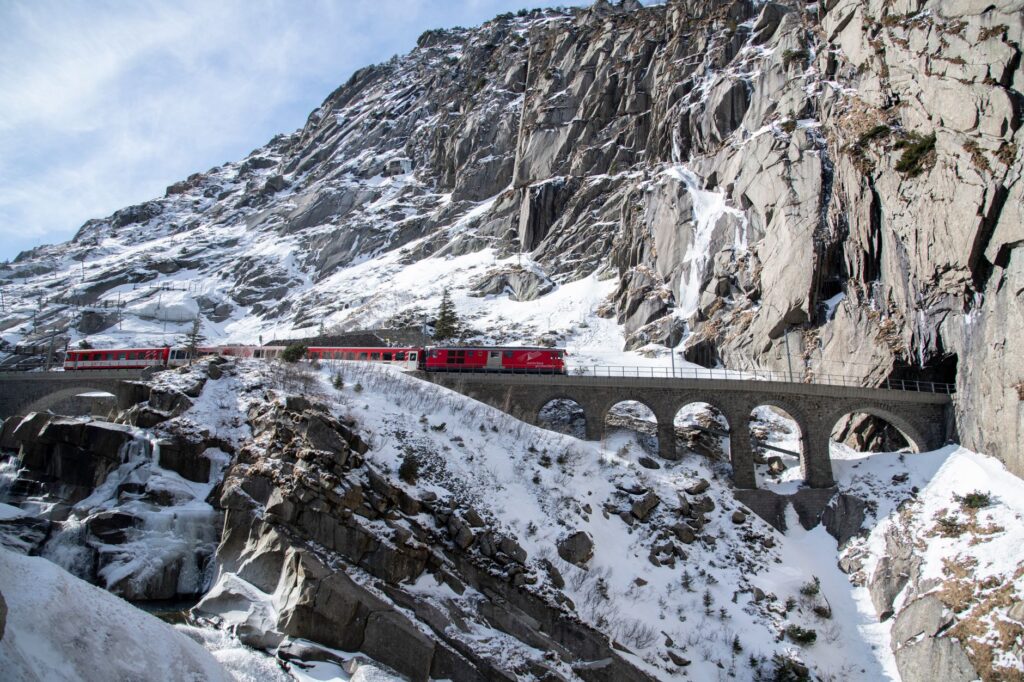
«The Bernina Railway does not master the mountain; it yields to its contours with the precision of an alpine watchmaker and the reverence of an engineer who understands that topography commands the machine.»
The High Divide: Ospizio Bernina and the White Lake
Ascending toward the pass, tree cover thins and disappears, yielding to a severe tundra landscape dominated by moraines, scree slopes, and the towering ice flanks of Piz Palü and Piz Bernina—the easternmost four-thousander in the Alps. Near the request stop of Morteratsch, the tongue of the Vadret da Morteratsch glacier comes into plain view, bearing somber witness to climatic retreat with historical markers set along the gravel trail below.
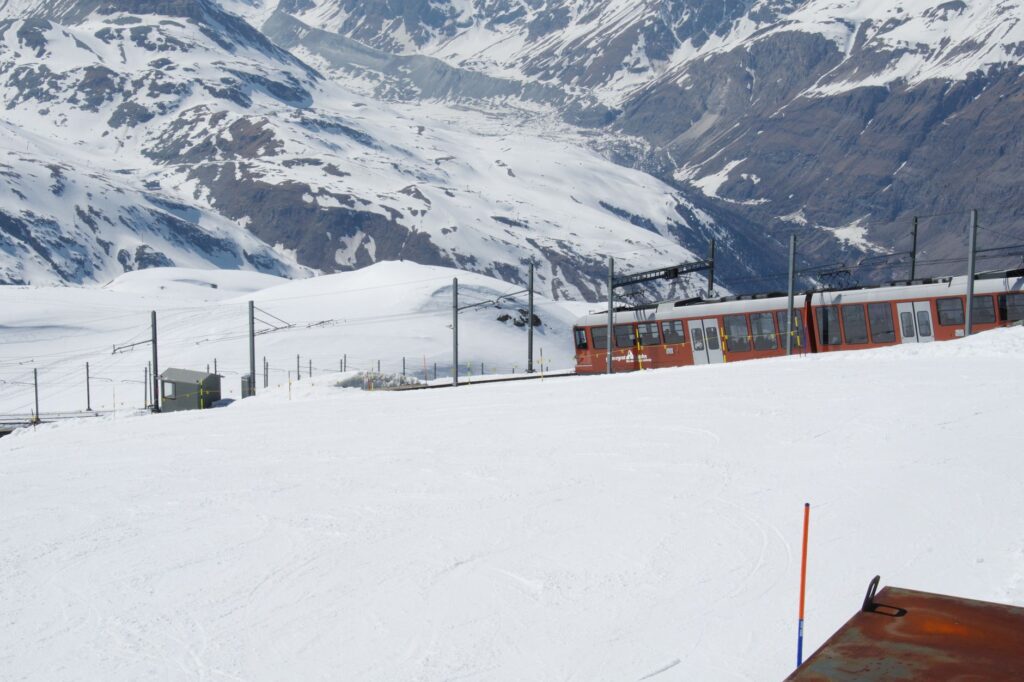
At 2,253 meters, the train skirts the shore of Lago Bianco (the White Lake). Fed by glacial silt, its waters possess an opaque, milky sheen, contrasting sharply with the nearby crystal-clear Lago Nero (the Black Lake). This elevated plateau represents a continental hydrographic divide: Lago Nero drains eastward into the Danube and the Black Sea, while Lago Bianco flows south into the Po River and the Adriatic Sea. During winter months, this frozen landscape turns completely monochrome, requiring heavy rotary snowplows to cut deep trenches through drifts to keep the railway operational.
Alp Grüm: Perched Over the Poschiavo Valley
Immediately after cresting Ospizio Bernina, the track clings to a precipitous ledge at Alp Grüm station, constructed entirely from local ashlar granite. Accessible solely by train or mountain footpath, this station balcony commands an uninterrupted vista of the Palü Glacier and the sheer drop of over a thousand vertical meters into the Valposchiavo below.
Here begins one of the steepest descents anywhere in the world on an adhesion railway. Utilizing a sequence of tightly engineered switchbacks and horseshoe curves through the rock walls of Cavaglia, the train drops 70 meters in elevation for every single kilometer traveled. Near Cavaglia station, melting glacial waters formed the famous ‘Giant’s Cauldrons’ (Gletschergarten)—smooth cylindrical potholes ground deep into bedrock by ice-age gravel vortexes, open to exploration during warmer months.
The Mediterranean Shift in Poschiavo
Reaching the valley floor, the cultural environment undergoes a decisive shift. Poschiavo, the district capital, welcomes travelers with refined neoclassical piazzas and terracotta roofs that replace the shingle and slate of the north. Here, Swiss-German and Romansh give way entirely to Italian-speaking Grisons culture. The striking ‘Spaniolenviertel’ (Spanish Quarter) features neoclassical palazzi erected by local emigrants who amassed fortunes abroad in confectioneries and trading houses before returning home in the nineteenth century.
South of town, the rails hug the turquoise waters of Lake Poschiavo through Le Prese and Miralago. Along certain village streets, the railway tracks run directly embedded in the asphalt road, causing the red train to share lanes with local traffic while chiming a warning bell reminiscent of turn-of-the-century streetcars.
The Brusio Spiral Viaduct: A Geometry of Stone
If Landwasser embodies the daring heights of the Albula railway, the circular viaduct at Brusio stands as the intellectual triumph of the Bernina pass. Situated near the Italian frontier, this nine-arch stone bridge spans 110 meters in total curvature, designed to drop the line down an abrupt valley ledge without constructing costly subterranean tunnels.
The train sweeps through a full 360-degree open-air loop, passing directly under its own elevated stone arches after shedding ten meters of altitude over a tight 70-meter curve radius. Constructed from local gneiss, this architectural marvel allows passengers on both sides of the train to admire the entire convoy curving through the landscape in a flawless display of gravitational mastery and structural balance.
From Alpine Granite to the Terraces of Tirano
Crossing the international border at Campocologno, the Bernina Express enters Italy’s Lombardy region, gliding onto the fertile floor of the Valtellina. Steep hillsides rise on either flank, covered in dry-stone terrace walls that support ancient Nebbiolo vineyards. The sudden sensory transition is startling: crisp glacial air yields to sun-warmed valley breezes, alpine conifers give way to fig trees and cypresses, and the train rolls into the square fronting the grand Renaissance Sanctuary of the Madonna di Tirano.
Terminating at Tirano station at an altitude of just 429 meters, the journey registers a total descent of more than 1,800 vertical meters from the summit at Bernina. Local trattorias around the station serve warm plates of pizzoccheri—buckwheat ribbon pasta smothered in melted Casera cheese, Savoy cabbage, potatoes, and sage-infused butter—celebrating the rich culinary heritage that marks the end of this transalpine passage.
Practical Planning and Transit Logistics
Navigating the Bernina line with ease requires understanding the operational differences between official panoramic coaches and regional rail options.
- Bernina Express vs. Regional Trains: The branded «Bernina Express» features floor-to-ceiling panoramic dome windows and requires a seat reservation fee. However, regular hourly regional trains (RhB R and RE) operate over the identical track, do not require seat reservations, and feature windows that can be lowered—crucial for reflection-free photography.
- Open-Top Summer Wagons: In July and August, select regional departures include open-air yellow coaches (Aussichtswagen) across the pass, offering direct exposure to the alpine air and pine-scented breezes.
- Rail Pass Acceptance: Both the Swiss Travel Pass and Eurail/Interrail passes cover the entire line from Chur/St. Moritz to Tirano without additional ticket purchases; only the panoramic reservation fee is extra on designated trains.
- Forward Connections: From Tirano, seasonal connecting Bernina Express buses run through northern Italy to Lugano, while Trenord regional rail lines provide direct, frequent services to Lake Como and Milan Central Station.
- Optimal Seasons: Autumn (October) offers brilliant golden larches across the Engadin and active grape harvests in Valtellina; winter (January to March) delivers a pristine, snowbound Arctic crossing kept running reliably despite heavy blizzards.
The Bernina Express endures not merely as a masterwork of alpine transport, but as a profound reminder that the deepest rewards of travel lie in honoring every meter of terrain that bridges distinct worlds.