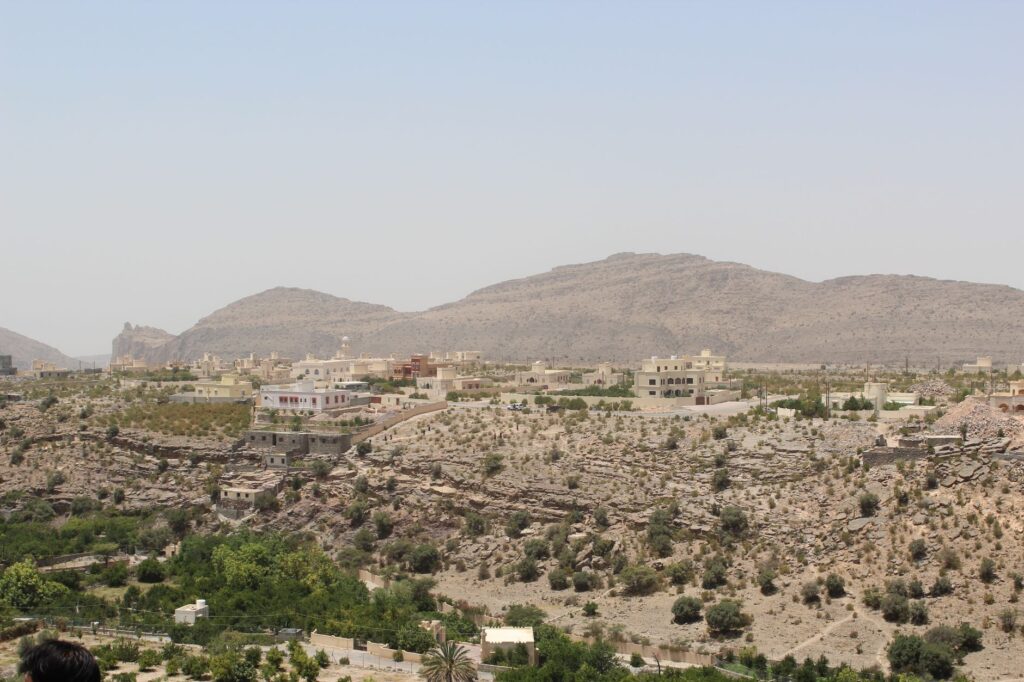
Izkī lies in the Ad Dakhiliyah Governorate of inland Oman, at around 547 metres above sea level and with a population close to 36,000. Its name appears in geographical records as Azkī or Ziki, and the area has long been associated with the great date-palm groves at the foot of the Hajar mountains. Visitors arrive by road from Muscat; anyone looking for a train to reach it will not find one. Oman has no passenger railway network in service, and that absence shapes much of daily life in the town and its neighbouring villages.
This report does not propose an imaginary journey or a first-hand travelogue. It proposes something more useful: understanding how a place without a station organises its mobility, what role intercity roads, shared cars and buses play, and why Izkī’s heritage — its aflaj, towers and mud-brick houses — remains the best guide to navigating inland Oman.
An oasis without a platform
The first surprise for a European traveller is discovering that the word «station» has no practical equivalent in Izkī. There are no tracks, no train timetables and no railway building to serve as a landmark. Transport is organised around the road linking the town with Nizwa, the capital of Ad Dakhiliyah, and with Muscat, the country’s main urban centre. That road is the real backbone of local life.
Intercity buses and private vehicles cover the route. For residents, the car is not a luxury: it is the tool that allows them to get to work, take children to school, transport dates or go to the market. For visitors, understanding this dependence on the car is the first step towards planning any journey realistically.
It is worth pausing on what the absence of a railway actually means in administrative terms. Oman has never opened a national passenger rail service, and the country’s transport planning has for decades prioritised roads and airports. Izkī therefore sits within a national system in which the private car is the default and buses are a secondary layer. This is not a temporary gap waiting to be filled by a future line; it is the operating reality that residents navigate every day, and any visitor who plans around an imagined train will simply lose time.
In Izkī, distance is not measured in kilometres of track, but in the time it takes to cross the palm grove and reach the road.
The palm grove as a map
Izkī’s landscape is dominated by the intense green of date palms, which spread across the valley floor and climb the slopes. This grove is not just a crop: it is infrastructure. Beneath the palms run the traditional irrigation channels known as aflaj, which distribute spring and runoff water among the plots. The system, recognised by UNESCO as intangible cultural heritage, requires meticulous community management and precise knowledge of the terrain.
For anyone walking in the area, the grove works as a living map: dirt paths, mud-brick walls and channels mark the routes. Villages cluster around these resources, and short distances are covered on foot. It is slow transport, but perfectly adapted to the scale of the oasis.
The falaj system deserves a little more explanation because it explains so much of the settlement pattern. Water is channelled by gravity along gently sloping underground and open conduits, then divided among families and plots according to inherited shares and a rotating schedule. That schedule is a form of timetable, though not one printed at a station: it governs who irrigates when, and it has shaped the layout of walls, paths and fields. Understanding the aflaj is, in a practical sense, the closest thing to reading a transport map of the oasis.
Architecture of earth and stone
Traditional buildings in Izkī combine mud brick, stone and palm wood. Houses usually have inner courtyards, thick walls and flat roofs, designed to withstand the heat and protect family privacy. Watchtowers and old fortifications survive in the surrounding area, recalling the strategic importance of this inland route.
The mosque and the market are the meeting points of social life. The market, though modest, remains the place where local products are exchanged and where the community’s economic pulse can be felt. Architecture here is not a backdrop for tourists: it is the setting in which daily life unfolds.
The construction techniques themselves are worth noticing. Mud brick responds to the climate: it absorbs heat slowly during the day and releases it at night, which moderates indoor temperatures without mechanical cooling. Palm trunks and fronds appear in roofs and beams, a reminder that the grove supplies not only food but building material. This interdependence between agriculture and architecture is one of the quiet lessons of the interior.
Road, bus and shared car
Mobility in Izkī rests on three pillars: the road network, intercity bus services and private or shared vehicles. The road connecting to Nizwa is the main access route, and from there it links to the national network leading to Muscat and other cities. Buses offer an economical option, though with limited frequencies and timetables that should be confirmed locally before travelling.
Shared cars, common in inland Oman, cover journeys between villages and to urban centres. For visitors, the practical advice is clear: do not assume a regular service exists at any hour, and plan alternatives. Planning is the best ally in a territory where public transport does not follow the logic of a large city.
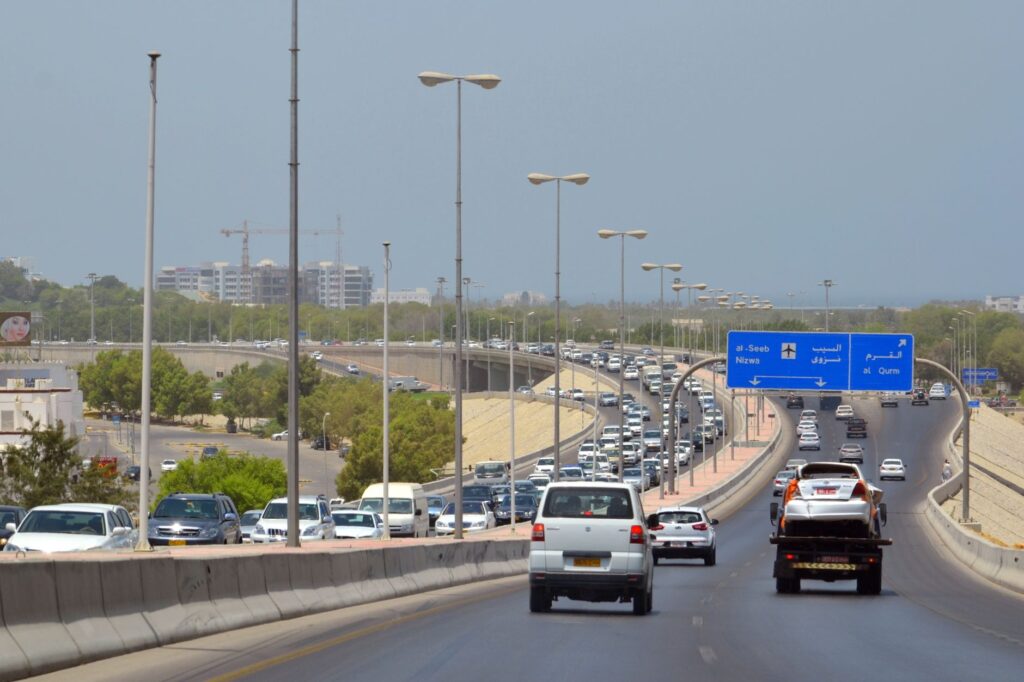
It also helps to think in terms of the day’s rhythm rather than a fixed schedule. Movement towards Nizwa tends to concentrate in the morning, and return journeys later in the day; outside those windows, options thin out considerably. Relying on a single late connection is risky, and building in a margin of time is not excessive caution but ordinary practice. For residents this knowledge is second nature; for a visitor it has to be learned deliberately.
What to see and how to get there
Izkī is not a destination of isolated monuments but of cultural landscape. The palm grove, the irrigation channels, the mud-brick villages and the watchtowers form a whole best explored on foot and with time. Some routes allow you to observe the irrigation system in operation and understand how water has shaped social life for centuries.
To get there, the usual route is to fly into Muscat International Airport and continue by road into the interior. From Nizwa, the connection to Izkī is relatively short, but it is worth checking road conditions and available services. There is no railway station to serve as a reference point, and that detail completely changes how an itinerary is organised.
Because there is no station to anchor a visit, the practical unit of planning becomes the road journey itself. Travellers should think about where they will stop, how long the drive will take and whether they will return the same day or stay overnight in the wider Nizwa area. Treating Izkī as a place to reach slowly, rather than a stop on a line, produces a more honest and more comfortable visit.
Daily life in the interior
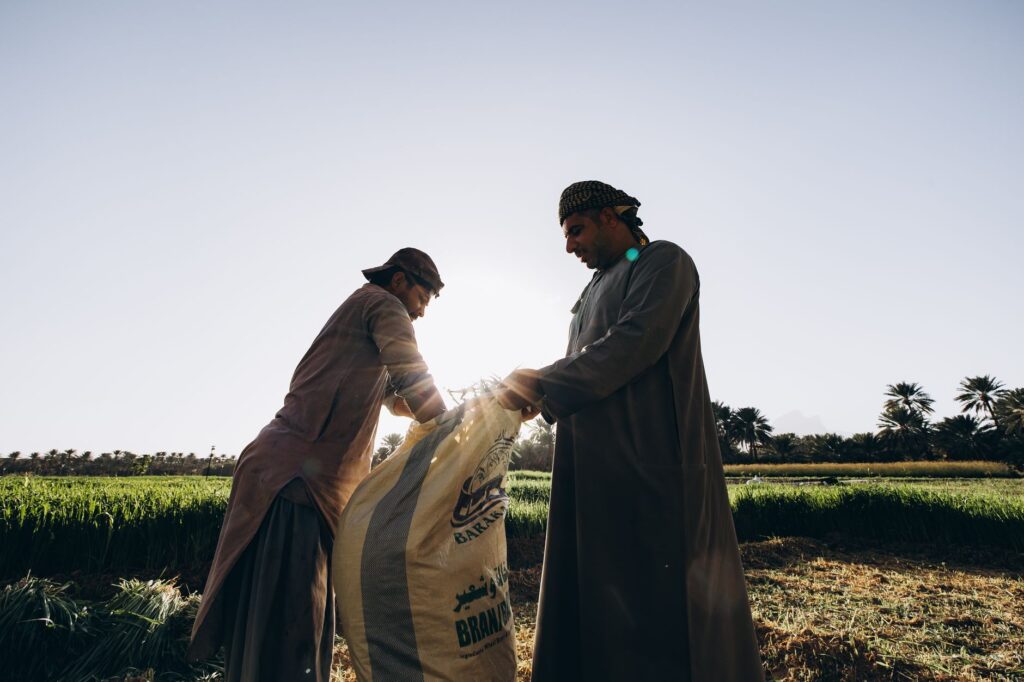
In Izkī, the day starts early. Agricultural tasks, care of the palm grove and water management set the rhythm. Families drive to workplaces and schools, and younger people study elsewhere or work in Nizwa or Muscat. The town retains a quiet character, with social life centred on the mosque, the market and family visits.
That slower pace does not mean isolation. The road connection to Nizwa provides access to broader health, education and commercial services. Transport, even without rail, sustains daily life with its own logic, adapted to the climate, the scattered villages and the oasis economy.
There is also a seasonal dimension to this life. The date harvest brings concentrated activity to the grove, with families and workers moving between plots and villages over a few intense weeks. Outside those periods, the oasis settles into a steadier routine. A visitor who understands this rhythm will find it easier to judge when the area is busiest and when it is quiet, and will be less likely to mistake calm for emptiness.
Heritage and local context
Izkī’s heritage is inseparable from its geography. The aflaj, the mud-brick houses and the defensive towers form a whole that explains why the place mattered on inland routes. The conservation of these elements depends on the community and local institutions, and their value is not only touristic: it is the foundation of local identity.

For travellers interested in heritage, the visit should be approached with respect. This is not a theme park but an inhabited territory. The best way to know it is to observe, ask with discretion and accept that some areas are private or in use.
It is also useful to remember that heritage protection here is a living process rather than a museum exercise. Repairs to a falaj wall or the upkeep of a tower are practical tasks carried out by people who use these structures. Recognising that labour, and not treating the landscape as scenery, is part of travelling responsibly in the interior.
Practical guide
- When to go: the inland Omani climate is hot; avoid the middle of the day and plan visits for early morning or late afternoon.
- Getting there: by road from Nizwa or Muscat. There is no passenger rail service in Oman.
- Getting around: private or shared car; intercity buses with limited frequencies. Confirm timetables locally.
- What to bring: water, sun protection and comfortable shoes for walking through the palm grove.
- Respect: modest dress and discretion when photographing people and private property.
- Planning: allow margin for journeys, since services outside peak hours are scarce, and keep a flexible return option.
The silence of the oasis
At the end of the day, when the sun drops behind the Hajar mountains, Izkī’s palm grove recovers its most characteristic sound: water running through the channels. There is no train announcing its arrival, no platform waiting for passengers. There are dirt paths, mud-brick walls and a community that has learned to measure time by the rhythm of water. For anyone arriving from the city, that absence of railway is not a lack: it is a different way of understanding movement, distance and life in inland Oman.