Dawn Over the Vertical Slopes of Gloucestershire
On the final Monday of May, the tranquil English countryside of Gloucestershire transforms into the backdrop for one of the most unique and perilous events on the planet. At the summit of Cooper’s Hill, the morning dew-soaked grass and the mist rising from the Severn Valley fail to dissipate an atmosphere of held breath. Thousands of spectators gather from the early hours of the morning, claiming spots along the flanks of a hill whose incline defies any recreational logic. This is no mere folk festival; it is a living manifestation of cultural resistance, an ancestral ritual where the laws of physics and self-preservation are temporarily suspended. Here, upon this green scar carved into the limestone of the Cotswolds, British rural heritage converges with the contemporary frenzy of travelers avid for extreme authenticity.
The history of this event is lost in the mists of time. Although official written records date the beginning of the competition to the early nineteenth century, local historians and elders of the Brockworth parish assert that its roots sink deep into pre-Roman pagan celebrations, likely linked to spring fertility rites and the equinox. The custom of rolling objects down a hillside formed part of communal festivities intended to guarantee bountiful harvests and renew rights over common pastures. Today, that communal heritage survives stripped of any official corporate sponsorship, kept alive exclusively by the tenacious will of local residents and the magnetic pull of a collective madness that draws curious onlookers from every corner of the globe.
The Anatomy of a Slope That Defies Physics
To understand the magnitude of what occurs on Cooper’s Hill, one must analyze the terrain. The hill is not merely steep; it is practically a vertical wall with an incline exceeding one-to-one in several stretches, reaching grades close to 1:0.7 or angles greater than forty-four degrees at its most critical point. Spanning approximately two hundred meters in length, the surface is irregular, marked by molehills, treacherous roots, water ruts, and hidden rocks beneath a layer of slippery turf. There are no natural braking zones; once a human body or a cheese wheel initiates the descent, gravitational acceleration is relentless and uncontrollable.

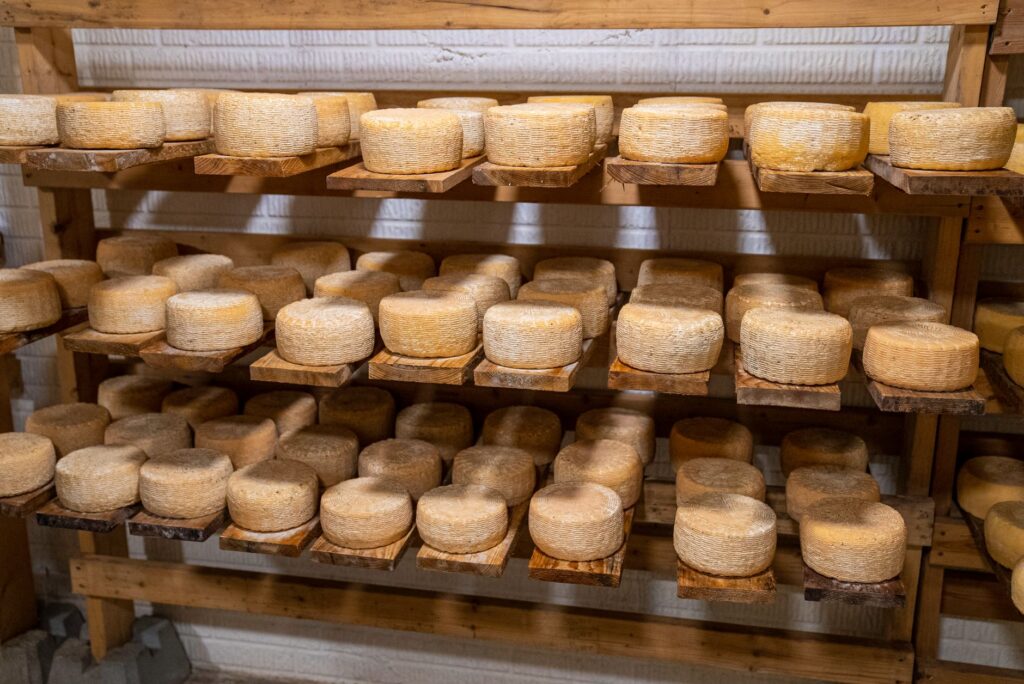
The inanimate protagonist of this farcical tragedy is a double Gloucester cheese wheel, a traditional dairy product crafted from whole cow’s milk, flat and circular, weighing around three to four kilograms. Because safety regulations barred the release of authentic cheese for years due to the risk of striking a spectator at terminal velocities approaching seventy miles per hour, wooden replicas painted firmly are used today. Nevertheless, the climax remains the precise moment when the master of ceremonies releases the object, unleashing an instantaneous human avalanche that pursues the projectile in an uncontrolled free fall.
The Ritual at the Summit: The Countdown and the Leap into the Void
The atmosphere at the top of the hill is a disconcerting blend of festive camaraderie and martial tension. Competitors, dressed in old clothes, improvised knee pads, bicycle pads, or simply with the unprotected determination of youth, stretch while exchanging nervous banter. They are men and women, mostly locals but with a growing presence of international extreme athletes, who have traveled to Gloucestershire seeking an invisible yet coveted medal: crossing the finish line on their feet, or at least crossing it ahead of the rest.
The master of ceremonies positions himself at the edge of the abyss, flanked by the guardians of the event. His voice rings clear over the murmur of the gathered crowd: “One to be ready!”. The runners lean forward, sneakers sinking into the mud. “Two to be steady!”. Muscles tense to the limit, breath holding collectively across the entire slope. “Three to prepare!”. Silence is absolute for a fraction of a second before the final shout: “And four to go!”. In that millisecond, the entire hill appears to collapse as twenty-five human figures hurl themselves into the void, losing their balance almost immediately and turning into a rolling mass of intertwined limbs and impossible twists.

Gravity on Cooper’s Hill is not an abstract scientific theory; it is an unrelenting physical force that decides who reaches the bottom on their own two feet and who does so on a stretcher.
Physics of a Fall: What Happens During the Seconds of Descent
The descent lasts mere seconds, but is experienced in absolute temporal dilation for both participants and spectators alike. The mechanics of the crash are always the same: the initial velocity exceeds human motor coordination capacity on sloped surfaces. The first runner to lose balance—which typically occurs within the first meter—triggers a devastating domino effect among the others. From that moment on, the race ceases to be a test of athletic speed and turns into an involuntary exercise in contorsion and impact resistance.
Injuries are an everyday occurrence at this event. Ankle sprains, collarbone fractures, concussions, deep cuts, and shoulder dislocations form part of the standard medical report managed by volunteer rescue teams and ambulance services stationed at the foot of the hill. Despite the grimness of the accidents, the organization lacks institutional backing from the local council, meaning that the entire safety apparatus is financed and operated independently. Paramedics and the local rugby team act as makeshift first responders, intercepting uncontrolled descending bodies before they reach the lower safety fence or the assembled crowd.
The Finish Line and the Crucial Role of the Catchers
At the base of Cooper’s Hill, tension shifts to the braking zone. Waiting there is the team of volunteers popularly known as the rugby lads. Their role is as noble as it is hazardous: acting as a human physical barrier to stop runners hurtling downward at dizzying speeds. Spectators watch with bated breath as bodies cascade onto the flat meadow, bouncing against the ground before being firmly intercepted by these burly local protectors who cushion the final impact.
The first person to cross the finish line—whether rolling, sliding on their back, or, on rare occasions, running—is declared the official winner and awarded the coveted double Gloucester cheese wheel as a trophy. There are no cash prizes, million-dollar advertising contracts, or athletic scholarships. The reward is purely intangible: eternal glory in the village, family pride, and the satisfaction of having survived one of the most absurd and pure physical challenges in the modern world. The losers, meanwhile, limp back toward local pubs with psychedelic-colored bruises and anecdotes that will last a lifetime.

Institutional Controversy and Resilient Clandestinity
Over the past decade, global popularity unleashed by the internet and social media has turned the Cheese Rolling into a massive viral phenomenon. This digital success has brought severe friction with local and governmental authorities in Gloucestershire. On multiple occasions, the Gloucestershire County Council and the police attempted to officially ban the event, citing public safety concerns, lack of public liability insurance, and the unacceptable risk of severe injury for attendees and participants.
Far from extinguishing the tradition, official prohibitions provoked the opposite effect: organized clandestinity. When local authorities attempted to fence off the perimeter of the hill and ban access, local organizers and participants simply shifted the announcement date or held the race spontaneously, defying institutional warnings. Today, the event operates in a fascinating legal limbo: it is not formally authorized by any public entity, yet it is celebrated with the tacit acquiescence of the community and the massive presence of international media documenting England’s most festive act of civil disobedience.
Traveler’s Practical Guide: How to Attend Without Risking Your Safety
Attending the Cheese Rolling as a spectator requires planning, patience, and absolute respect for local dynamics. The event is traditionally held on the final Monday of May, coinciding with the Spring Bank Holiday in the United Kingdom. The official time is usually set for noon, but due to massive public influx and traffic restrictions on secondary rural roads leading to Brockworth and Cooper’s Hill, arriving hours in advance—ideally before nine in the morning—is imperative.

Access via public transport is complex. The nearest train station is Gloucester, from where it is necessary to take a local bus to Brockworth and then embark on a twenty-minute walk along rural paths to the base of the hill. If opting for a private vehicle, keep in mind that local authorities generally close direct access roads and there are no official parking lots available, causing many attendees to park along distant shoulders and walk at their own risk. Wearing appropriate hiking footwear with high-traction soles, waterproof clothing—Cotswolds weather is notoriously fickle—and sufficient water is essential, as there are no commercial food stands on the hill itself.
The true traveler is not one who seeks the comfort of predictable tourist circuits, but one who knows how to observe with respect the indomitable passions of local communities.
The Cultural Context of the Cotswolds Beyond the Cheese
Visiting Cooper’s Hill also offers the perfect opportunity to explore the Cotswolds region, one of England’s premier Areas of Outstanding Natural Beauty. Just a short drive from the hill lie picturesque golden stone villages like Painswick, famous for its parish church surrounded by ninety-nine clipped yew trees, or Cheltenham, the elegant regency spa town known for its architecture and vibrant cultural scene.
To regain strength after the morning spectacle, heading to traditional local pubs such as The Cheese Rollers in Shurdington or historic establishments in Brockworth is recommended. In these sanctuaries of rural British hospitality, the post-race atmosphere is vibrant and welcoming. Amid pints of local cider and traditional meat pies, spectators and a few newly bandaged brave runners share stories, analyze the day’s best tumbles, and toast to the survival of one of the most genuinely eccentric traditions surviving on the European continent.
Epilogue: The Persistence of Danger in a Sterilized World
In an era marked by hyper-regulation, sterile safety protocols, and an obsession with eliminating any trace of physical risk from human activities, the Cooper’s Hill Cheese Rolling stands as a glorious anachronism. It is a tangible reminder that spaces exist where human nature retains its appetite for the uncontrollable, for physical testing without safety nets, and for communal celebration devoid of commercial artifice.
Witnessing this descent leaves no one indifferent. It challenges our perception of sanity and forces us to question the boundaries between legitimate tradition and reckless foolhardiness. But above all, it offers a privileged window into the soul of a rural community that refuses to let its past die, keeping alive a flame that, year after year, continues to roll downhill with the unstoppable force of a double Gloucester cheese wheel.
Source in English: Adventurous Kate