Bahía Blanca occupies a peculiar place on the Argentine map: it is a city of the flatlands that nevertheless turns its face toward the water. Located in the south of Buenos Aires Province, on the shores of an estuary that separates it from the open ocean, its identity has been built on a constant tension between the solid land that sustains it and the sea that projects it toward the world.
For visitors arriving from Buenos Aires or from the Patagonian south, the city does not present itself as a single postcard destination but as a territory that demands time. Its attractions lie in everyday life: the clubs where basketball is played, the confectioneries that have endured for decades, the port buildings that tell stories of immigration and labour, and a cultural scene that sustains itself with effort and conviction.
A geography that shapes urban life
Bahía Blanca’s location is no accident. The city sits where the estuary of the bay of the same name meets the Pampas plain, a position that for more than a century made it a strategic hub for trade and communication. That geographic condition still sets the rhythm of its neighbourhoods: the oldest look toward the centre and the port, while newer ones spread west and north, gaining ground from the countryside.
The altitude is low, just a few metres above sea level, and the climate swings between hot summers and cold winters with winds arriving from the southwest. That combination has shaped an architecture of high ceilings, galleries and interior courtyards that protect against sun and cold. Walking through the centre means encountering a mix of styles: early twentieth-century buildings, rationalist constructions from the 1950s and 1960s, and recent renovation that coexists with the old without erasing it entirely.
The port and the memory of work
For many residents, the port of Bahía Blanca is more than infrastructure. It is the memory of grandparents who arrived by ship from Europe, the sound of sirens marking shifts, and the certainty that the city was always connected to something larger than itself. Although access to the port facilities is restricted for security reasons, visitors can approach the commercial port area and walk through the public spaces that face the water.
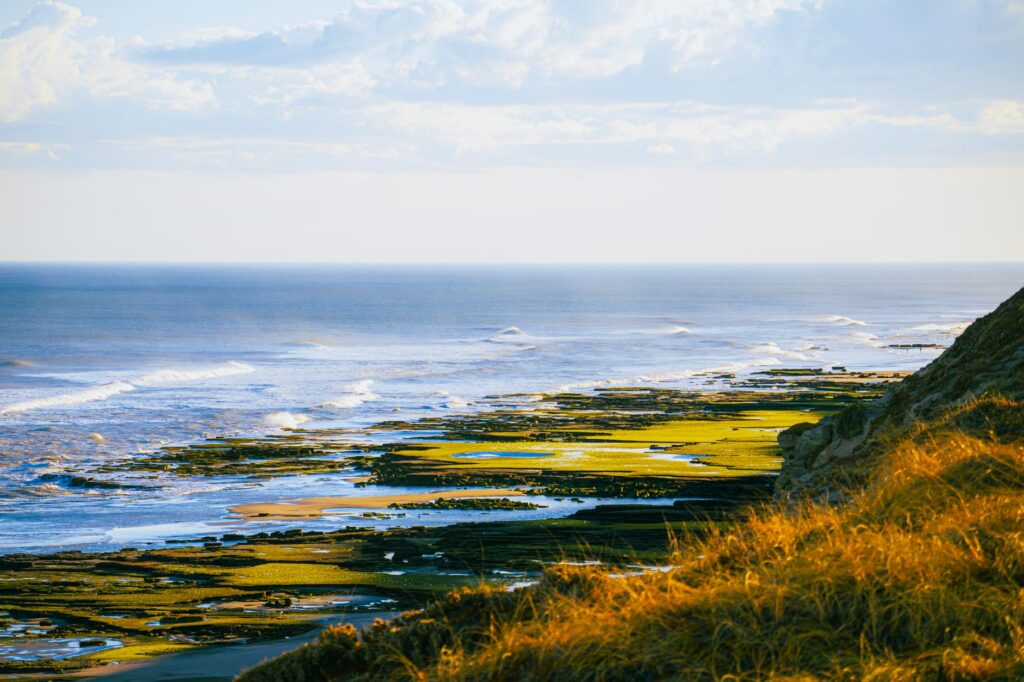
That relationship with the sea is not simple. Bahía Blanca does not have urban beaches of fine sand like other coastal cities; its bond with the water is more about work than leisure. However, in recent years projects have emerged seeking to recover the coast for public use, with trails, viewpoints and recreation areas. The tension between the industrial port and the desire for an accessible coast is one of the city’s most interesting urban debates.
Bahía Blanca’s identity cannot be understood without that double condition: a city of the interior that always looked to the water as both promise and wound.
Clubs, the city’s other infrastructure
If the port organizes the economy, clubs organize social life. Bahía Blanca has a sporting and associative tradition that spans generations. Basketball is perhaps the sport that has given it the most identity: local teams have competed in the country’s top divisions and have produced players who reached the national team. But beyond professional competition, neighbourhood clubs remain spaces where children are raised, families gather and networks of solidarity are sustained.
For visitors, these spaces are not tourist attractions in the traditional sense, but they do offer a gateway to local life. An afternoon at a neighbourhood club, a basketball game in a gym that smells of wood and sweat, or a conversation in the canteen can say more about the city than any guided tour.
Architecture and heritage in the centre
The centre of Bahía Blanca concentrates architecture that deserves a leisurely walk. Plaza Rivadavia, the city’s civic heart, is surrounded by buildings dating from different periods. The Municipal Building, the Cathedral and the Municipal Theatre are landmarks that show the ambition of a city that, in the early twentieth century, wanted to demonstrate its importance on the national stage.
Beyond the official buildings, there is a lesser heritage that often goes unnoticed: the tin and wood houses of the old neighbourhoods, the grocery stores with tiled facades, the confectioneries that preserve their original interiors. That everyday heritage is fragile and not always protected by conservation regulations, which generates a constant debate between real estate development and the preservation of built memory.
A cultural scene that endures
Bahía Blanca has a dense cultural life for its size. The Universidad Nacional del Sur, founded in 1956, has been an engine of intellectual and artistic activity. Its choirs, theatre groups and publications have nourished a scene that extends beyond the academic sphere.

The Municipal Theatre, with a programme combining opera, classical music and contemporary shows, is one of the most active spaces. Around it, independent venues, cultural centres and art spaces have grown, reflecting a community that does not wait passively for official programming. Visitors should check the local agenda: there is likely to be an exhibition, a play or a concert during their stay.
Food as a social map
Food in Bahía Blanca tells stories of immigration and adaptation to the territory. The Italian tradition is present in homemade pasta and in pan pizzas; the Spanish heritage appears in tapas bars and in preserved fish; and criollo cuisine is sustained in grill restaurants and in the spoon dishes served at clubs and community centres.
An interesting phenomenon is the presence of historic confectioneries, some with more than half a century of activity, where medialunas, pastries and coffee are served in an atmosphere that seems frozen in time. They are not museums but living spaces where people meet daily. For visitors, sitting in one of them is one of the most direct ways to understand how the city’s social life is organized.
The estuary as landscape and as question
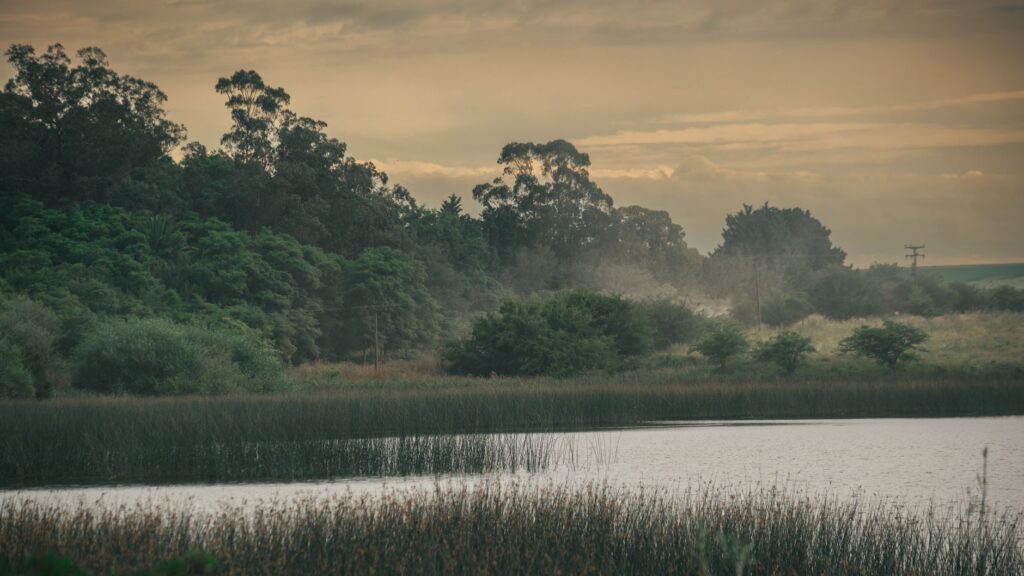
The Bahía Blanca estuary is an ecosystem of great ecological value, with wetlands, islands and biodiversity that includes migratory birds and marine species. However, industrial pollution and the pressure of port development have generated concern among scientists and environmental organizations.
For visitors interested in nature, there are options for birdwatching and tours of wetland areas, although access is not always straightforward and requires planning. The question of how to reconcile economic activity with conservation of the estuary is one of the city’s major pending issues, and it directly affects the experience of those who want to know that landscape.
What can be done in a few days
Bahía Blanca is not a city to be explored in an afternoon. Its medium scale and geographic dispersion make it necessary to organize time. A walk through the historic centre, a visit to the Municipal Theatre and a tour of the neighbourhoods near the port can fill a full day. Another day can be devoted to the university’s cultural spaces and the confectioneries in the centre.
For those with more time, it is worth exploring the residential neighbourhoods, the clubs and the wetland areas. The city can also serve as a base for discovering other parts of Buenos Aires Province, such as the Ventania hills, although that involves longer journeys.
Practical guide
Getting there: Bahía Blanca has an airport with regular flights to Buenos Aires and other Argentine cities. It can also be reached by train or bus from the federal capital and from other cities in the south of the country. The bus terminal is well connected to the centre.
When to go: Spring and autumn are the most pleasant seasons, with moderate temperatures. Summer can be hot and winter cold, with intense winds. Check the forecast before travelling and bring warm clothing if visiting between June and August.
Where to stay: The city centre concentrates most of the hotel and apartment offerings. Neighbourhoods near the centre also offer quieter options at varied prices.
What to visit: Plaza Rivadavia, the Municipal Theatre, the Cathedral, the Port Museum (if open to the public) and the cultural spaces of the Universidad Nacional del Sur. For those interested in nature, the wetland areas of the estuary require prior coordination.
Tips: Public transport operates with a card, and taxis and ride-hailing apps are a practical option for getting around. It is advisable to book in advance if you want to attend shows at the Municipal Theatre. The city is generally safe, but the usual precautions for any urban destination apply.
Language: Spanish is the official language. In tourist settings and hotels, you may find staff who speak English, though this is not the general rule.
A closing facing the water
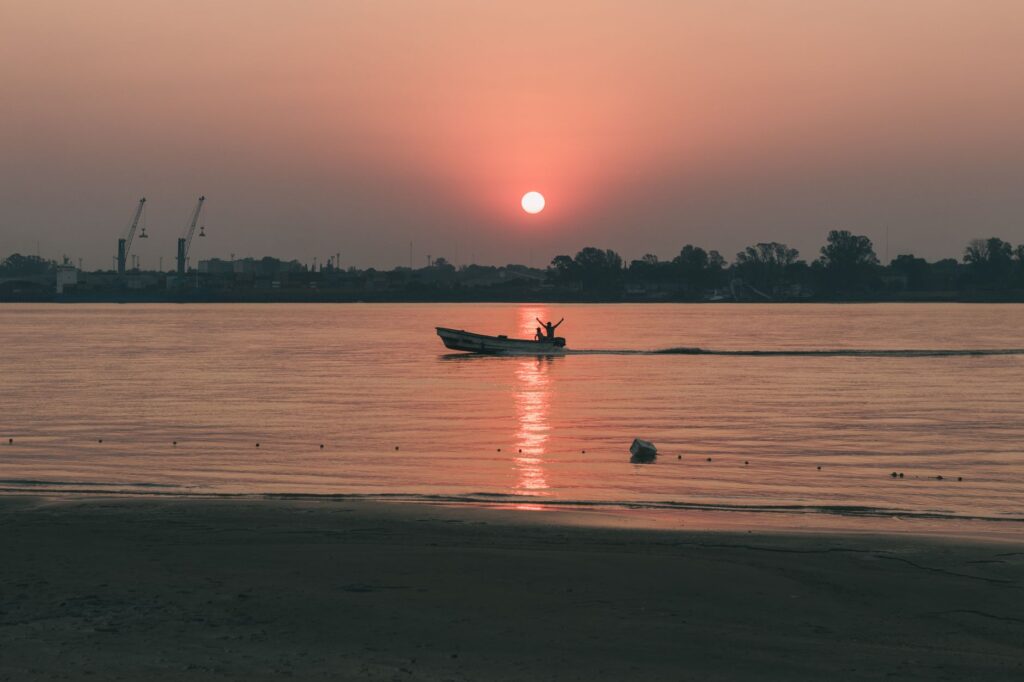
At sunset, the light over the estuary takes on a particular tone. It is not the sun of the open ocean but a softer clarity, filtered by humidity and by the dust of the plain. In those moments, Bahía Blanca seems to reconcile its contradictions: the industrial city and the neighbourhood city, the port and the wetland, the memory of those who arrived and the uncertainty of those who stay.
Visitors who approach with curiosity and without haste will find a city that does not give itself easily but rewards patience. It is not a destination of grand gestures but of small discoveries: a conversation in a confectionery, a basketball game at a neighbourhood club, a walk down a street that preserves the layout of another era. Bahía Blanca does not promise a perfect experience, but it offers something more valuable: the chance to understand how the identity of a city is built, one that, like few others, lives its history in the present tense.