The Okavango Delta is not a conventional destination reached via paved highways or standard railway networks. In this vast labyrinth of channels, floodplains, and palm-fringed islands in Botswana, mobility becomes a daily exercise in amphibious precision and extreme adaptation. Here, rigid infrastructure gives way to an intermodal system where light bush aviation shares center stage with traditional wooden boats propelled by poles. This fragile transport balance sustains not only the region’s low-impact tourism economy but also the everyday survival of remote communities that rely entirely on the seasonal fluctuations of water.
Understanding Okavango logistics requires examining how aeronautical high technology and ancestral craftsmanship converge. While the international airports in Maun and Kasane act as major entry gates, the true challenge begins past the tree line. At that point, geography enforces its own rules: compacted dirt airstrips that vanish during the flood season and waterways that narrow into impenetrable papyrus mazes. Connectivity in this African outpost is, by definition, a living organism that contracts and expands in rhythm with rains fallen months earlier in the Angolan highlands.
Bush Aviation: The Umbilical Cord of the Liquid Desert
The backbone connecting the Delta’s most inaccessible areas is light aviation, operated by fleets of single and twin-engine aircraft adapted for extreme conditions. These planes, often seating between five and twelve passengers, take off and land multiple times a day on packed soil or stabilized sand airstrips distributed strategically among wildlife concessions. For luxury camps and local communities, these flight routes are not a recreational luxury, but the sole secure conduit for transporting medical supplies, technical personnel, fresh food, and international travelers.
Pilots operating in this region face unique meteorological and topographical challenges. The absence of complex instrument landing aids on many strips demands visual navigation strictly contingent on light conditions and the occasional presence of wildlife on landing terrain. Aviation safety in the Delta relies on constant communication between operators and camps, which continuously evaluate ground conditions and water sheet levels. This air bridge represents an invisible engineering feat, where human skill compensates for the lack of large fixed air traffic control infrastructure.

From Air to Water: The Transition to Motorboats and Amphibious Vehicles
Once the traveler touches down on the interior’s secondary strips, the transport system undergoes a radical metamorphosis. In the main water arteries, where depth permits, aluminum motorboats equipped with outboard engines come into play. These vessels feature shallow-draft hulls designed to navigate hidden sandbars and dense water lily blankets. Their design allows considerable distances to be covered in a few hours, connecting riverside camps and scientific research zones scattered across the wetland.
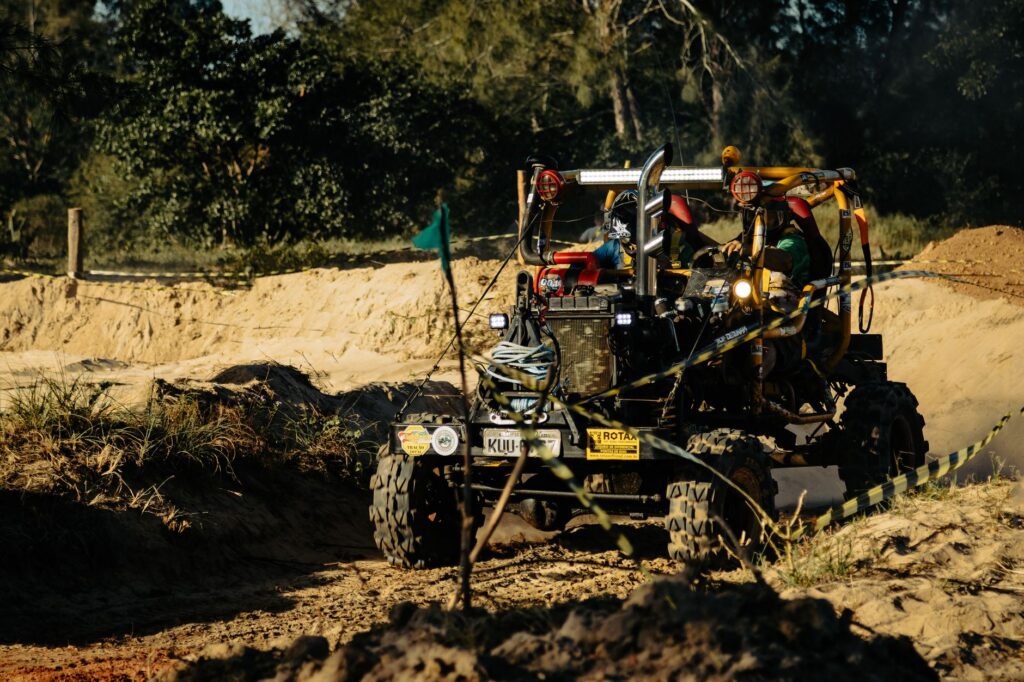
However, terrain alternating between muddy swamps and flooded savannas requires specially modified all-terrain vehicles with elevated suspensions and reinforced traction systems. These adapted trucks and jeeps act as mobile bridges between dry land and water, enduring extreme mechanical punishment due to mineralized water corrosion and continuous wear over irregular terrain. Managing the maintenance of these fleets remains one of the most costly and complex tasks for tour operators based in the reserve.
The Art of Poling: Ancestral Navigation in Mokoros
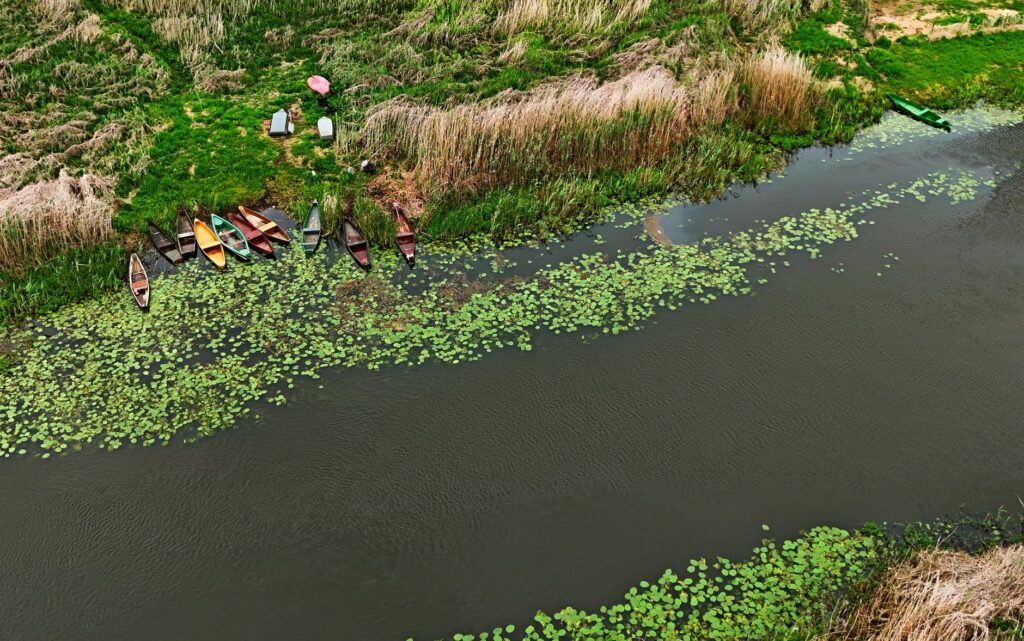
Operating at an entirely different level of speed and scale is the mokoro, the quintessential traditional canoe of the Okavango. Originally carved from the timber of large trees such as African ebony or sausage trees—though increasingly constructed from durable fiberglass today to protect local forests—the mokoro glides silently over the water through the technique of poling. An expert guide, known as a poler, stands at the stern of the canoe, propelling it with a long wooden pole planted against the muddy bottom.

This non-polluting mode of transport is far more than a tourist attraction; it forms the historical pillar of mobility for the baYei and Hambukushu communities inhabiting the Delta margins. Poling requires encyclopedic knowledge of currents, aquatic wildlife habits, and the shifting morphology of channels. Navigating by mokoro grants access to the wetland’s most secluded corners without disturbing the delicate acoustic and visual environment of wildlife, turning into a masterclass of sustainable transport integrated into nature.
Hydrological Seasonality and Logistical Bottlenecks
The greatest challenge facing the Okavango’s transport system is its extreme reliance on the hydrological cycle. Waters flooding the Delta do not originate from local rain, but travel over a thousand kilometers from the Angolan highlands during the dry season, taking months to reach Botswana. This phenomenon creates a radical seasonal inversion: while outer savannas are dry and hot, the Delta’s interior transforms into a vast network of navigable channels isolating certain terrestrial zones.
This dynamic generates recurring logistical bottlenecks. During flood peaks, some airstrips submerge completely, forcing operators to relocate operations to higher ground and redesign river transport routes. Similarly, in severe drought years, main channels choke with sediment and vegetation, halting motorboat passage and demanding increased reliance on air routes or costly, ecologically supervised manual dredging operations.
Transport in the Okavango Delta does not measure its effectiveness in travel speed, but in its capacity to respect the fragile limits of a flooded ecosystem that rejects the imposition of asphalt.
Community Integration and Local Employment in the Transport Chain
The Delta’s mobility system does not merely transport tourists and supplies; it serves as the primary source of socioeconomic integration for rural populations residing in peripheral settlements like Seronga, Beetsha, and Etsha. Local cooperatives manage a large share of mokoro concessions, ensuring revenue generated by the river transport chain directly benefits local families through fair wages and community development funds.

Furthermore, aviation and mechanical training programs fostered in partnership with private operators allow a growing share of technical and support personnel to come from surrounding communities. Nonetheless, significant challenges persist regarding wage equity and access to higher education infrastructure allowing local youth to lead technical management of these complex transport networks. Logistical sovereignty remains a core aspiration for local authorities in northwestern Botswana.
Green Innovation and the Future of Amphibious Mobility
Facing rising pressure to reduce carbon footprints in one of the planet’s premier ecological sanctuaries, the Okavango transport sector has begun exploring low-impact technological alternatives. Several pioneering safari camps are experimenting with electric outboard motors powered by solar panels installed on floating bases. Although battery autonomy remains limited compared to the Delta’s long distances, they represent a promising step toward decarbonizing commercial river navigation.
Meanwhile, the digitalization of logistical management has notably improved bush flight efficiency. Satellite tracking platforms and load optimization software enable precise coordination of aircraft schedules, minimizing empty legs and optimizing fuel consumption. These tools demonstrate that high technology can ally with environmental conservation to sustain an inherently fragile transport system dependent on ecological equilibrium.
Practical guide
Getting there: Primary access to the Delta transport system is via Maun International Airport (MGB), connected through scheduled flights from Johannesburg (JNB) and Cape Town (CPT) operated by carriers like Air Botswana and Airlink.
Internal connections: Journeys into the Delta interior are conducted exclusively via charter bush planes operated by local airlines such as Mack Air, Air Kavango, or Moremi Air, or through river transfers coordinated by individual camps.
Best time to travel: May to October coincides with the optimal flood season for mokoro navigation and wildlife viewing. November to April experiences the rainy and hot season, with lower water levels in certain interior zones.
Logistical requirements: Booking internal flights and amphibious transfers months in advance is essential, as airstrip capacity and aircraft seating are strictly limited by environmental conservation regulations.
Luggage allowance: Due to weight and volume restrictions on bush planes, luggage must be packed exclusively in soft bags, with a strict limit generally hovering around 20 kilograms per passenger, including camera gear.
Health and safety: The Delta is a low-risk malaria zone, though prophylaxis and effective repellents are recommended. Strictly following local guides’ instructions regarding wildlife interaction during mokoro or boat journeys is vital.
Sustainability: Choose certified tourism operators actively supporting local communities and utilizing low environmental impact technologies across their amphibious and aerial transport fleets.
The sun begins to set slowly over the flooded Okavango plains, dyeing the water in copper and gold hues stretching to the horizon. At the wooden jetty, a guide adjusts the final mooring of his mokoro while the distant whistle of a bush plane announces the close of the day at the nearby dirt airstrip. In this remote confine where land and water merge in an eternal embrace, mobility is not a mere mechanical formality, but a meditative dance with the environment. Here, every journey reminds us that the true luxury of modern travel lies in the capacity to move with respect, listening to the secret heartbeat of a world that still refuses to be tamed by asphalt.